
Unbiased headlines. Facts, not spin.
Unbiased Headlines is an independently owned news organization. We bring you the facts, not opinions, written fresh from 110+ named sources. Sources linked so you can verify it yourself.
 politics
Breaking / Critical (9/10)
Trump, Xi and Putin Hold Trilateral Summit in Shenzhen; White House Yet to Confirm Declaration Released by Beijing and Moscow
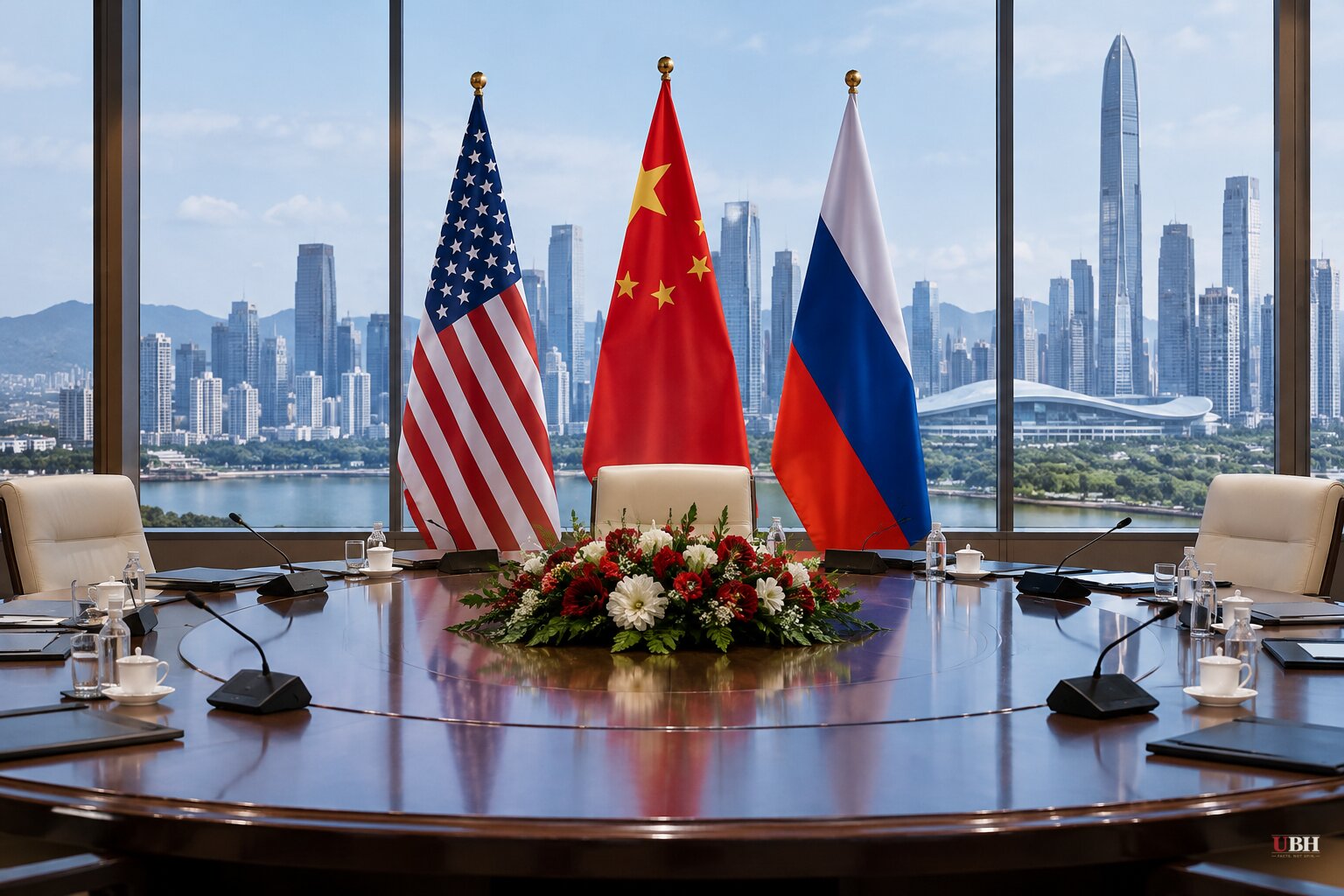
Since Trump landed in China on Wednesday, Nov. 18 for the 33rd APEC leaders' meeting, the trip has built toward one event: a three-way sit-down with Xi Jinping and Vladimir Putin at Kylin Villa in Shenzhen on Thursday, Nov. 19. It happened. It also produced very little that can be measured yet.
The session started around 3 a.m. ET, about two hours behind schedule. It lasted roughly 80 minutes by the New York Post's count, including 10 minutes of opening remarks to the press. NBC News put it at 90. Trump left for the airport around 5 a.m. ET and was not expected to make public remarks before flying home, Fox News reported.
What the leaders said
"We are really making history," Trump said as talks opened. He framed the meeting as a rejection of past American diplomacy. "No problems were ever solved under the old school refusing to talk about them," he said. "Together we are choosing a different course."
Trump put nuclear weapons first. "The United States, Russia and China are uniquely positioned to discuss how to reduce the number of nuclear weapons on Earth, and also to lessen the risk that those weapons will ever be used," he said.
In a Fox News interview Thursday morning, Trump said the U.S. has 4,000 nuclear weapons, Russia has 3,800 and China has "400 or 500" and is "going hot and heavy" on building more. "You don't need 4,000," he said. "We only need about 10."
Xi called the meeting a "groundbreaking move" and said the three powers would discuss "promoting world peace." Putin said the three should "strengthen the system of international law" and work on food and energy security.
Trump also floated ending the wars in Ukraine and Iran, and cooperating against what he called "rogue globalist organizations" such as the International Criminal Court.
The declaration
Afterward, China and Russia released identical statements of a four-point joint declaration titled "The Russia-China-US Heads of State Declaration Toward Peace." The White House has not yet confirmed the text.
According to the declaration, the three countries:
- Reaffirm that a nuclear war cannot be won and must never be fought, and will hold a dialogue on reducing nuclear risks and preventing proliferation. No date, venue or format for that dialogue is given.
- Commit to reforming the United Nations, with no specifics.
- Agree to increase production and supply of refined petroleum products.
- Endorse the principle of state consent and immunity for state officials, and say the ICC and similar bodies "must not abuse their jurisdiction."
That last item is not abstract. The ICC has indicted Putin over alleged war crimes in Ukraine. Russia has denied wrongdoing. The energy pledge also lands in the middle of the Iran war, with tankers being hit near the Strait of Hormuz, and NBC News noted that more energy output would feed Russia's oil-driven war economy.
The nuclear backdrop
The last remaining nuclear treaty between Washington and Moscow lapsed this year. China has resisted calls to join any replacement, pointing to an arsenal far smaller than the other two. Trump's own figures put Beijing's stockpile at a tenth of America's or less.
An administration description of the nuclear track ahead of the summit called it a preliminary step rather than the prelude to an immediate pact. The declaration's language is consistent with that. It pledges talks, not cuts.
The side meetings
Before the trilateral, Trump held a one-on-one with Xi, his third substantial meeting with the Chinese leader this year, according to the Associated Press. Trump praised their friendship and the shared interest in keeping oil moving through the Strait of Hormuz. He also pressed on agriculture. "I'll be asking you to do some more for our farmers," he said.
Xi said U.S.-China relations have been "generally stable and improved" during Trump's presidency. After meeting Xi, Trump said both countries want to see the Ukraine war end.
A Putin aide said the Trump-Putin bilateral went well and that Putin was in an excellent mood. Trump greeted Putin by joking "Who is he?" and then called him "my friend."
Trump also argued that Obama-era energy deals pushed Moscow and Beijing together. "They were natural enemies, but because of Obama... he drove them together because of energy," he said. Russia and China signed a major gas deal in 2014 after about a decade of negotiations.
The Yalta comparison
Some commentators have already likened the gathering to the 1945 Yalta Conference. Russian economist Vladislav Inozemtsev rejects that in an Al Jazeera opinion piece. Putin, he writes, proposed the meeting in an October call with Trump, and Moscow's view of the summit as a carve-up of spheres of influence reflects wishful thinking rather than a realistic prospect.
In 1945, Inozemtsev argues, the three allies had just defeated a common enemy. Today, he writes, they are on opposing sides of various conflicts and have divergent ideas of what a multipolar world means. Moscow wants to be a pole in Eurasia, Washington wants to stay pre-eminent, and Beijing wants to pull the Global South away from U.S. leadership. He says the U.S. and China are effectively building a two-power system, the "G2" Trump has talked about, that Russia cannot stop.
What comes next
The immediate open item is whether Washington adopts the declaration Beijing and Moscow published, including the ICC passage and the energy pledge. Trump has not commented publicly since the talks ended. The nuclear dialogue the text promises has no schedule, and China has not said it will accept limits on its arsenal.
Sources used for this briefing
7 links from 7 independent newsrooms (syndicated copies of the same report count once)
These are the sources it draws on, linked so you can verify.
More coverage: Donald Trump and China


