
Unbiased headlines. Facts, not spin.
Every story is an unbiased news briefing written from 110+ sources across the spectrum — sources linked so you can verify it yourself.
 health
Major Story (7/10)
July 5, 2026 at 11:00 AM
health
Major Story (7/10)
July 5, 2026 at 11:00 AM
Trump Signed an Executive Order Accelerating FDA Review of Psychedelic Therapies, with $50 Million for State Research Programs
What the Order Actually Does
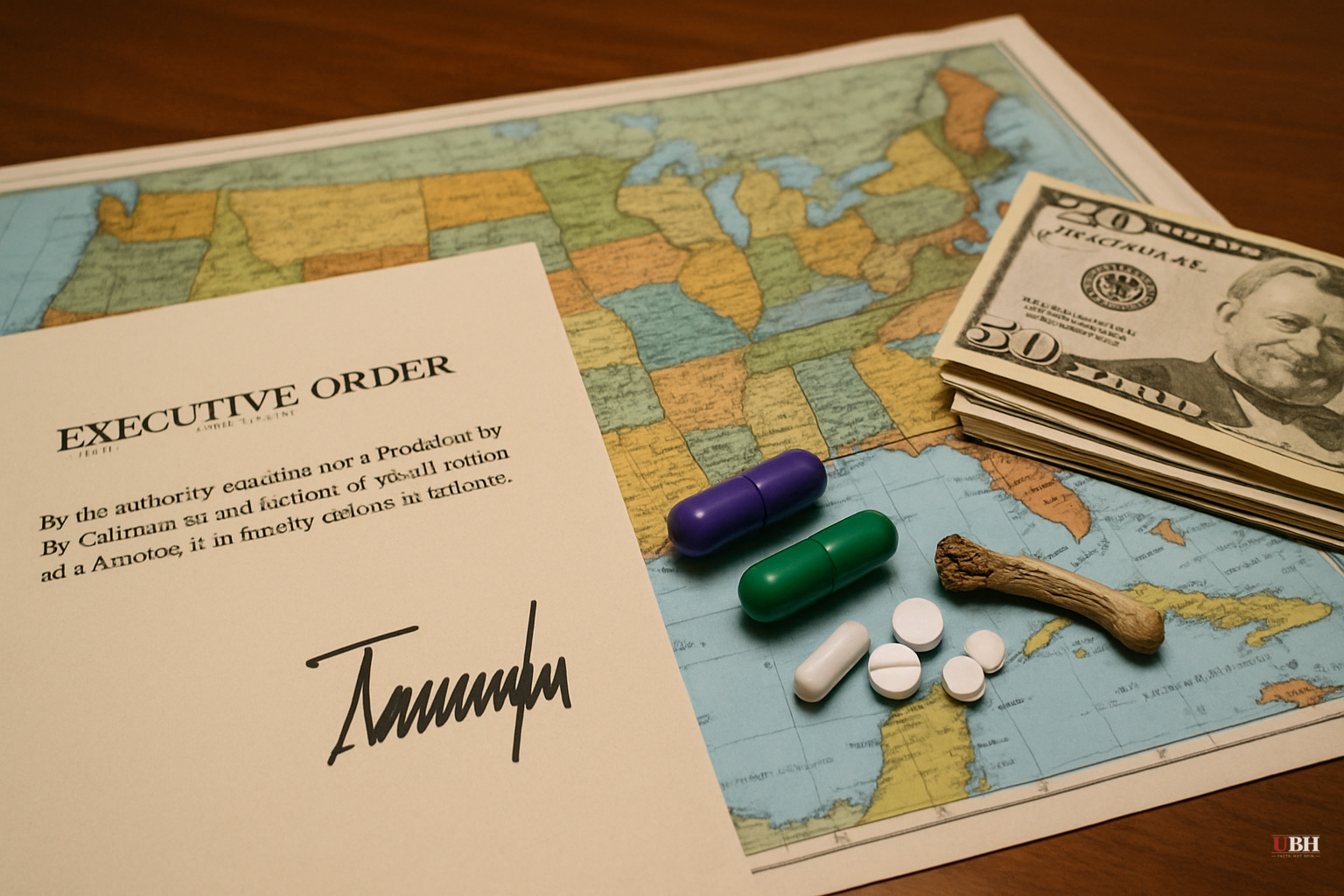
President Trump signed an executive order directing the Food and Drug Administration to accelerate its review process for what the order calls "appropriate psychedelic drugs," with ibogaine listed as a primary target, according to Reason magazine.
The order commits at least $50 million from existing funds to state programs investigating psychedelic therapies. It also directs the FDA to coordinate with the Department of Veterans Affairs on clinical trials, a specific structural step rather than a press release.
The Veteran Case Is Doing the Heavy Lifting
The policy has a clear political center of gravity: military veterans.
Former Navy SEAL Marcus Luttrell, whose memoir about his Afghanistan mission inspired the 2013 film Lone Survivor, underwent ibogaine therapy at a clinic in Mexico and credited it with changing his life. He told Trump at the signing ceremony, "You're going to save a lot of lives with it."
Luttrell's twin brother, Rep. Morgan Luttrell (R–Texas) and also a former Navy SEAL, called ibogaine therapy "one of the greatest things that ever happened to me."
Trump's order cited a sustained rise in the U.S. suicide rate over the past two decades, noting that veterans bear that burden disproportionately. That context explains why this cause has found genuine traction on the right: former Texas Gov. Rick Perry, Rep. Dan Crenshaw (R–Texas), Texas state legislators who approved ibogaine research funding in 2025, and Utah legislators who backed psychedelic research overwhelmingly in 2022 have all supported it.
Joe Rogan's Role
Podcaster Joe Rogan, who endorsed Trump in the 2024 election, described texting the president information about ibogaine and receiving a response he characterized as: "Sounds great. Do you want FDA approval? Let's do it."
Rogan recounted this on April 18, the same day the order was signed. Whether that exchange was decisive or retrospective storytelling is impossible to verify. Rogan has spent years popularizing psychedelic research to an audience that skews politically mixed, and his platform helped pull this issue out of niche advocacy circles.
What the FDA Has Done Since
The agency's response has been substantive, not performative.
Then-FDA Commissioner Marty Makary announced approval of the first U.S. human trial of ibogaine, specifically testing it as a potential treatment for alcohol use disorder.
Psilocybin and MDMA-adjacent compounds are further along in the pipeline. Six days after the executive order, the FDA issued "national priority vouchers" for psilocybin as a treatment for depression and for methylone—a compound similar to MDMA—as a treatment for PTSD. Both had already received the FDA's "breakthrough therapy" designation, which is supposed to speed review. The new vouchers promise a timeline of one to two months after required studies are completed, versus the standard six months or more.
The Strongest Counterargument Deserves a Fair Hearing
Critics of rapid psychedelic approval raise legitimate concerns. Some researchers worry that political enthusiasm, including pressure from high-profile advocates, could rush products through before safety and efficacy standards are fully met. Psychedelics are not risk-free: ibogaine in particular carries documented cardiac risks and has caused deaths in uncontrolled settings.
Accelerated review is only as good as the trials feeding into it. If the underlying studies are underpowered or poorly designed, a faster timeline just produces a faster wrong answer.
What's Actually Unresolved
The executive order is real. The FDA actions are real. What remains genuinely open is whether the clinical evidence—particularly for ibogaine, which has the fewest completed U.S. trials—will meet FDA approval standards even under the accelerated timeline. The first U.S. human trial for ibogaine in alcohol use disorder was only recently approved as of this reporting; trial completion, data review, and a potential approval decision are all still ahead.
The specific schedule for those outcomes has not been publicly set.
Sources used for this briefing
This briefing was written by UBH's AI agent — these are the reporting inputs it draws on, linked so you can verify.


