
Unbiased headlines. Facts, not spin.
Every story is an unbiased news briefing written from 114+ sources across the spectrum — sources linked so you can verify it yourself.
 defense
Major Story (8/10)
October 8, 2026 at 07:19 PM
defense
Major Story (8/10)
October 8, 2026 at 07:19 PM
Trump Says US Will Not Attack Iran Before Nov. 3 Midterms, Keeps Blockade in Place
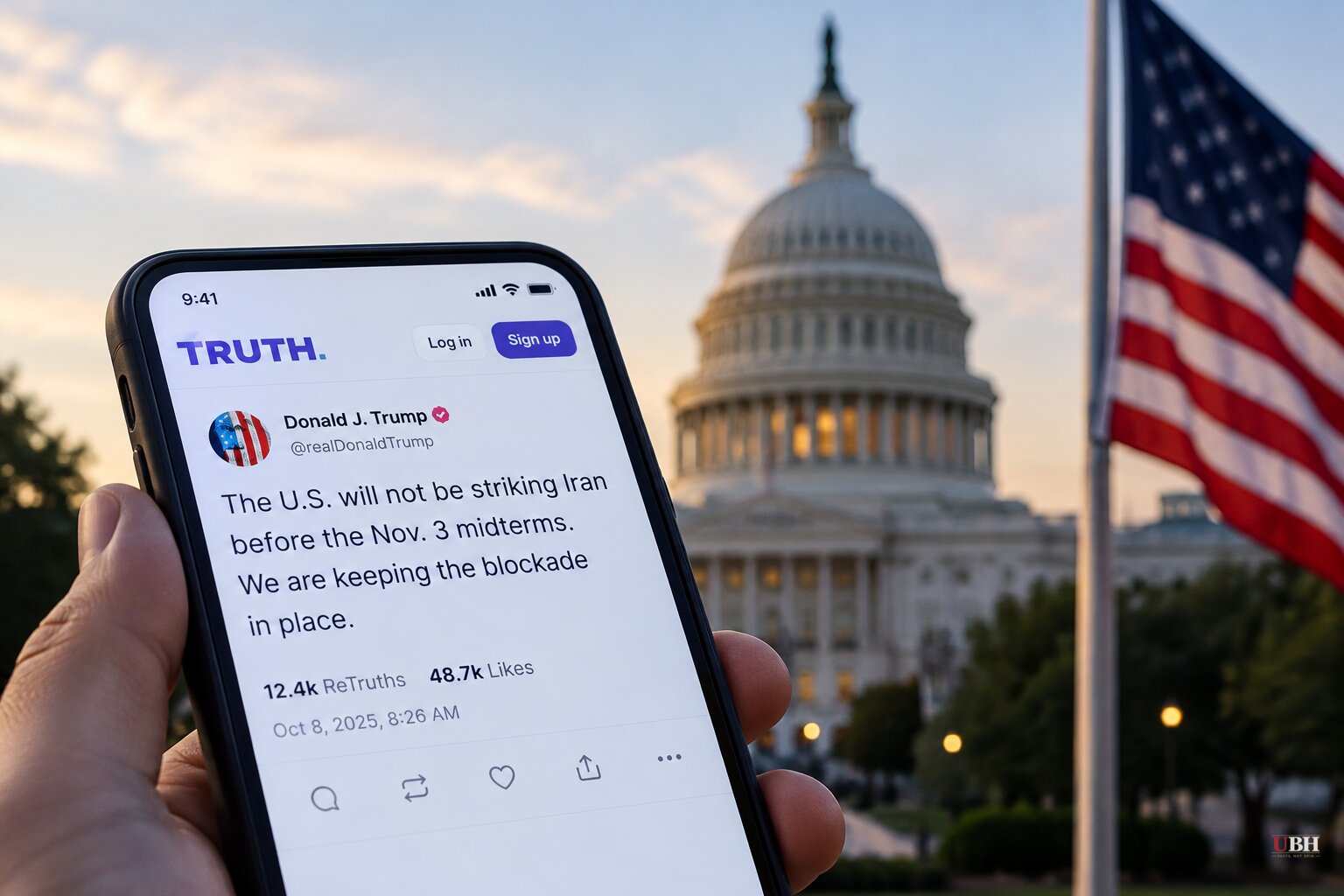
Since the U.S. and Israel struck Iran on Feb. 28, the war has run through a collapsed June ceasefire, a naval blockade, and a flare-up in early September. On Thursday, Oct. 8, President Trump put an explicit date on the next pause.
"We will not be attacking Iran at any time prior to the Midterm Elections to be held in the United States on November 3rd," Trump wrote on Truth Social. He added that Washington is "having productive discussions" with Tehran, which he said is "in very bad condition, both Economically and Militarily."
A reversal in under a day
Late Wednesday, Trump told reporters his administration was considering renewed strikes before the election. At a San Antonio rally that night, he said of a deal with Iran: "I think the deal isn't really something that I want to do, but they're willing to offer us anything to stop."
The Thursday post also said the naval blockade of Iranian ports stays in place and repeated that Iran will not have a nuclear weapon. It did not say what the U.S. will do after Nov. 3.
Reuters reported in September that top Trump aides were pushing to keep the war contained through the midterms while leaving heavier strikes open afterward. The Wall Street Journal reported late last month, citing U.S. officials, that Trump had told aides he expected strikes to resume after the election. The White House has not confirmed either account. The timing language in Thursday's post is Trump's own.
Oil, gas and the polls
Brent crude rose more than 4% Thursday to above $104 a barrel. AAA put the national average for gasoline at $4.36, up from $2.98 just before the war began, roughly 40% above a year ago.
Trump claimed 22 million barrels of oil moved through the Strait of Hormuz overnight, with none going to or from Iran. That figure has not been independently verified. Kpler data show about 11.3 million barrels per day of crude and petroleum products left the strait in the week ended Tuesday.
Politically, the war is a drag. A Reuters/Ipsos poll in August found 31% of Americans supported military action against Iran, down from 37% in March. A late-September Reuters/Ipsos survey found Trump's approval among Republicans fell from 82% to 73% in a week. Forecaster Nate Silver's averages show Democrats up roughly nine points on the generic congressional ballot. Several GOP candidates in competitive races have tried to distance themselves from the war.
The Trump team's case, and Tehran's
The administration's argument is that leverage is shifting. U.S. Central Command is escorting tankers through Hormuz at night with their location systems off, and with the help of Gulf pipelines, Gulf states are exporting oil at nearly prewar levels, according to the Associated Press. On Thursday the Treasury Department sanctioned 17 tankers and their owners, which it said carried millions of barrels of Iranian crude to Asian markets. "Today's action effectively neutralizes the vast majority of Iran's remaining shadow fleet network," Treasury said. Secretary Scott Bessent said the department is "starving the tyrannical regime in Tehran of the money it uses to wage war."
Tehran sees little to talk about. Iranian President Masoud Pezeshkian said this week that negotiations with Washington are "meaningless." Foreign Minister Abbas Araghchi has laid out a seven-day plan: the U.S. lifts the blockade, waives oil sanctions, releases frozen assets and observes a ceasefire that includes Lebanon, and Iran reopens the strait and starts nuclear talks. Trump rejected that plan in late September. Iran says it has since received a U.S. counterproposal, and Araghchi said Thursday he expects a formal reply within days.
Putin met Pezeshkian in Turkmenistan on Thursday and said Russia is ready to "do everything that is in our power" to help settle the conflict.
The military bill keeps growing
The pause comes with a buildup. About 9,000 sailors and Marines and a third carrier, the USS Theodore Roosevelt, are headed to the region and could arrive as early as the end of October, putting three carriers there.
The USS Abraham Lincoln was due back in San Diego on Thursday after a record-long deployment. There have been reports of crew stress, poor mental health and shortages of food and hygiene products.
A Congressional Research Service report updated this week counts at least 81 U.S. military aircraft and drones lost or damaged in the war. That includes 45 MQ-9 Reaper drones, 12 F-15E Strike Eagles, seven KC-135 tankers and one F-35A. The military has declined to discuss dozens of the drone losses.
Fighting continues on other fronts
The Houthis have hit Riyadh's King Khalid International Airport four times this week. Saudi aviation authorities said three people were killed at airports on Oct. 6 and 7, including one at King Khalid. The U.S. Embassy told Americans to "exercise heightened vigilance" and now requires special authorization for government personnel to use the airport. Lufthansa, IndiGo and Air India have suspended or canceled Riyadh service.
Iran has also stepped up attacks on tankers in recent days, and overall ship traffic through Hormuz remains well below prewar levels.
The next marker is Tehran's formal reply to the U.S. counterproposal, which Araghchi expects within days. Whether it opens a real negotiation before Nov. 3 is unknown, and the carrier arrivals in late October will land days before the vote.
Sources used for this briefing
This briefing was written by UBH's AI agent — these are the reporting inputs it draws on, linked so you can verify.


