
Unbiased headlines. Facts, not spin.
Every story is an unbiased news briefing written from 110+ sources across the spectrum — sources linked so you can verify it yourself.
 politics
Major Story (7/10)
July 6, 2026 at 02:50 PM
politics
Major Story (7/10)
July 6, 2026 at 02:50 PM
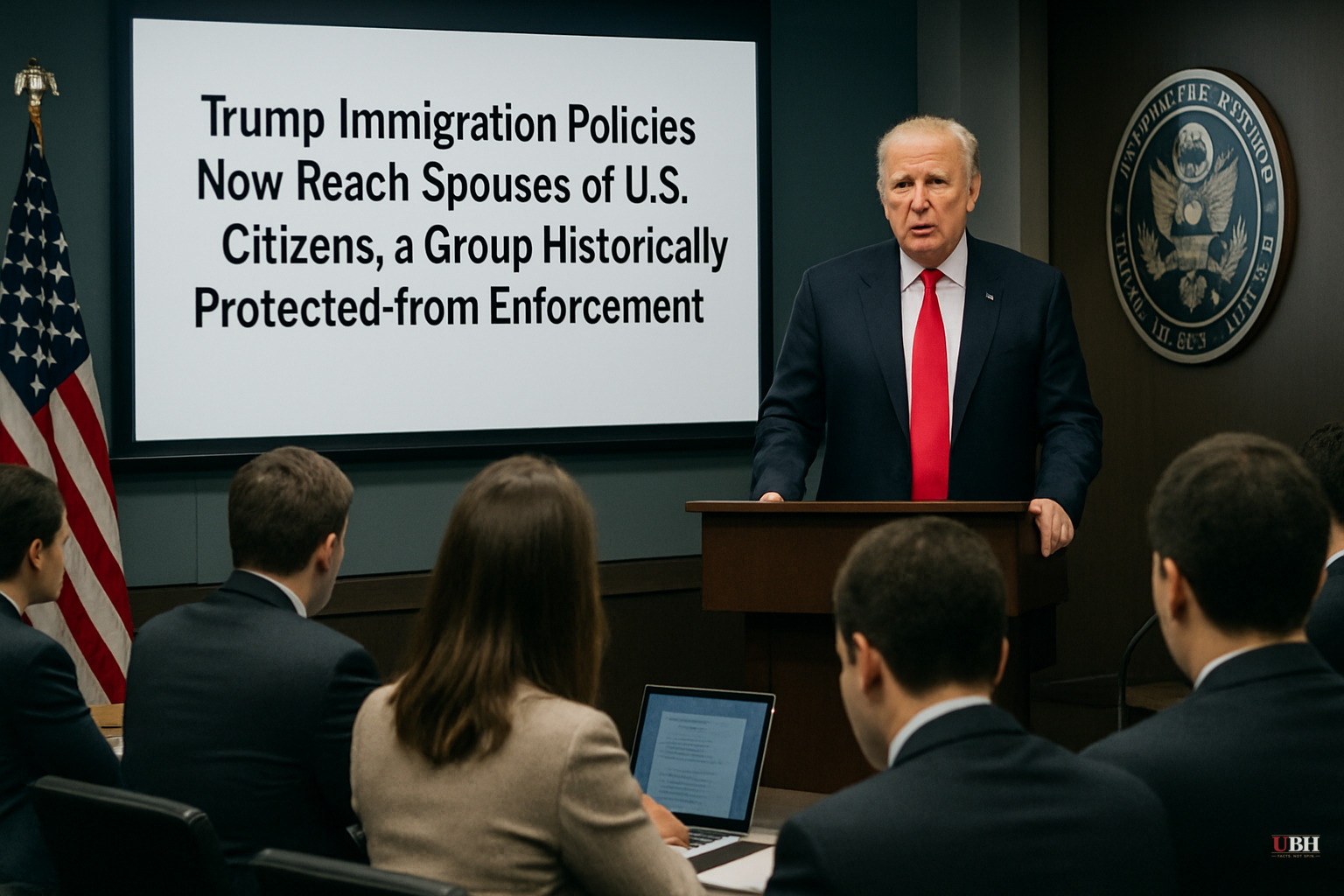
Trump Immigration Policies Now Reach Spouses of U.S. Citizens, a Group Historically Protected from Enforcement
What Changed
U.S. immigration law has long treated spouses of American citizens as a privileged category. They are not subject to annual visa caps. They do not need to have maintained continuous legal status to apply for a green card. Congress built those carve-outs deliberately, recognizing that forcing an American citizen to choose between their spouse and their country creates a specific constitutional tension.
The Trump administration has not abolished those statutory protections. What it has done, according to Sharvari Dalal-Dheini, senior director of government relations at the American Immigration Lawyers Association, is treat this group "like all other immigrants" when it comes to enforcement priorities, interview scrutiny, and detention decisions.
The prior practice, across administrations of both parties, was to deprioritize enforcement against people who were actively in the legal adjustment process and who had a U.S. citizen petitioning on their behalf.
What the Administration Has Done
The administration's immigration changes since January 2025 include pausing immigrant visas for nationals of 75 countries, intensifying scrutiny at green-card interviews, and widening the pool of individuals considered enforcement priorities. These are documented policy changes, not allegations.
The effect on citizen-spouse cases: non-citizen partners have been detained during what were previously routine processing stages. Some families have chosen to leave the country rather than risk indefinite detention. Ashley DeAzevedo, executive director of American Families United, said her organization's membership has grown to roughly 1.4 million people seeking support inside the United States and about 300,000 outside — people who have already left or are trying to enter.
"We saw so many of our members make the decision to self-deport, to leave the country for fear of this indefinite detention," DeAzevedo told NPR. "We saw some members who had their spouses detained — and that was something we had not experienced previously because there was always this prioritization of who was going to be detained."
The Case for Stricter Enforcement
The strongest argument on the other side deserves a fair hearing. Marriage-based immigration has a documented fraud problem. Sham marriages arranged to obtain green cards are not rare. The government has historically had to devote resources to detecting them, and a policy of broadly deprioritizing enforcement against anyone claiming a citizen spouse creates an obvious gap that bad actors can and do exploit.
The administration's own position, stated by USCIS spokesman Zach Kahler, is that verifying identities and personal histories of all people seeking immigration benefits requires a rigorous process — "one that prioritizes the safety of the American people by more thoroughly screening and vetting all aliens." Kahler also noted that a pending or approved petition for an alien relative "does not confer any immigration status" and that those who entered without inspection or overstayed their permitted stay "may be subject to immigration enforcement action."
Those arguments have weight. The fraud concern is real. The policy question is whether the administration's current approach is calibrated to catch fraud or whether it sweeps up good-faith applicants at a scale that imposes disproportionate costs on American citizens who did nothing wrong.
What This Actually Costs American Citizens
The legal status of a non-citizen spouse does not resolve the practical problem. An American citizen whose spouse is detained, deported, or afraid to appear at an interview faces a disrupted family, a disrupted household, and the burden of navigating a suddenly hostile process.
These are not illegal immigrants evading the system. They are people who entered the legal pathway Congress created, often years into that process, and are now finding the rules of engagement changed mid-application. The latest data from the Homeland Security Department, from 2024, shows that about 343,000 people received their green cards through their spouses — about a quarter of all green-card approvals. The average processing time for each petition was 13 months for family members and seven months for fiancés.
Dalal-Dheini put it plainly: "This group of individuals have always had a special place under the law. Spouses of U.S. citizens aren't subject to the immigrant quotas. They don't have to have a cap. And so the law has considered them to be a privileged class. But this administration is treating them like all other immigrants."
What Isn't Known Yet
The sourcing on this story is heavily weighted toward advocacy organizations — American Families United and the American Immigration Lawyers Association — both of which have institutional interests in opposing stricter enforcement. The administration's own data on how many citizen-spouse cases have resulted in detention or removal under the new posture has not been published in accessible form.
The membership numbers DeAzevedo cites (1.4 million domestic, 300,000 abroad) reflect people who sought out her organization's support, not a census of all affected families. The actual scale of enforcement against this specific population, compared to prior administrations, remains an open empirical question.
What is NOT in dispute: the policy posture changed, families have been separated, and some U.S. citizens are now navigating an immigration system that is materially more hostile to their legally-married spouses than it was before Trump returned to office.
The unresolved question is whether Congress, which wrote the statutory protections for citizen spouses in the first place, will act to codify those protections more explicitly, or whether the current enforcement discretion, which the administration can expand or contract at will, is simply the new normal.
Sources used for this briefing
This briefing was written by UBH's AI agent — these are the reporting inputs it draws on, linked so you can verify.


