
Unbiased headlines. Facts, not spin.
Every story is an unbiased news briefing written from 113+ sources across the spectrum — sources linked so you can verify it yourself.
 politics
Major Story (7/10)
September 27, 2026 at 07:14 AM
politics
Major Story (7/10)
September 27, 2026 at 07:14 AM
Trump Approval Sinks to 37% in WSJ Poll, Worst Pre-Midterm Mark for Any President Since 1990
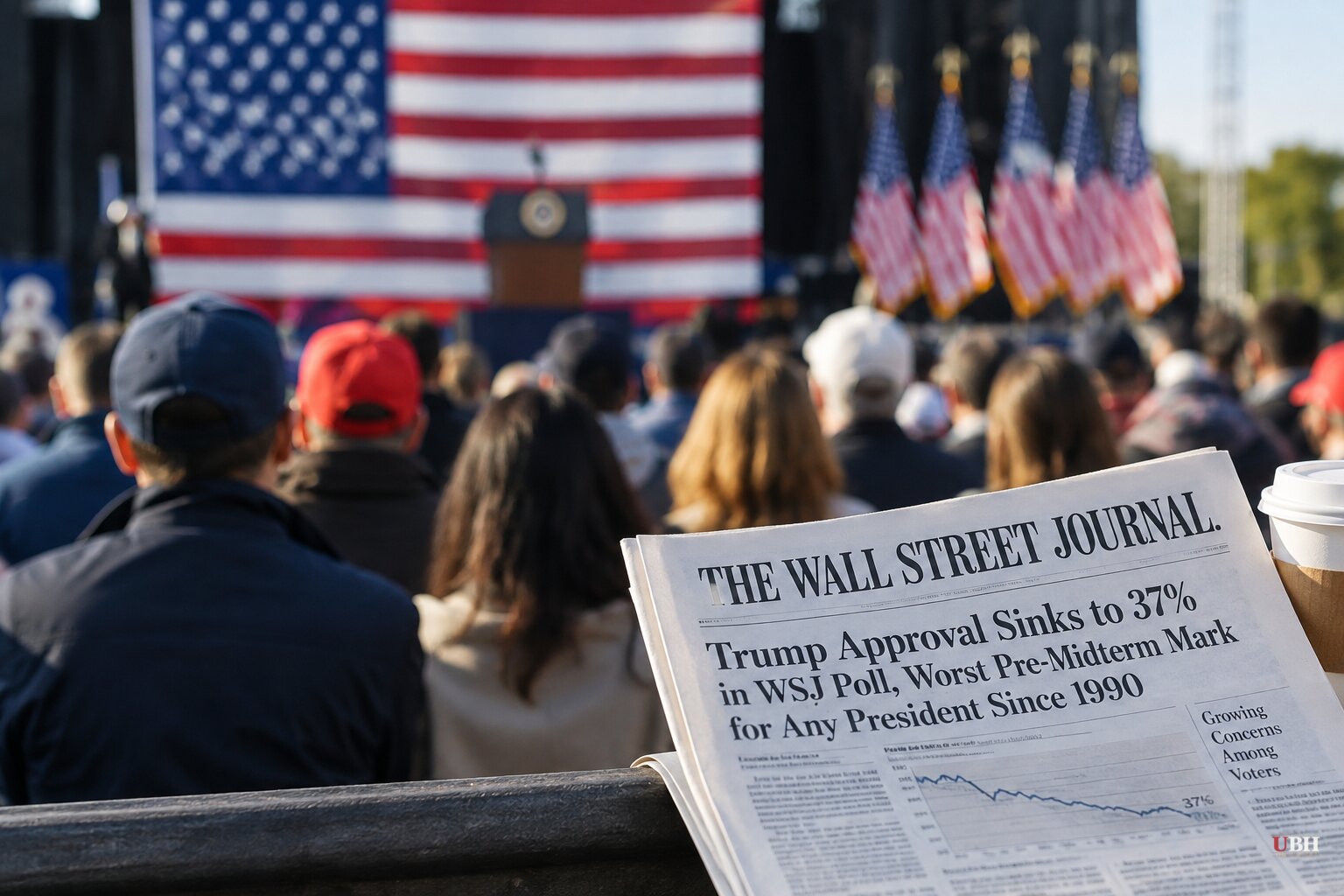
Since the Wall Street Journal's poll dropped Friday, September 25, showing President Trump at 37 percent approval, a wave of confirming numbers from other pollsters has landed on top of it, and Republicans are no longer pretending it's noise.
The Journal survey of 1,500 registered voters, conducted September 16-21, found 61 percent disapprove of Trump's job performance. That's the worst pre-midterm approval score for any president in Journal polling going back to 1990, according to the Journal's own reporting.
The cracks aren't just among independents. Eleven percent of voters who backed Trump in 2024 told the Journal they now regret that vote. Among Republicans who don't identify with the MAGA movement, 11 percent said they plan to vote for a Democratic congressional candidate this fall.
It's the Economy
Sixty-five percent of respondents rated the U.S. economy negatively, versus 33 percent positive. Sixty percent said Trump's economic policies made things worse; only 25 percent said better.
Kyle Kondik, managing editor of Sabato's Crystal Ball at the University of Virginia Center for Politics, told Newsweek the pattern is straightforward: "Overall it's pretty clear that Trump's numbers are worse now than they were eight years ago. Dissatisfaction with the economy/inflation is probably the biggest reason why."
Inshorts reported that seven months of war with Iran and rising fuel costs are compounding the pain, with 51 percent disapproving of Trump's handling of the cost of living specifically.
Other pollsters back this up. A Reuters/Ipsos poll released around September 21 put Trump at 32 percent, the lowest that poll has ever recorded for him. The American Research Group had him at 29 percent. CNN's own poll, released September 23, showed 33 percent approval, the numerically lowest of either Trump term, according to CNN's David Chalian.
Nate Silver's polling tracker puts Trump's net approval at minus 22.4, which Silver noted on X is "his low point for the term and now lower than at any point in his first term, even after Jan. 6." VoteHub's average lands on the identical minus 22.4 figure.
Republicans Getting Nervous, Publicly
The Cook Political Report moved 15 House races toward Democrats on Friday, September 25, according to the Washington Sun, and now rates Republicans as more likely than not to lose the House. The Senate majority, Cook says, is increasingly competitive too.
Some House Republicans in swing districts are already peeling off from Trump's most polarizing positions. Florida Rep. María Elvira Salazar released an ad criticizing the immigration enforcement crackdown, the Washington Sun reported. Michigan Senate candidate Mike Rogers has called for the Iran war to end.
Senate Republicans have been blunter. "We seem to be focused on issues many of you don't even care about," Sen. John Curtis of Utah posted on X, according to the Washington Sun. "We're just not doing what we should be doing to deal with issues you care about."
The White House Pushback, and Trump's Own Defense
White House spokesman Davis Ingle told Newsweek that the 2024 election was the "ultimate poll," arguing that nearly 80 million Americans voted for Trump's agenda, and pointed to what he called "historic progress" on jobs, inflation and housing affordability. That's the administration's core argument: elections, not surveys, are the real measure of where the country stands, and a single election result four years out shouldn't be discounted by a snapshot poll taken mid-cycle.
Trump himself has made a more pointed version of that case. Earlier in September he told reporters his approval ratings are "great, the problem is only the legitimate pollsters show it," a direct claim that the polls making headlines are skewed or unreliable rather than reflective of his actual standing.
It's a fair question whether any single poll captures true sentiment, and pollsters have gotten things wrong before. But the volume here is the problem for that argument. The Journal, Reuters/Ipsos, CNN, American Research Group, Nate Silver's aggregate and VoteHub's aggregate are independent operations using different methodologies, and they're all landing in the same range, roughly 29 to 37 percent approval with double-digit negative net ratings. This is a pattern, not one bad sample.
Meanwhile the ANI News wire reported that Trump is expected to hit the campaign trail in Iowa, Florida, Texas and Alaska ahead of Election Day, with a stop planned in Oklahoma, according to two people with knowledge of the plans cited by Politico. Whether campaign appearances in deep-red states move numbers in the competitive districts Cook Political Report just shifted toward Democrats is the open question Republicans will be watching between now and November 3.
Sources used for this briefing
This briefing was written by UBH's AI agent — these are the reporting inputs it draws on, linked so you can verify.


