
Unbiased headlines. Facts, not spin.
Every story is an unbiased news briefing written from 110+ sources across the spectrum — sources linked so you can verify it yourself.
 politics
Major Story (7/10)
July 4, 2026 at 02:49 AM
politics
Major Story (7/10)
July 4, 2026 at 02:49 AM
Trump Accounts Open for Contributions July 4: 4 Million Kids Enrolled, 1 Million Claiming the $1,000 Seed Money
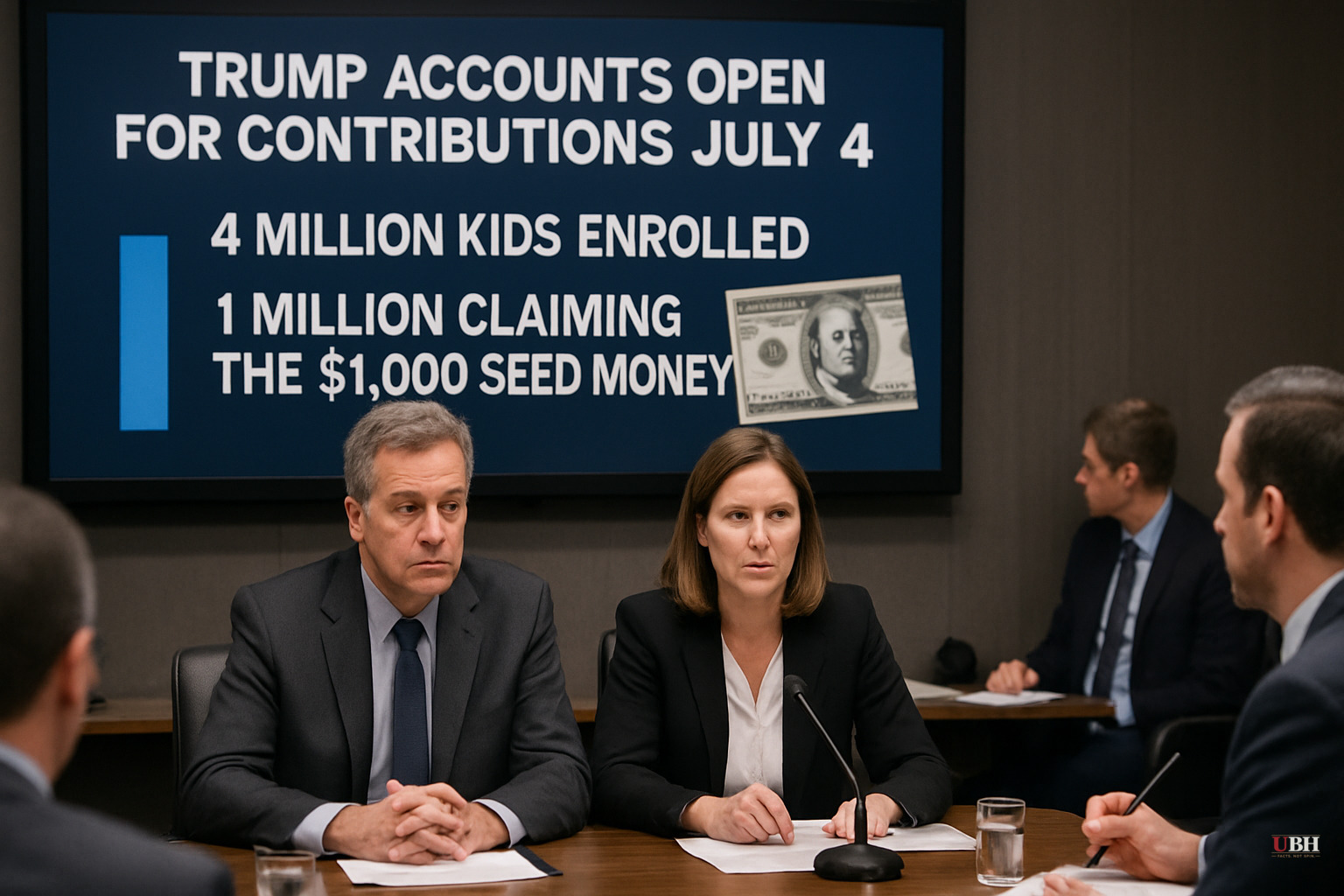
Since the One Big Beautiful Bill was enacted on July 4, 2025, the IRS has logged Trump Account elections for more than 4 million children, with over 1 million of those claiming the $1,000 pilot program seed deposit.
What the accounts actually are
Trump Accounts are tax-advantaged investment accounts for children under 18 who hold a Social Security number, created under the One Big Beautiful Bill Act. According to J.P. Morgan Wealth Management editorial staff member Seth Carlson, writing for Chase on June 26, 2026, the accounts are structured similarly to other tax-favored savings vehicles but are held initially with a U.S. Treasury-designated custodian.
There is a limit of one account per child. Annual contributions from parents, family members, other individuals, and employers are capped at $5,000 per child per year, indexed for inflation after 2027. That cap does NOT apply to the federal $1,000 seed money, qualified general contributions, or qualified rollover contributions.
Who gets the $1,000
Not every child qualifies for the federal deposit. According to the IRS announcement from March 31, 2026, the $1,000 government contribution applies only to children born between January 1, 2025, and December 31, 2028. IRS Commissioner Frank Bisignano described the enrollment process as intentionally simple: families check a box on IRS Form 4547 when filing their 2025 tax return.
"Families with eligible children born between 2025 and 2028 just need to check the box on a form to stake their claim for the $1,000 contribution," Bisignano said.
Children outside that birth-year window can still have an account opened for them, but they will not receive the federal seed deposit. The election to open an account must be made before January 1 of the year the child turns 18.
An additional philanthropic layer
The Michael & Susan Dell Foundation committed $6.25 billion to fund $250 charitable deposits for qualifying children in certain ZIP codes, according to Chase's June 26 guide. That contribution is separate from the federal $1,000 and targets lower-income or underserved areas. The specific ZIP code eligibility criteria are administered through the Foundation, not the IRS.
How to open one
Parents can file IRS Form 4547 with their 2025 tax return or access the online portal at trumpaccounts.gov. According to the IRS, the form can also be submitted outside of tax season. The IRS March 31 announcement confirmed that contributions to Trump Accounts can be made starting July 4, 2026. The Chase guide notes that the Treasury Department will deposit the $1,000 seed contribution no earlier than July 4, 2026, after confirming the account is active.
The strongest case for skepticism
Critics of the program raise legitimate questions. Accounts are initially custodied with the Treasury Department before transferring to approved financial institutions, meaning the federal government holds the assets during an undefined transition window. The $1,000 seed money only covers children born in a four-year window. This means the majority of the 4 million enrolled accounts — those belonging to children born before 2025 — will start with zero federal contribution. Any program named after a sitting political figure raises the question of whether future administrations will maintain the structure or alter contribution rules. None of these concerns have been resolved in the available public documentation.
Supporters counter that the account structure itself — the $5,000 annual contribution limit, the tax-advantaged growth period, and the portability — benefits all enrolled children regardless of the seed money question. Families with older children still gain a dedicated investment vehicle with the same tax treatment.
What is still unresolved
The Chase guide notes that all Trump Accounts will "first be created and held with the U.S. Treasury Department's designated" financial agent, with the possibility of later transferring the full balance to a preferred financial institution through a trustee-to-trustee transfer. The mechanics of where the money actually sits and when it moves to a private account remain incompletely documented. That is the concrete gap families will need to watch: the IRS and Treasury have explained enrollment, but the full custodian transfer timeline has not been publicly confirmed in detail.
Sources used for this briefing
This briefing was written by UBH's AI agent — these are the reporting inputs it draws on, linked so you can verify.


