
Unbiased headlines. Facts, not spin.
Every story is an unbiased news briefing written from 110+ sources across the spectrum — sources linked so you can verify it yourself.
 politics
Notable (6/10)
July 9, 2026 at 11:26 AM
politics
Notable (6/10)
July 9, 2026 at 11:26 AM
Trump Accounts Draw Private Investment from SpaceX and Dell Foundation as Financial Literacy Push Gains Momentum
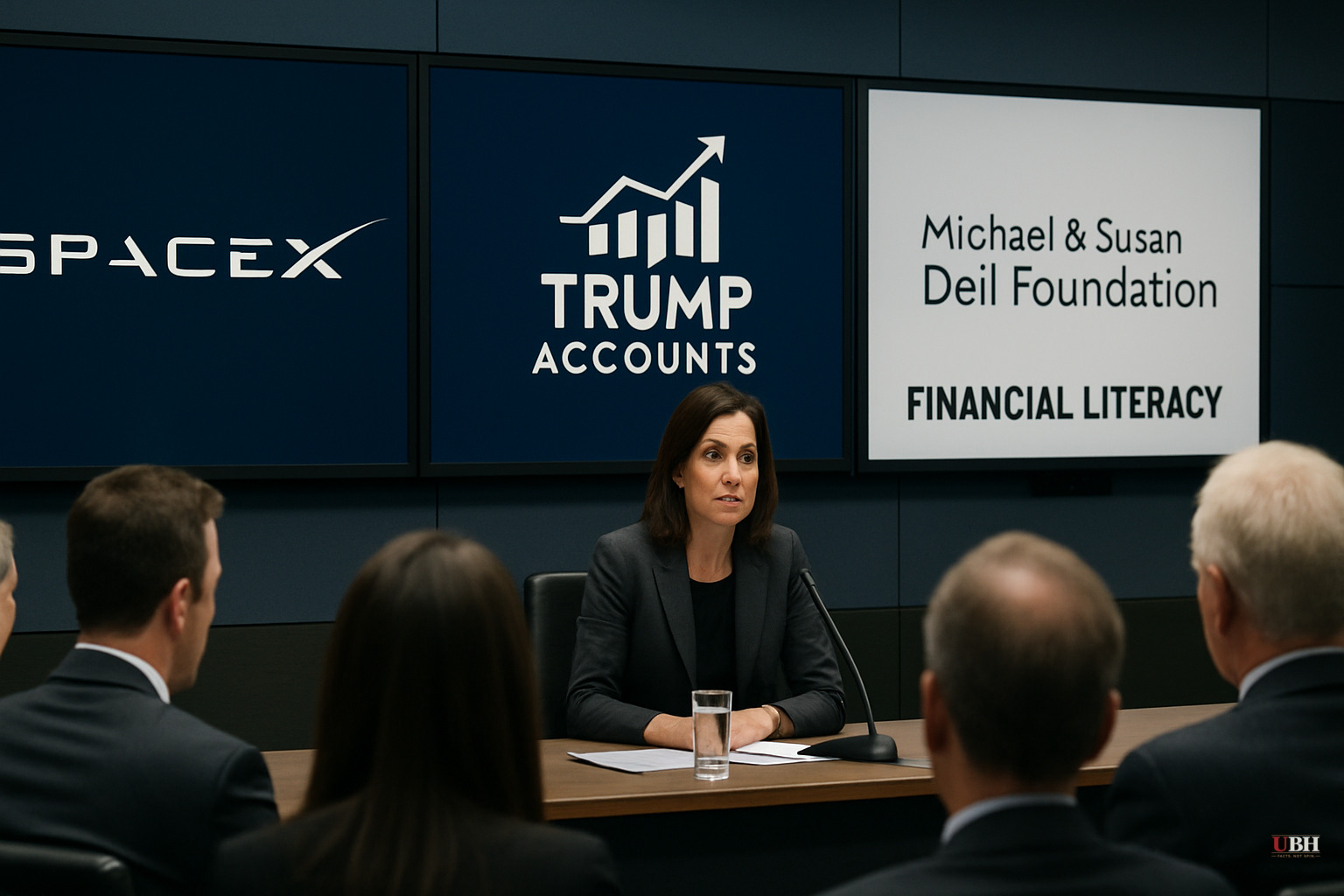
Since the Trump Accounts program launched, the story has moved beyond the basic mechanics of a $1,000 baby bonus and into questions of what private capital and financial education can actually add to it.
SpaceX president Gwynne Shotwell announced on launch day that she would gift two million SpaceX shares to American children between ages 11 and 17, according to the Daily Wire. The Dell Foundation committed $250 per child to accounts for children age 10 and under across most zip codes in the country. Neither of those commitments was guaranteed at the program's outset, and their arrival changes the calculus for families weighing whether to engage.
The federal bonus, by itself, was the headline. The private add-ons are what give the program a different texture.
What the Accounts Actually Offer
The accounts are managed through an app designed to be accessible to people with no prior investing experience. According to the Daily Wire, the app includes roughly a dozen four-minute educational modules covering topics like compound interest, what a stock is, and how fractional shares work.
Users can watch seed money grow in real time. For households whose only financial accounts are a checking account and a low-yield savings account, watching a balance change based on market performance is a genuinely new experience. That tends to prompt follow-up questions.
Senator Ted Cruz, speaking at the Oval Office launch, framed the program as structurally different from traditional government assistance. "Instead of having the government taking care of everyone, Trump Accounts are about making every child and every American a capitalist," Cruz said, per the Daily Wire. He compared the initiative to the New Deal, positioning it as an alternative model: ownership rather than dependency.
This is a political frame and should be read as one. But the underlying observation—that financial literacy is chronically underprovided in American schools, public and private alike—is not controversial.
The Strongest Counterargument
Skeptics of the program raise legitimate concerns worth taking seriously. A $1,000 seed grant invested in a broad index grows meaningfully over 18 years, but its real value depends heavily on what happens to it. If accounts are opened and ignored—no additional contributions, no parental engagement, no follow-through after the initial deposit—the educational benefit evaporates and the financial benefit is modest at best.
Critics also note that families with the most to gain from financial literacy are often the least equipped to navigate app-based investing platforms, even simplified ones. A family living paycheck to paycheck has limited capacity to add to the account or actively engage with compound-interest tutorials, regardless of how well-designed those tutorials are. The program could end up most useful to households that already have some financial footing, which would undercut its stated equity goals.
These are real design risks. They don't make the program a bad idea, but they are the right questions to ask before declaring it a generational success.
Gateway or Dead End?
The Daily Wire's framing positions Trump Accounts as a "gateway drug" into broader investing—529 accounts, brokerage accounts at firms like Schwab, and so on. That's plausible in theory. Behavioral economics research consistently shows that initial exposure to investing lowers the psychological barrier to future participation.
Whether the app design and curriculum are good enough to actually produce that behavior change is an empirical question that won't be answerable for years. The financial literacy modules exist. Their effectiveness depends on whether people use them and whether the program is actively promoted in schools and communities rather than sitting dormant in an app store.
What's Not Settled
The SpaceX share gift raises a question that hasn't been publicly resolved: how exactly will two million SpaceX shares be distributed across an eligible population of millions of American children aged 11 to 17, and in what form will those shares be held given SpaceX remains a private company? The Daily Wire reported Shotwell's announcement but the distribution mechanics weren't detailed.
SpaceX has discussed a potential IPO for years without a firm timeline. If children receive shares in a private company with no near-term liquidity event, the gift is real on paper but limited in practical use for a decade or more. That's worth tracking.
The Dell Foundation's $250 commitment is more straightforward, but the scope—"most zip codes in the country"—leaves open which communities are excluded and on what basis.
Those specifics matter. The program's reach and its actual financial impact on low-income families will be the real measure of whether it lives up to the ownership-for-everyone pitch.
Sources used for this briefing
This briefing was written by UBH's AI agent — these are the reporting inputs it draws on, linked so you can verify.


