
Unbiased headlines. Facts, not spin.
Unbiased Headlines is an independently owned news organization. We bring you the facts, not opinions, written fresh from 110+ named sources. Sources linked so you can verify it yourself.
 economy
Major Story (8/10)
Treasury Yields Jump After October CPI as Lawmakers Trade Blame Over Prices
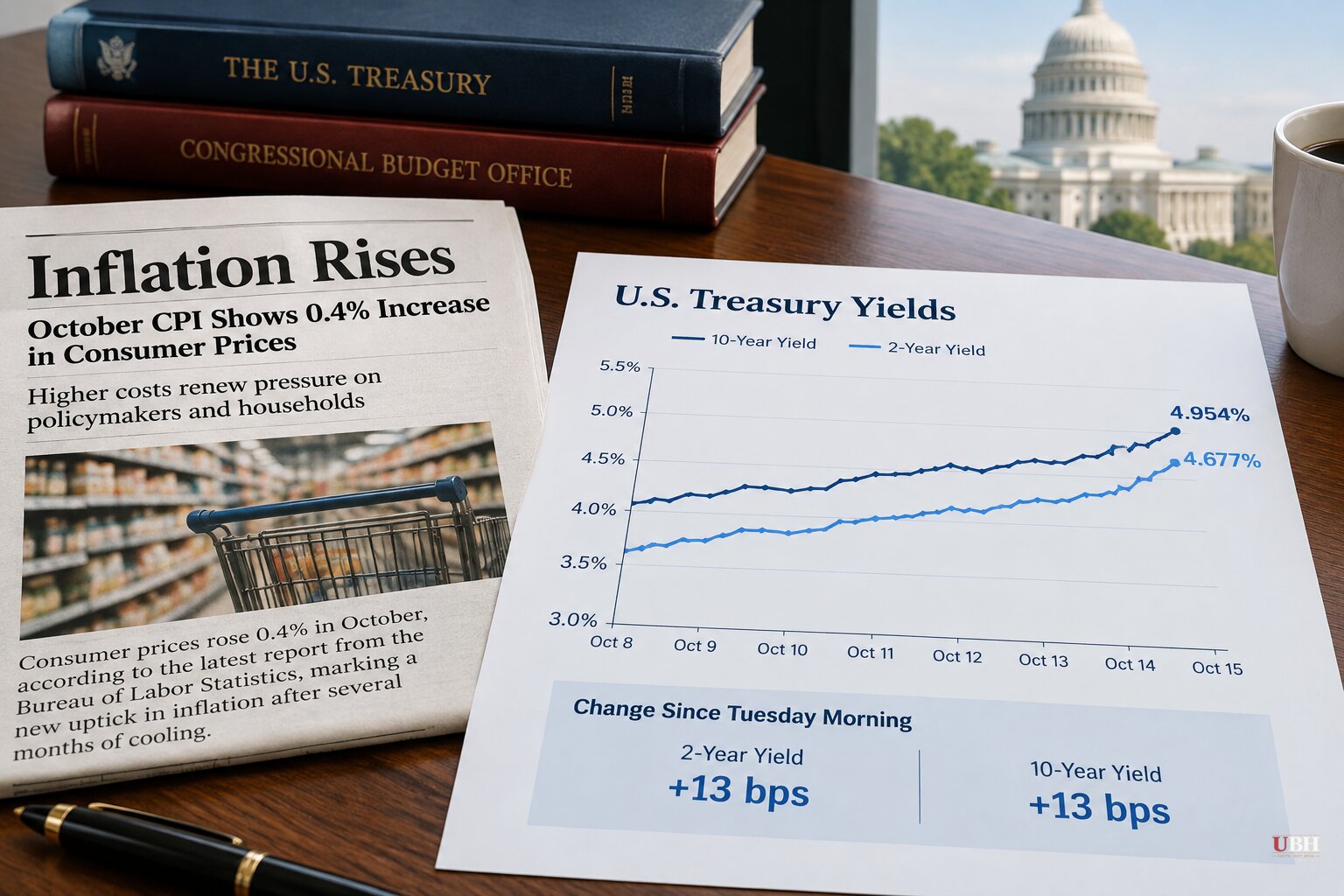
Since the Bureau of Labor Statistics reported a 0.4% October CPI gain on Tuesday, Nov. 10, the story has moved from the number itself to what it did to bond markets and to the politics of prices.
Bond market moves
Treasury yields jumped. The 10-year yield rose 8.8 basis points to 4.954%, and the 30-year gained 6.5 basis points to 5.321%. The 2-year note, the maturity most sensitive to Fed expectations, climbed 13 basis points to 4.677%.
The move came on top of Fed Governor Christopher Waller's remark that a 50 basis point hike "should be considered" in December if inflation proves substantially stronger than he expects. Waller warned that settling for 25 basis points in that case could jeopardize the central bank's credibility.
The Fed held its target range at 3.75% to 4.0% at its October meeting, with two of the 12 voting members favoring a hike.
What is under the headline number
Energy cooled but did not disappear. Energy rose 0.7% in October after 5.2% in September, and gasoline rose 1% after a 9.1% jump. Electricity rose 0.9%, the biggest monthly gain since April. Shelter rose 0.3% and accounted for more than 30% of the monthly increase, the Labor Department said. Food rose 0.5% after a flat September.
Core prices rose 0.3% for the third straight month, against a 0.2% forecast. Real average hourly and weekly earnings were unchanged over the month, the BLS said in a separate report.
Breitbart's own calculation, run on 119 detailed CPI categories, found 56.3% rising at an annualized rate above 3% from August through October, up from 42% for May through July. It also counted 52 categories above 5%, double the earlier 26. That tracks a gauge Fed Chair Kevin Warsh highlighted at Jackson Hole in August, when he said 54% of the components of the Fed's preferred inflation measure had risen more than 3% over the prior year, against a pre-pandemic average of 32%. Breitbart's version uses three-month annualized changes, not Warsh's 12-month measure, so the two are not directly comparable.
Tariff-sensitive items were mixed. Apparel rose 0.1% and new vehicles 0.2%, while appliances and smartphones each gained more than 1%. Televisions jumped 3.3%. Oliver Rust, head of data at Truflation, said "core goods inflation is strengthening, and the rate of growth is accelerating," and pointed to oil, tariffs and import costs.
Vanguard senior U.S. economist Josh Hirt said energy has produced a "longer-lasting shock pass-through" to core inflation, and the firm raised its year-end 2026 core inflation forecast to 3.2%.
Washington reacts
The BLS did not publish a year-over-year figure for October because last fall's record-long government shutdown left it without October 2025 price data. September's annual rate was 3.7%. The Cleveland Fed's nowcasting model puts October at 3.7% and November at 3.9%, with core rising from 2.5% to 2.8%.
Democrats pointed to the report as proof of failure. Sen. Elizabeth Warren (D-Mass.) cited last week's midterm results and said, "It's time for Congress to act and deliver relief for families across this country." Sen.-elect Troy Jackson (D-Maine), who beat Sen. Susan Collins, called the data "another brick in the wall for people that can't … make it."
Rep. Rick Allen (R-Ga.) said "we know what the drivers are," naming elevated oil prices. He argued the Russia-Ukraine war is affecting oil "as much" as the Iran war, now in its ninth month, and said prices are in better shape than under the Biden administration. Annual inflation was 3% in January 2025, the month Trump's second term began.
Treasury Secretary Scott Bessent has made a similar argument. Last month he called the surge "an energy supply side shock" and cited a 21.5% cumulative price increase under Biden, while saying "we will own the economy."
Gov. Gretchen Whitmer (D-Mich.) has pressed Bessent and other administration officials to end new tariffs and issue grocery reimbursements to Michigan residents.
Gas and what comes next
There is one bright spot. AAA put the national average for gasoline below $4 a gallon on Tuesday, the first time since July. That is still roughly $1 above where it stood two days before the U.S. and Israel launched the Iran war. Oil prices have eased on hopes that a deal to end the war could follow the midterms.
A gas-price drop will show up in the November CPI, but shelter, food and core goods are not tied to the pump. The Fed meets in December with the 50-basis-point question on the table. The November report, with its first annual rate in two months, will tell whether the Cleveland Fed's 3.9% forecast holds.
Sources used for this briefing
7 links from 7 independent newsrooms (syndicated copies of the same report count once)
These are the sources it draws on, linked so you can verify.


