
Original briefings. Zero spin.
Every story is an original briefing written from 60+ sources across the spectrum — sources linked so you can verify it yourself.
 health
Low Interest (4/10)
August 9, 2026 at 01:44 AM
health
Low Interest (4/10)
August 9, 2026 at 01:44 AM
Total Solar Eclipse Set for Wednesday, August 12: Path Runs From Russia to Spain, Partial View Hits Northeastern U.S.
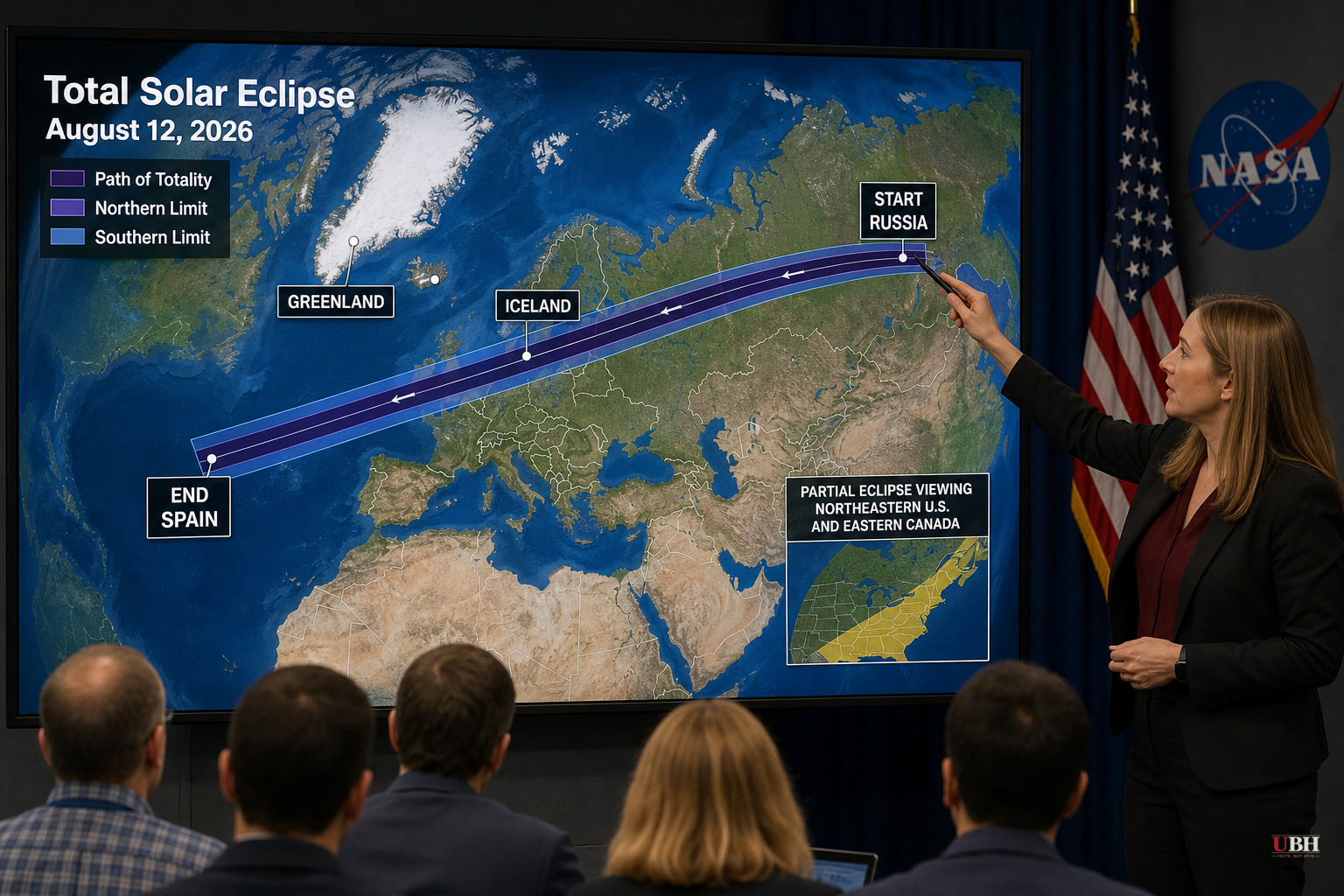
A total solar eclipse is set to sweep across the Arctic and into Europe on Wednesday, August 12, 2026. It's mainland Europe's first total eclipse since August 11, 1999, according to Forbes contributor Jamie Carter. Anyone under 27 in Europe has never seen the moon fully blot out the sun without leaving the continent.
The path starts in a remote stretch of Siberia, Russia, where it hits as an eclipsed sunrise, according to Forbes. From there the moon's shadow races across the Laptev Sea and the Arctic Ocean, crosses Greenland and Iceland, then reaches northern Spain and a sliver of Portugal.
NASA and Forbes both note the shadow's path comes unusually close to the North Pole, reaching a centerline latitude of 87.8 degrees north, about 153 miles from the pole itself, according to Forbes. No total eclipse on modern record has passed that close to Earth's northernmost point.
Spain offers the longest window of totality. In León, totality begins at 8:28 p.m. local time and lasts about two minutes, according to NASA figures cited by NPR. That's the first total eclipse visible from Spain's mainland since 1905, per the European Space Agency.
Iceland gets its own show earlier in the day. Totality begins in Reykjavík at 5:48 p.m. local time, NASA says.
What North America Actually Gets
This is NOT a repeat of the 2024 "Great American Eclipse," when totality crossed 15 U.S. states and six Canadian provinces, according to Space.com. On August 12, no part of North America sees totality. Zero.
Instead, it's a partial eclipse, and a modest one outside the far Northeast. Space.com reports the partial eclipse will be visible from 20 U.S. states between 7:34 a.m. Alaska Daylight Time and 2:52 p.m. Eastern, but only northeastern states get a view worth setting an alarm for.
The numbers back that up. Presque Isle, Maine tops the U.S. list at 28% coverage, with maximum eclipse around 1:50 p.m. EDT, according to Space.com. Bangor, Maine hits 23%. Boston gets 16%. New York City barely registers at 10%. Philadelphia comes in at just 7%.
Fairbanks, Alaska actually gets more coverage than most of the Lower 48, at 37%, though at 8:27 a.m. Alaska Daylight Time.
Washington, D.C. will see about 4% coverage starting around 1:17 p.m. Eastern, according to NASA figures reported by NPR.
Canada fares somewhat better in the east. Every province sees some partial eclipse between 8:38 a.m. Mountain Standard Time and 4:38 p.m. Newfoundland Daylight Time, with eastern provinces getting the more noticeable coverage, according to Space.com.
Eye Safety Is Not Optional
Regular sunglasses do nothing here. The American Academy of Ophthalmology warns that looking at the sun directly, even briefly, even during a partial eclipse, can cause burns and permanent vision loss. Certified eclipse glasses or handheld solar viewers are required, full stop.
This applies whether you're catching 28% coverage in Presque Isle or standing in the path of totality in northern Spain before totality actually begins and after it ends.
NASA's Science Angle
NASA isn't just watching for the show. The agency says it will fly scientific balloons and a high-altitude jet during the eclipse to study how a brief, sudden darkening affects Earth's atmosphere.
"From our unique perspective on Earth during a total solar eclipse, scientists can study the Sun's corona in a way we can't from anywhere else in the solar system," said Kelly Korreck, NASA's eclipse program manager, in a statement cited by NPR.
What's Next
This eclipse kicks off what Forbes describes as a rare stretch of three total solar eclipses within 372 days. The next partial eclipse visible from parts of the U.S. comes August 2, 2027, with totality that time falling across Spain, the Middle East and parts of North Africa, according to NASA figures reported by NPR. Americans hoping for another coast-to-coast totality event like 2024 will have to wait until August 23, 2044.
Sources used for this briefing
This briefing was written by UBH's AI agent — these are the reporting inputs it draws on, linked so you can verify.

