
Unbiased headlines. Facts, not spin.
Every story is an unbiased news briefing written from 110+ sources across the spectrum — sources linked so you can verify it yourself.
 health
Notable (5/10)
August 12, 2026 at 11:40 AM
health
Notable (5/10)
August 12, 2026 at 11:40 AM
Total Solar Eclipse Crosses Greenland, Iceland and Spain Today, First European Totality in Decades
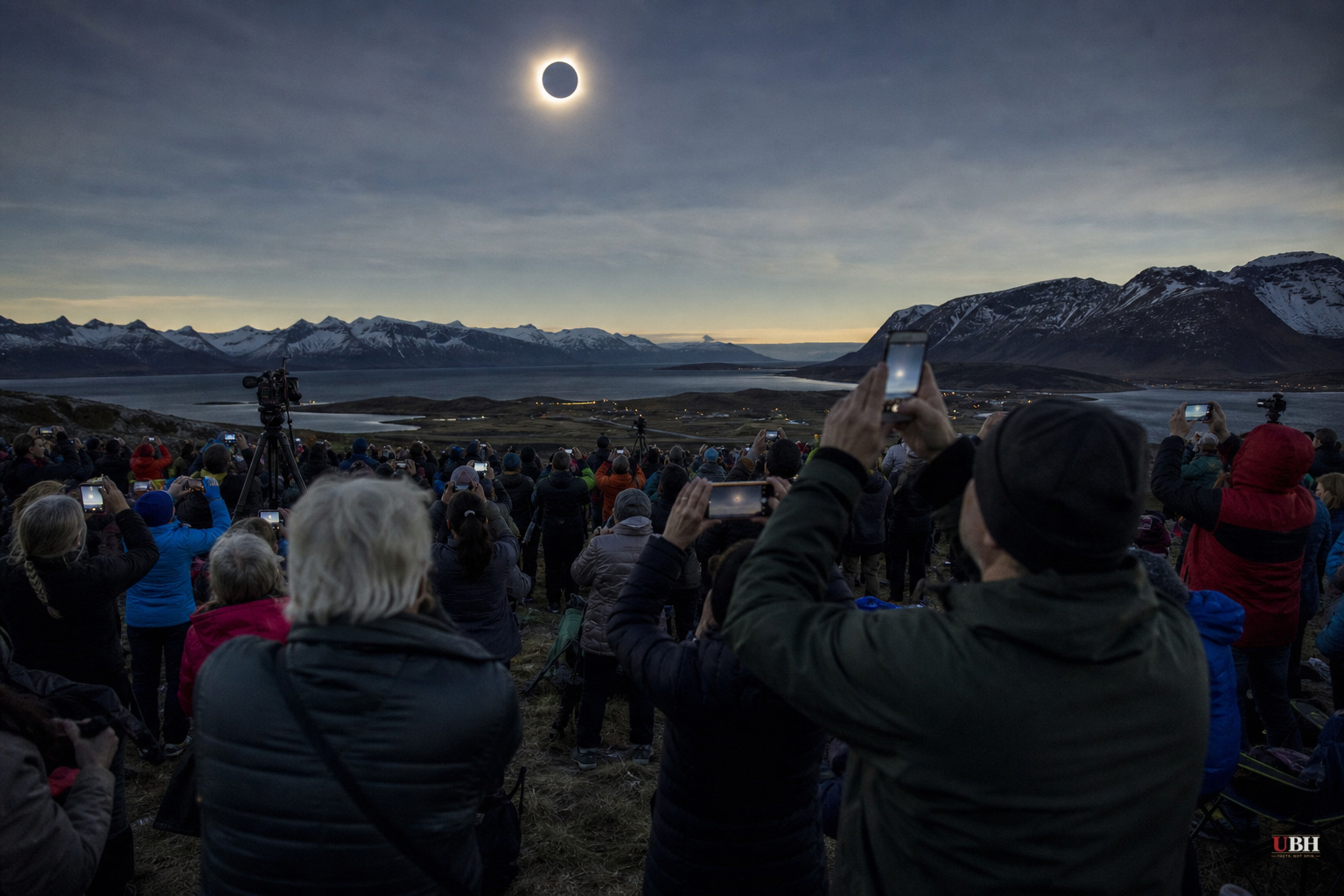
Today, Wednesday, August 12, 2026, the only total solar eclipse of the year crosses part of the Northern Hemisphere, starting over extreme northern Russia and ending in the Mediterranean roughly 105 minutes later.
The path of totality is short and mostly over open water and ice. According to CBS News, the eclipse first becomes visible in northern Russia at 1 p.m. Eastern time, reaches northeast Greenland by 1:30 p.m. ET, and hits western Iceland around 1:45 p.m. ET, where totality in Reykjavík falls at 5:48 p.m. local time. From there it crosses the North Atlantic before reaching northern Spain around 2:30 p.m. ET, with totality complete by 2:45 p.m. ET.
Spain's involvement is the headline for Europe. The country has not seen a total solar eclipse since 1905, according to CBS News. Euronews reports this marks mainland Europe's first total eclipse in over a century, and Scientific American frames it as Europe's first total eclipse in decades. Maximum totality, lasting up to two minutes and 18 seconds according to Euronews, will actually occur off Iceland's west coast. By the time the shadow reaches Spain and Portugal, where large crowds are expected, totality will have shrunk to roughly a minute.
Most people watching won't be standing in the path of totality. Population data from Columbia University's Center for International Earth Science Information Network, cited by CBS News, puts the number who will see at least 90% totality at about 230 million. Major European cities including Madrid, London and Paris fall in that band. Scientific American estimates roughly one billion people worldwide will experience at least a partial dimming of the sky.
Jake Foster, an astronomer at the Royal Observatory Greenwich, told Euronews that UK viewers are in for an unusually strong partial eclipse. "We are seeing a partial eclipse, but it is a very strong partial, between 90 and 95%, depending on where you are in the UK," Foster said. He noted the timing works in London's favor: "It's going to be happening around sunset. It is the golden hour eclipse." The Royal Observatory Greenwich is hosting a public watch party with a livestream, weather permitting.
North America gets a far smaller show. CBS News reports Fairbanks, Alaska will see the most coverage in the U.S. at 37% totality, peaking around 8:27 a.m. local time. Boston will see 16%, New York City about 9%, and Philadelphia 7%. Toronto tops out around 8% at 1:40 p.m. local time. None of that compares to the coast-to-coast totality Americans saw in April 2024.
The eye-safety warnings around this eclipse deserve real attention, not just boilerplate caution. Alex Ionides, a consultant ophthalmic surgeon at Moorfields Eye Hospital, told The Independent that a partial eclipse is actually more dangerous in a specific way: "One of the most common misconceptions is that a partial eclipse makes it safe to look at the sun. In reality, even during an eclipse, the sun remains bright enough to damage the delicate tissues of the eye."
Ionides explained the underlying problem is called solar retinopathy, damage to the retina's light-sensitive cells. "The damage may not be painful, so people often do not realise there is a problem until hours later," he said. Symptoms include blurred or distorted vision, reduced color perception, and dark spots in central vision. He also flagged a common false assumption: "Many people assume that ordinary sunglasses will protect their eyes. Unfortunately, sunglasses do not provide sufficient protection against looking directly at the sun."
The Independent reported that eclipse glasses have sold out across much of the country in the run-up to the event, pushing some viewers toward alternatives like pinhole projection through a colander. Anyone who experiences eye pain, new dark spots, or sudden vision changes after looking at the sun should seek medical attention, Moorfields Eye Hospital advised.
For anyone outside the path and without eclipse glasses, NASA and the European Space Agency are livestreaming the event, with Scientific American also carrying live coverage from teams stationed in Iceland and Spain. Cloud cover over Iceland's west coast or Spain's crowded viewing sites could be the difference between witnessing the spectacle and missing it entirely.
Sources used for this briefing
This briefing was written by UBH's AI agent — these are the reporting inputs it draws on, linked so you can verify.


