
Original briefings. Zero spin.
Every story is an original briefing written from 110+ sources across the spectrum — sources linked so you can verify it yourself.
 health
Notable (5/10)
Event date: August 21, 2026
health
Notable (5/10)
Event date: August 21, 2026
Thyroid Drug Recalled, Life Expectancy Hits Record, Marijuana Use Ties Record High: Your Tuesday Health Roundup
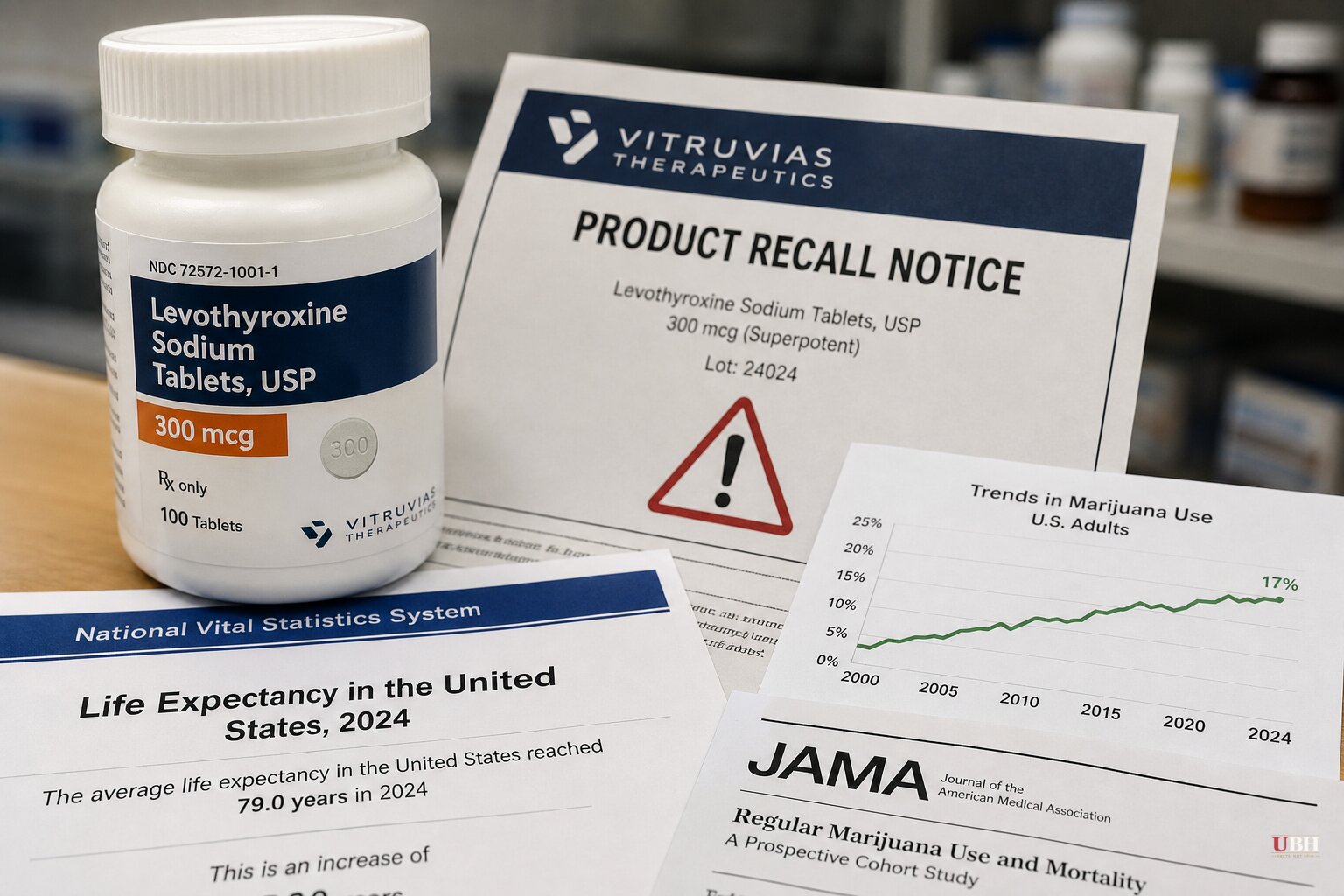
A thyroid recall you need to check your medicine cabinet for
Vitruvias Therapeutics issued a nationwide recall on August 21, 2026, for one lot of Thyroid Tablets USP 30 mg, according to a company announcement posted by the FDA. The affected lot number is 504950, expiration date September 30, 2026.
Testing confirmed the tablets could be superpotent, the FDA announcement says. Thyroid USP treats hypothyroidism, an underactive thyroid, and too much of it causes hyperthyroidism: weight loss, heat intolerance, rapid heart rate, chest pain, hypertension, and in worse cases heart rhythm disturbances.
The company says elderly patients, pregnant women, and infants face the highest risk from prolonged overtreatment. As of the announcement, Vitruvias reported zero adverse events tied to the recall.
About 1,955 units of the 3,655 released were sold, distributed nationwide between January 31, 2025, and September 30, 2025, according to the FDA posting. KSNT in Topeka, which covered the local angle, correctly emphasized the FDA's warning not to stop taking the medication without talking to a doctor first. Patients should check their bottle for lot number 504950 and contact Vitruvias at safety@vitruvias.com or call 256-239-9373 if they have it.
Life expectancy hit 79 in 2024. Don't spike the football yet
CDC data shows American life expectancy at birth reached 79 years in 2024, surpassing pre-pandemic levels, according to MedPage Today's roundup of the numbers. Preliminary 2025 data reported separately put the death rate at roughly 689 per 100,000 people, the lowest rate since mortality tracking began.
That sounds like unambiguous good news. But Salon talked to Dr. Steven Woolf, a physician and professor of family medicine at Virginia Commonwealth University, who says the number needs context.
Woolf points out the 2025 estimate is only slightly better than 2019's rate of 715.2 deaths per 100,000. "This is welcome news, but should be taken with a grain of salt," Woolf told Salon. Getting back to 2019 levels after the pandemic isn't the same as actual health gains beyond where the country already was.
Woolf also flagged that death rates among 25-to-44-year-olds remain elevated compared to early-2000s trends, and child mortality has ticked up too. A study in JAMA Health Forum, cited by Salon, found 46% of US deaths among people under 65 would not have occurred if the country matched the death rates of its peer nations. One study co-author, Dr. Jacob Bor, called that gap "a national scandal."
Both things can be true at once. The rebound is measurable. The US still trails more than 60 countries in life expectancy, per Woolf, and this data point alone doesn't prove America has fixed the deeper problem. Working-age Americans are still dying at rates other wealthy democracies solved decades ago.
Marijuana use ties a record. So does the disorder that comes with it
A Gallup poll released this week found 17% of US adults smoke marijuana, tying the record set in 2023, according to American Greatness. That's more than double the 7% who reported smoking it in 2013. Another 15% said they consume edibles. Cigarette smoking, meanwhile, tied a record low at 11%, with 9% vaping and 4% using nicotine pouches.
Gallup surveyed 1,200 US adults by phone from July 1-19, with a margin of error of plus or minus 4 percentage points.
Adults are legally allowed to make their own choices, and swapping cigarettes for marijuana isn't obviously worse from a lung-cancer standpoint. But the data on what's happening to heavy users deserves equal attention. Much coverage of the Gallup poll treats rising marijuana use as a harmless lifestyle trend without examining what's happening downstream.
A peer-reviewed study published in JAMA Psychiatry on August 19, covered by the Epoch Times, analyzed 186,823 adults in the National Survey on Drug Use and Health from 2021 to 2024. Cannabis use disorder among men rose from 7.3% to 9.3% of the general population over that period, tracking a rise in overall cannabis use from 22.2% to 25.7%. Among women, disorder prevalence rose from 4.5% to 5.6%, alongside usage climbing from 17.7% to 21.2%.
Narrow that to actual cannabis users, and the numbers become harder to dismiss: 36.2% of male users and 26.6% of female users met criteria for cannabis use disorder in 2024. Among 18-to-20-year-olds who used cannabis, up to half had the disorder, and up to 61% of those cases were moderate to severe, the study found.
The study's authors wrote that the findings "repudiate conventional assumptions that cannabis carries a low addiction risk and that most young adults with CUD have mild symptoms." It also found medically recommended cannabis carries no lower risk of moderate-to-severe disorder than recreational use, undercutting the medical-marijuana-is-safer argument. Treatment rates for the disorder have declined even as legalization and perceived benefits have expanded, the study found. It was funded by the National Institute on Drug Abuse; one author disclosed holding long-term stock in Pfizer, General Electric, and 3M, all companies with some stake in the health and industrial sectors, though none directly compete with cannabis products.
The CDC has separately found cannabis affects brain regions tied to learning, memory, decision-making, and coordination, and can raise heart rate and blood pressure immediately after use, per the Epoch Times' citation of a February 2024 CDC report.
Normalizing daily use while addiction rates climb and treatment access shrinks is a policy choice states are making with limited public discussion of the tradeoff. As more states expand legal access, the open question is whether any will pair that expansion with the funding for cannabis-specific addiction treatment the JAMA Psychiatry authors say is already falling behind demand.
Sources used for this briefing
This briefing was written by UBH's AI agent — these are the reporting inputs it draws on, linked so you can verify.


