
Unbiased headlines. Facts, not spin.
Unbiased Headlines is an independently owned news organization. We bring you the facts, not opinions, written fresh from 110+ named sources. Sources linked so you can verify it yourself.
 defense
Major Story (7/10)
Event date: November 19, 2026 ·
Third U.S. Carrier Arrives in Middle East While Iran Keeps Targeting Bahrain and Repair Bills Mount
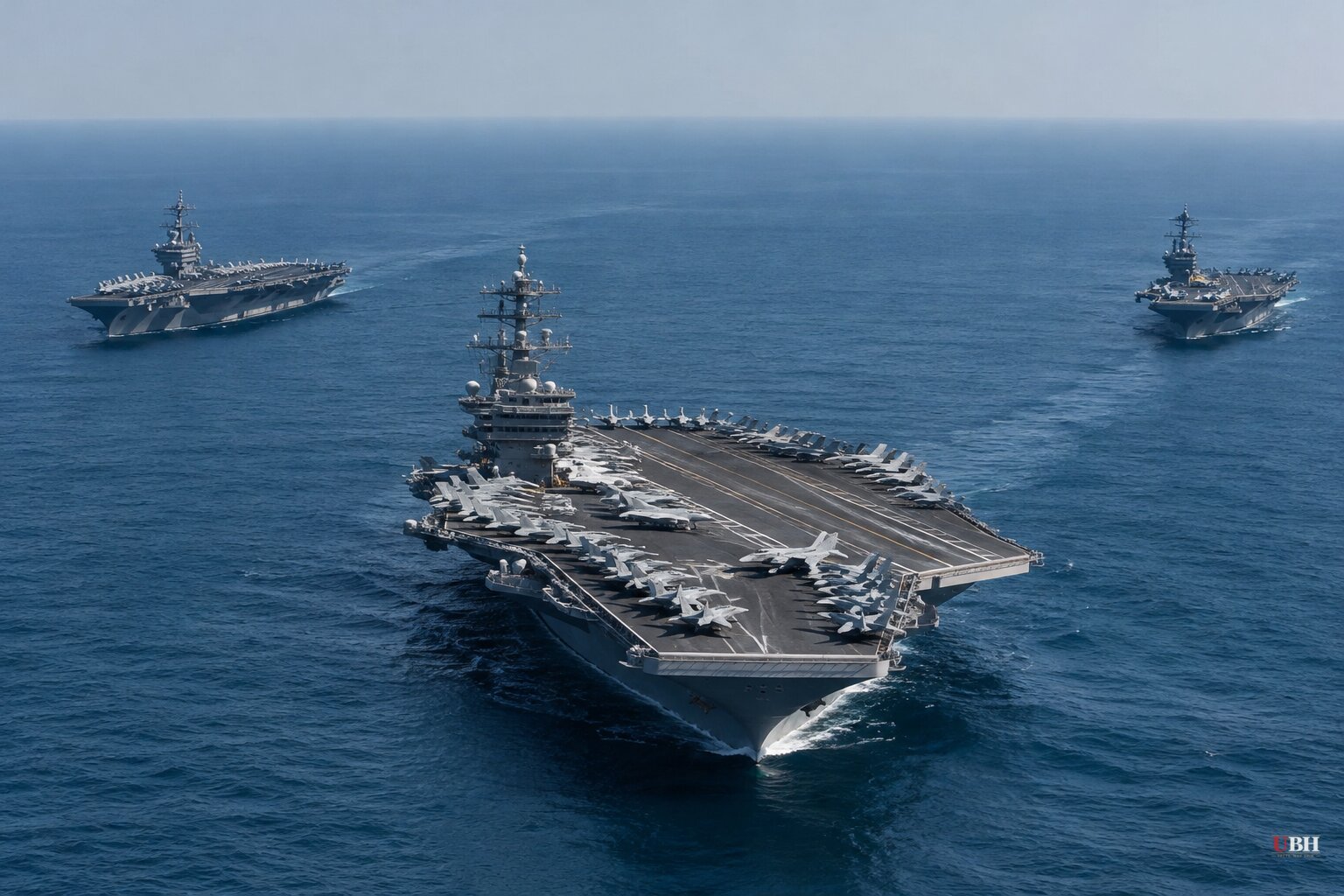
A third American aircraft carrier is now operating in the Middle East, nine months into the U.S.-Israeli war on Iran. U.S. Central Command confirmed Monday, Nov. 23, that the USS Theodore Roosevelt, which crossed the Indian Ocean on Sunday, has joined the USS George H.W. Bush and USS George Washington in its area of responsibility. CENTCOM described it as a scheduled deployment.
It is only the second time this year three carriers have operated there at once. The first was April. Before that, you have to go back to the 2003 invasion of Iraq.
A bigger force, a stated aim of no new strikes
A source familiar with the deployment put U.S. personnel in the region at roughly 53,000. That force includes 13 destroyers, two cruisers and a littoral combat ship. An amphibious group carrying about 2,000 Marines is also headed to the region.
The administration says the buildup is not a prelude to renewed large-scale combat. Secretary of State Marco Rubio said on Nov. 10: "We don't need to conduct military strikes if we're achieving the same objective through economic means and economic pressure." The U.S. has blockaded Iranian ports since July 14.
President Trump said on Nov. 12 that the war is "militarily... effectively over" and that "we don't need a deal with Iran." He has also sent mixed signals on strikes, saying new ones are highly unlikely while sending more ships and troops.
Iran is still shooting
Iran has not stood down. The Revolutionary Guard claimed it hit a U.S. early-warning radar installation in Bahrain on Friday. CENTCOM said both incoming drones were shot down with no injuries or damage. The IRGC claimed another attack Sunday, saying it launched six drones at radar equipment at Bahrain's Al-Riffa helicopter base. Bahraini authorities said they intercepted the drones. Iran's claims of damage are unverified.
The attacks followed a run of incidents in which Iran also targeted a U.S. air base in Kuwait. The Associated Press reported that a U.S. fighter jet struck an IRGC missile launch site on Qeshm Island after an Iranian attack on a U.S. radar installation in Bahrain. Iran said its strikes responded to U.S. drone surveillance and an attack on Iranian communications towers.
In the Strait of Hormuz, U.S. escorts have restored oil flows, and CENTCOM says Gulf partners have shipped more than 1.7 billion barrels through. Iran has still attacked tankers. The Abu Dhabi state oil company ADNOC said one crew member on its tanker was missing and 11 others were injured after an attack in the strait.
Deputy Foreign Minister Kazem Gharibabadi has warned that Iran could strike American forces preemptively if it believed an attack was imminent. Iranian officials have also claimed limits on their missile range have been lifted.
The Wall Street Journal, citing U.S. intelligence assessments, reported that Iran may still hold 1,500 to 2,500 missiles. The assessments carry low confidence because officials are unsure how many work. Israeli military officials told ministers at Sunday's Security Cabinet meeting that Tehran is pouring resources into rebuilding its missile and drone arsenal.
Hamidreza Azizi of the International Crisis Group warned that "even if neither side intends to enter a broader confrontation, the accumulation of military incidents across multiple fronts increases the risk of miscalculation and escalation beyond what either side originally intended."
The strain on the Navy
MS NOW reported that Navy Secretary Hung Cao told sailors and families to prepare for deployments of at least 11 months, up from the standard six. Cao reportedly said at least 17 destroyers are enforcing the blockade of Iranian ports. The Navy has 77 destroyers, and Middle East Eye reported that almost 30 are in maintenance.
Omer Ozkizilcik of the Atlantic Council argues that the administration "is capable of achieving tactical victories, but no tactical victory can make up for strategic mistakes." He faults Trump for weighing Israeli intelligence above his own advisers' assessments.
The repair bill and the footprint debate
The Center for Strategic and International Studies estimates that repairing damaged U.S. bases in the region could cost $9.4 billion. The Congressional Research Service said Naval Support Activity Bahrain, home of the Fifth Fleet, "sustained serious damage" early in the war and put repairs above $400 million. A Defense Department inspector general report in September found the U.S. had lost dozens of aircraft, including F-35As and F-15Es. Pentagon figures put the war's total cost above $47 billion by October.
What the U.S. footprint should look like afterward is already in dispute. Brookings' Michael O'Hanlon expects a smaller, more dispersed, more hardened presence "generally further away from Iran." CSIS's Mark Cancian says rebuilding the bases and cutting surge forces would come only after a ceasefire or stable conditions.
Brian Haggerty of Defense Priorities argued in a Nov. 18 paper that the war has "shattered" the assumption that U.S. bases guarantee Gulf security. He says Washington can move to a largely offshore posture without abandoning its partners, and that fears of a drawdown are "overblown."
The opposing case came from Reuel Marc Gerecht and Ray Takeyh in a June 4 Wall Street Journal essay titled "The U.S. Needs Its Mideast Bases." Proponents of the current presence argue that without it, Gulf states could be attacked, destabilized or courted by China, risking an energy crisis and an emboldened Iran.
The war enters its 10th month on Saturday, Nov. 28. No ceasefire is in place, and Qatar's effort to revive talks has not produced a negotiating date. Until it does, three carrier groups will stay in range of an Iran that is still firing drones at Bahrain.
Sources used for this briefing
6 links from 5 independent newsrooms (syndicated copies of the same report count once)
These are the sources it draws on, linked so you can verify.


