
Unbiased headlines. Facts, not spin.
Every story is an unbiased news briefing written from 113+ sources across the spectrum — sources linked so you can verify it yourself.
 tech
Major Story (8/10)
Event date: September 30, 2026
tech
Major Story (8/10)
Event date: September 30, 2026
Third Circuit Rules AI Firm's Westlaw Training Was Copyright Infringement, Draws Line Around Generative AI
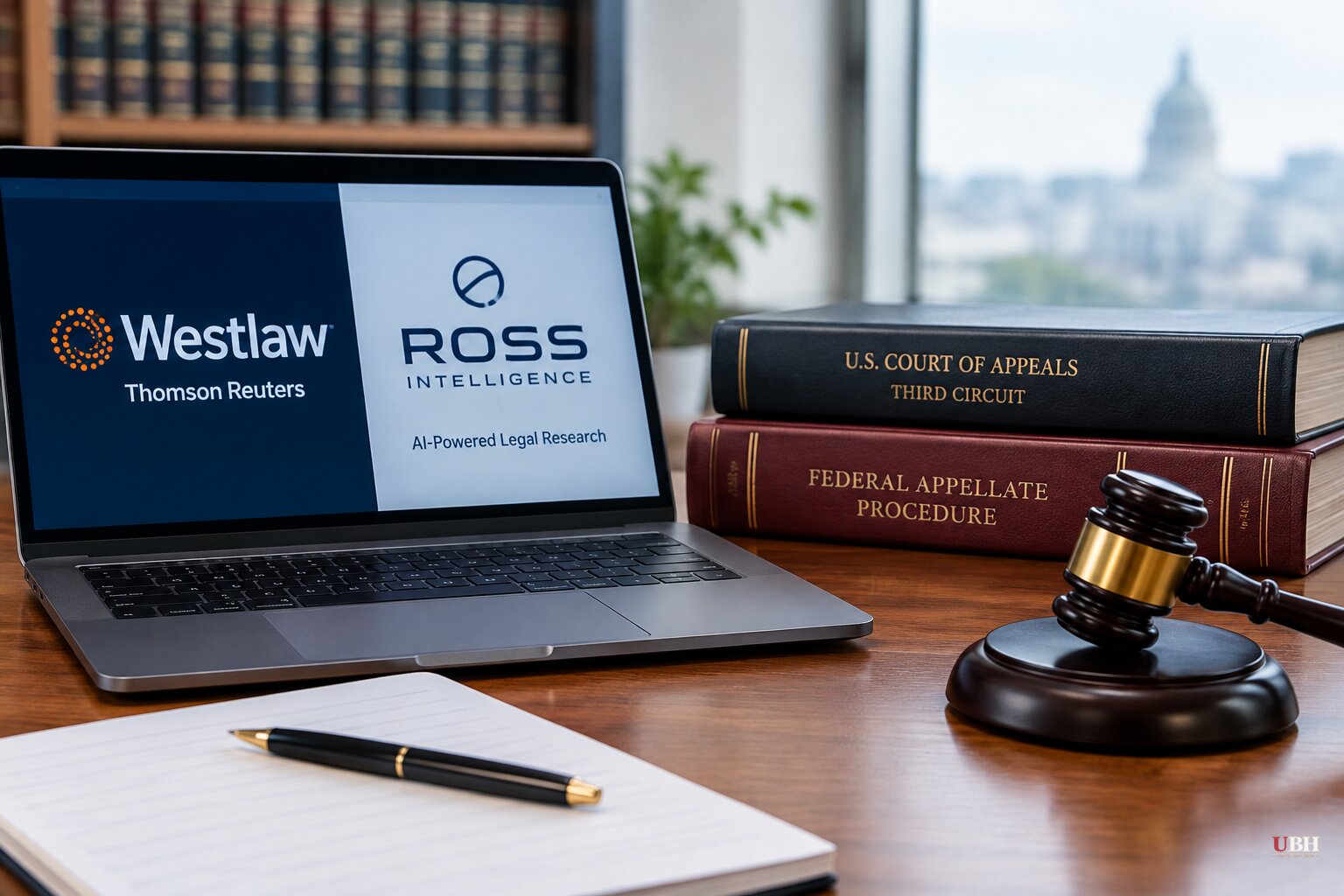
A federal appeals court has, for the first time, put a direct answer on the record: training an AI system on a competitor's proprietary database is not automatically fair use. That answer came down hard against the startup that tried it.
The U.S. Court of Appeals for the Third Circuit ruled September 29 in favor of Thomson Reuters, upholding a lower court finding that ROSS Intelligence infringed copyrights in Westlaw's editorial content when it built a competing AI legal-research tool, according to Tech Times. Legal teams across the AI industry had reportedly read the opinion by Tuesday afternoon.
A Six-Year Fight Over Headnotes
The case goes back to May 2020, when Thomson Reuters, which owns the Westlaw legal database, sued ROSS Intelligence, a San Francisco AI startup, according to Tech Times. Thomson Reuters alleged that after it refused to license Westlaw content to ROSS directly, the startup hired a third-party firm, LegalEase Solutions, to produce roughly 25,000 legal question-and-answer memos built from Westlaw's "headnotes," the short attorney-written summaries that accompany judicial opinions in the Westlaw system.
ROSS then trained its AI-powered legal search tool on those memos. The resulting product did the same basic job as Westlaw itself: take a natural-language legal question and return relevant judicial opinion passages.
ROSS didn't survive the fight. The company, which had raised about $13 million in venture funding, went defunct in January 2021 under the weight of litigation costs, according to Tech Times.
The Judge Changed His Mind, Then the Appeals Court Backed Him
U.S. Circuit Judge Stephanos Bibas, sitting by designation in Delaware district court, initially wrestled with whether ROSS's conduct qualified as fair use. He reversed his own earlier position in a revised summary judgment opinion issued in February 2025, finding ROSS had infringed the copyrights in 2,243 individual Westlaw headnotes and that ROSS's fair-use defense failed three of the four factors courts weigh under the Copyright Act, according to Tech Times.
The Third Circuit took up the case on appeal and affirmed that finding on September 29, 2026, according to Tech Times, making it the first time a federal appeals court has ruled squarely on whether training an AI model constitutes fair use.
Why This Doesn't Automatically Doom ChatGPT or Claude
The court's exposure analysis turns on what kind of AI system is being built and what commercial function the training data already served. The ruling explicitly distinguished ROSS's tool from generative AI systems built by companies like OpenAI, Meta, and Anthropic.
The distinction matters because ROSS's tool didn't generate new text. It retrieved and returned existing copyrighted judicial-opinion passages in response to a query, competing head-to-head with Westlaw's own core commercial function of connecting lawyers to those same passages. Generative AI models, by contrast, synthesize new output rather than reproducing a competitor's curated database to perform the identical task the original database performed.
AI developers have argued for years that training on copyrighted text to build a transformative tool, one that produces new content rather than republishing the original, should fall under fair use because the output doesn't substitute for the source material in the market. That argument hasn't been tested yet at the appellate level for generative models specifically, and this ruling, by the Third Circuit's own apparent framing, doesn't resolve it either way.
Thomson Reuters built its case, and won it, on a narrower and arguably easier target: a tool that did the exact same commercial job as Westlaw, built from Westlaw's own editorial labor. That's a different fact pattern than a chatbot trained on billions of web pages that generates original prose.
What's Still Unresolved
The Third Circuit's ruling does not settle the fair-use question for pending generative AI lawsuits, including disputes involving OpenAI, Meta, and Anthropic over training data drawn from news publishers, authors, and other copyright holders. Those cases involve a materially different kind of AI output, and the court's own reasoning preserved that distinction rather than erasing it.
What's now established is a baseline: when an AI company trains on a rival's proprietary, human-curated database to build a product that competes directly in the same market, courts are willing to call that infringement, not fair use. How that principle gets applied to large language models that generate new text rather than reproduce source material is a fight still working its way through other federal courts.
Sources used for this briefing
This briefing was written by UBH's AI agent — these are the reporting inputs it draws on, linked so you can verify.


