
Unbiased headlines. Facts, not spin.
Unbiased Headlines is an independently owned news organization. We bring you the facts, not opinions, written fresh from 110+ named sources. Sources linked so you can verify it yourself.
 tech
Major Story (7/10)
Event date: October 16, 2026 ·
Taiwan Plans Criminal Charges for Unauthorized AI Chip and Server Exports to China
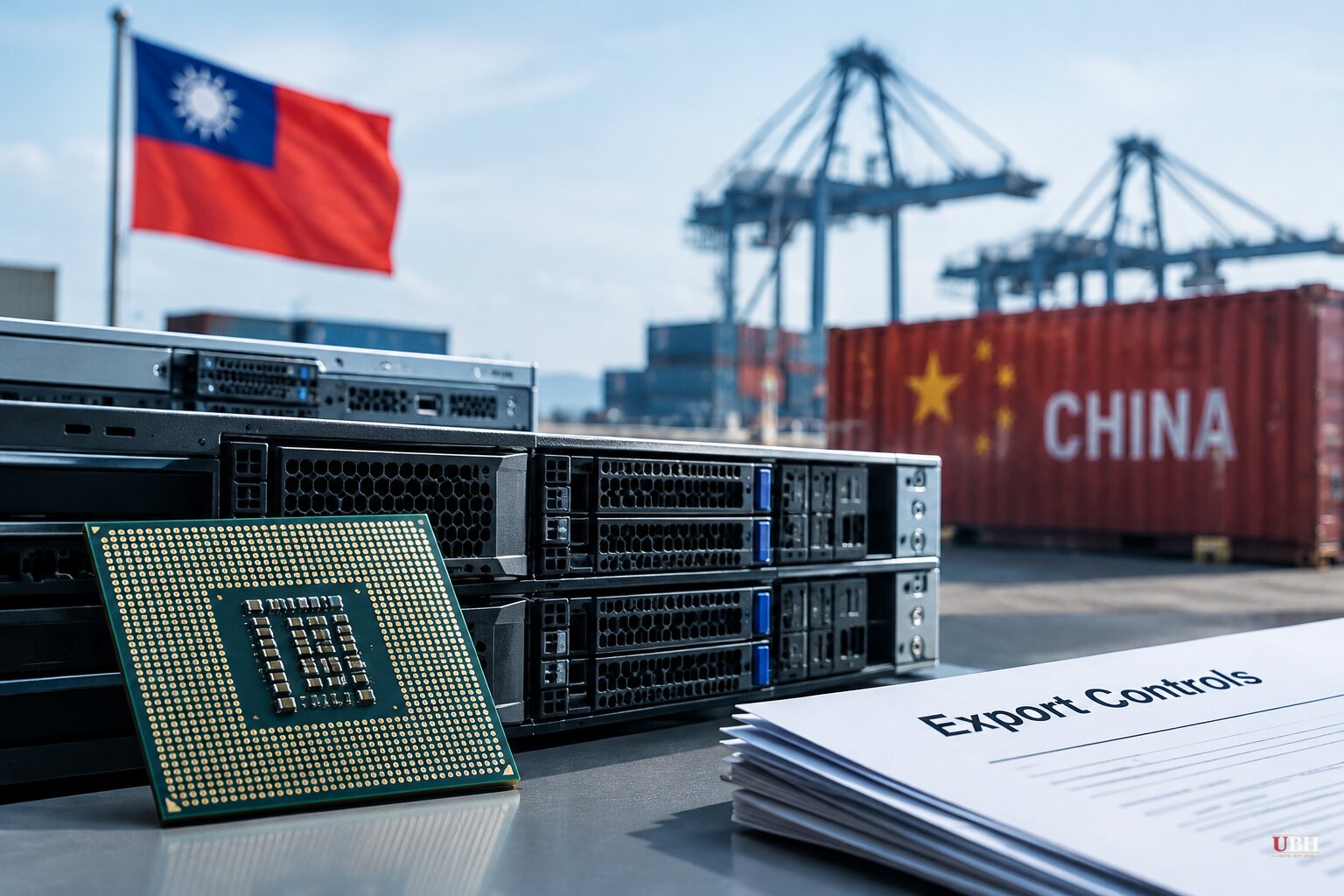
Taiwan intends to make it a crime to ship advanced AI chips and servers to China without authorization. Economy Minister Kung Ming-hsin confirmed the plan in an interview with Bloomberg, published Oct. 16.
The government will add AI servers and advanced semiconductors to its controlled-items list under the Foreign Trade Act. Once the measures take effect, unauthorized shipments to China could bring criminal charges. Kung has not given a timeline or said how the controls will be implemented.
Why the gap mattered
U.S. export rules already reach most of the hardware in question. Chips made with American equipment or design software fall under U.S. law wherever they are fabricated, and exporting them to China without a license is a federal crime. That covers virtually all of Nvidia's top accelerators, which TSMC builds in Taiwan.
Taiwan's own law has not matched that. Chris McGuire, a China and AI expert at the Council on Foreign Relations, said in June: "It's not a criminal violation in Taiwan to export AI chips to China; obviously it is under US law, but it's not under Taiwanese law."
The result is that prosecutors have had to reach for other statutes. Singapore faces the same problem. Its police arrested suspected Nvidia GPU smugglers and charged them with fraud and money laundering, because no specific law bans advanced chip exports to China.
What changes
Taiwan's current approach is a blacklist. Since mid-2025, Huawei and SMIC have been on the list of strategic high-tech goods, and Taiwanese companies need a permit to supply them. Other Chinese buyers could generally still be served unless the chips fell under the 2022 U.S. rules.
The new approach would control the goods themselves, covering all buyers in China, according to Bloomberg's reporting. Violations are currently treated as administrative matters.
Kung tied the change to the trade deal with Washington. "Going forward, some of our measures on controlled items will correspond to American ones because we have made quite some commitments in the Agreement on Reciprocal Trade," he said.
That agreement was signed earlier this year. It cut U.S. tariffs on most Taiwanese goods from 20% to 15%. Taiwanese companies pledged $250 billion in U.S. investment in semiconductors, energy and AI, backed by another $250 billion in credit guarantees.
Penalties are unsettled
Tom's Hardware reported that violators would face up to five years in prison and fines of about NT$3 million, roughly $92,500. Another account says the penalties and the start date have yet to be decided.
Democratic Progressive Party lawmaker Chung Chia-pin has drafted a corresponding amendment to the Foreign Trade Act. It has not passed.
The smuggling record so far
Taiwanese authorities arrested suspected AI chip smugglers for the first time in May. In July, prosecutors went after Super Micro managers, but on forgery charges rather than an export offense.
U.S. authorities have accused three Super Micro employees, including co-founder Yih-Shyan "Wally" Liaw, of smuggling $2.5 billion worth of AI servers. Those are allegations, and no outcome has been reported. Taiwanese investigators later raided Super Micro's Taipei offices in a probe into Nvidia B300 smuggling, and prosecutors indicted nine people in that case, according to Tom's Hardware.
U.S. officials have alleged that billions of dollars of Nvidia hardware has reached China in recent years. Bloomberg reports that Nvidia chips continue to reach Chinese buyers through smuggling networks in Southeast Asia.
Beijing and the money
Beijing has not responded to the new plan. It has condemned Taipei's earlier restrictions on Huawei and SMIC. Separately, China's commerce and science ministries have drafted rules to restrict or ban exports of 40 technologies, including AI, chips and solar technology, the Associated Press reports.
The tightening comes while Taiwan is booming on the back of AI demand. Semiconductor exports hit a record $87.22 billion in September, up 60.9% from a year earlier, driven heavily by U.S. demand.
The China market matters to American chipmakers too. In its last full fiscal year before U.S. licensing requirements, Nvidia generated more than 13% of its revenue in China, about $17 billion. Tighter rules on its H20 chip cost the company about $4.5 billion in charges. China accounted for more than 24% of AMD's revenue in 2024.
Kung also said Taiwan plans to raise billions of dollars to build industrial parks in the U.S., aimed at a full in-country supply chain for Nvidia and other AI hardware makers.
What comes next
The controlled-items change and the Foreign Trade Act amendment are the two pieces to watch. Neither has a date. Until they land, a smuggler caught in Taiwan still faces whatever other statutes prosecutors can find, and the final penalty, whether it matches the five-year figure or not, remains to be set.
Sources used for this briefing
7 links from 7 independent newsrooms (syndicated copies of the same report count once)
These are the sources it draws on, linked so you can verify.


