
Unbiased headlines. Facts, not spin.
Unbiased Headlines is an independently owned news organization. We bring you the facts, not opinions, written fresh from 110+ named sources. Sources linked so you can verify it yourself.
 tech
Major Story (7/10)
DHS Orders Civilian Agencies to Remove DeepSeek and Bars Federal Purchases of Its Products
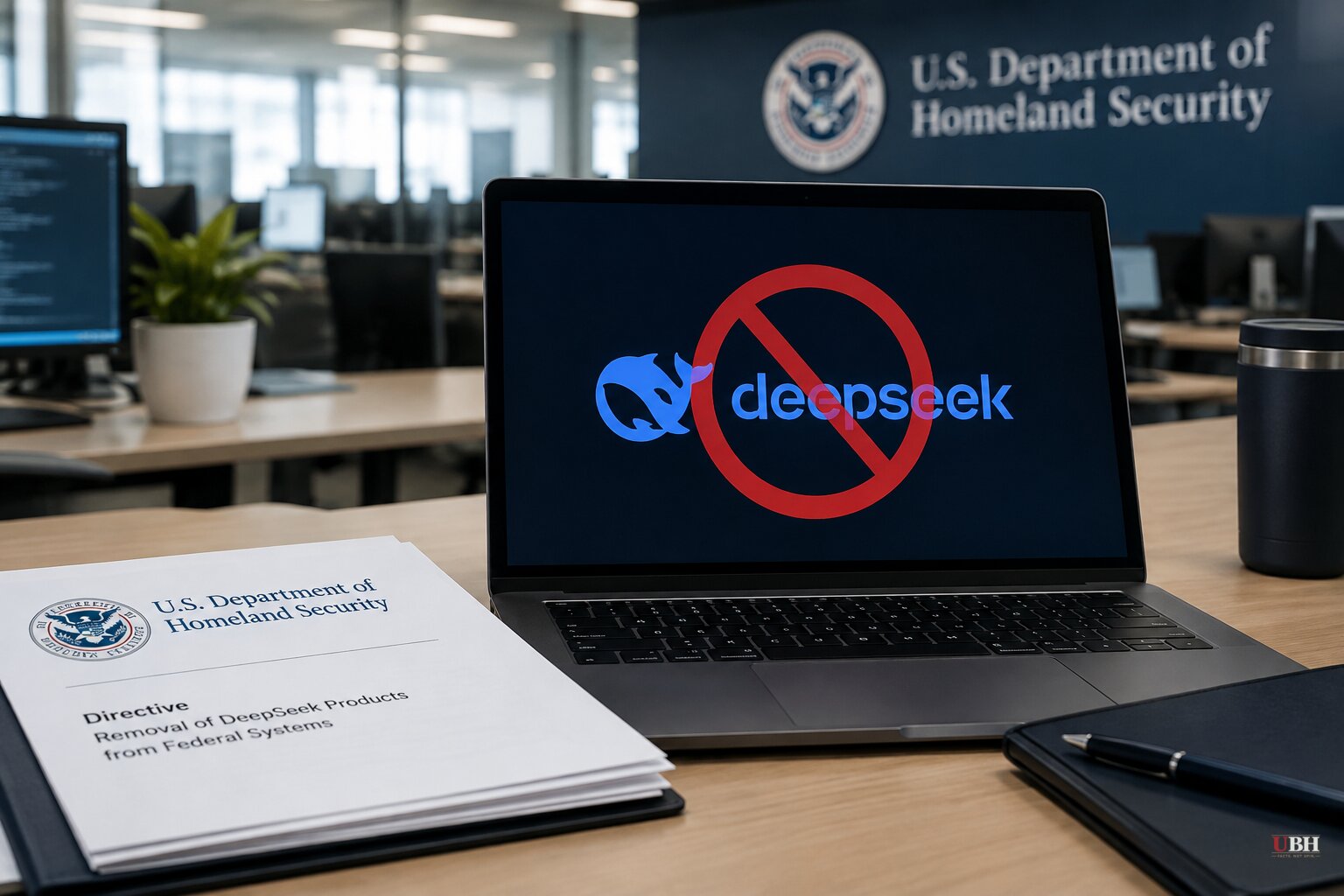
The Department of Homeland Security has ordered every civilian federal agency to remove DeepSeek products from its IT systems and stop buying them.
The notice was filed Monday, Oct. 19, and is scheduled for publication in the Federal Register on Tuesday, Oct. 20. It sits under docket number DHS-2026-0628.
What the order covers
The Homeland Security Secretary issued the order under the Federal Acquisition Supply Chain Security Act of 2018. DHS said it acted after reviewing a recommendation and related evidence from the Federal Acquisition Security Council.
The exclusion reaches IT products and services from Hangzhou DeepSeek Artificial Intelligence Co., Ltd, plus affiliated entities as defined in federal acquisition rules. It also bars DeepSeek from federal procurements.
The removal requirement is not limited to DeepSeek's own apps. It extends to third-party products and services developed using DeepSeek implementations. Any vendor that built a tool on DeepSeek's models and sells to a civilian agency is now caught by the order.
Questions go to the FASCSA Order Implementation Team in the Cybersecurity and Infrastructure Security Agency's Cybersecurity Division.
The stated threats
DHS said DeepSeek's models pose "multiple threat vectors." The department said use of the product "may result in the transfer of sensitive data to the PRC if used by US government employees or vendors."
It added that use by government agencies "could produce actionable intelligence on US persons and/or government agencies. The models themselves may contain malware or other security vulnerabilities."
DHS has not publicly released evidence of an actual breach or data transfer in these filings. The language describes risks, not an incident.
Bloomberg reported that the order also says DeepSeek collects a large amount of user data that could be passed to Beijing under Chinese security laws. Bloomberg also reported that the order is dated July 24 and signed by Homeland Security Secretary Markwayne Mullin. If that date is right, the order sat for nearly three months before the notice was filed. DHS has not explained the timing in the material made public.
Separately, a July DHS memo made public Monday told federal agencies to monitor traffic flowing in and out of government websites to address potential risks from DeepSeek.
A patchwork becomes a rule
This is not the first government move against DeepSeek. The Commerce Department and the Navy already banned it on government devices. Bloomberg reported that a Pentagon IT agency blocked its chatbot in January 2025. New York, Tennessee and Virginia have taken similar steps.
Washington has watched the company closely since its R1 model rattled global markets in early 2025. In April 2025, the House Select Committee on China called DeepSeek's links to Beijing's government "significant."
OpenAI told U.S. lawmakers in February that DeepSeek used distillation, training one model on another model's outputs, to build R1, according to Bloomberg. In a September report, Anthropic accused DeepSeek and four other China-based labs of illicit distillation without permission. Anthropic said it logged more than 12 million exchanges tied to DeepSeek's distillation activity over two weeks in July 2026. Those are allegations from the two U.S. companies. DeepSeek has not commented on them in the coverage of this order.
Bloomberg also reported that DeepSeek's lower-cost, open-weight models are putting competitive pressure on Silicon Valley developers.
What the order does not do
The scope is narrow. It applies to civilian agencies. It does not impose export controls or add DeepSeek to the Commerce Department's Entity List.
The Next Web reported that in June the White House held off on blacklisting DeepSeek and more than 100 other Chinese firms, even after a panel of officials cleared them for a U.S. trade blacklist. The White House has not publicly explained that decision in the material available for this story. The DHS order is a procurement and network-security action, a lighter tool than a trade blacklist.
The Chinese Embassy in Washington did not immediately comment. DeepSeek did not respond to requests for comment.
Part of a broader squeeze
The Trump administration has pressed a series of actions against Chinese technology firms. In December, the FCC banned imports of all new models of Chinese drones and Chinese-made consumer routers. In July, the FCC voted to bar sales in the U.S. of devices containing key hardware from Chinese companies deemed national security risks. It has also proposed barring U.S. carriers from interconnecting with Chinese telecom firms deemed national security risks.
The next vote is Oct. 29. The FCC is scheduled to decide whether to bar all Chinese labs from testing electronics such as smartphones, cameras and computers for the U.S. market. In 2025, 82% of U.S. electronics were tested in China.
Enforcement is what remains unsettled. Federal agencies must scrub DeepSeek from their own systems, and also from vendor products that use its models. How CISA's implementation team handles contractors that embedded DeepSeek technology, and how quickly, will show whether the order changes anything beyond the agencies that had already blocked it.
Sources used for this briefing
7 links from 6 independent newsrooms (syndicated copies of the same report count once)
These are the sources it draws on, linked so you can verify.


