
Unbiased headlines. Facts, not spin.
Every story is an unbiased news briefing written from 110+ sources across the spectrum — sources linked so you can verify it yourself.
 politics
Major Story (7/10)
August 14, 2026 at 04:31 PM
politics
Major Story (7/10)
August 14, 2026 at 04:31 PM
Syria's al-Sharaa Says He Won't Help Disarm Hezbollah, Floats Security Deal With Israel
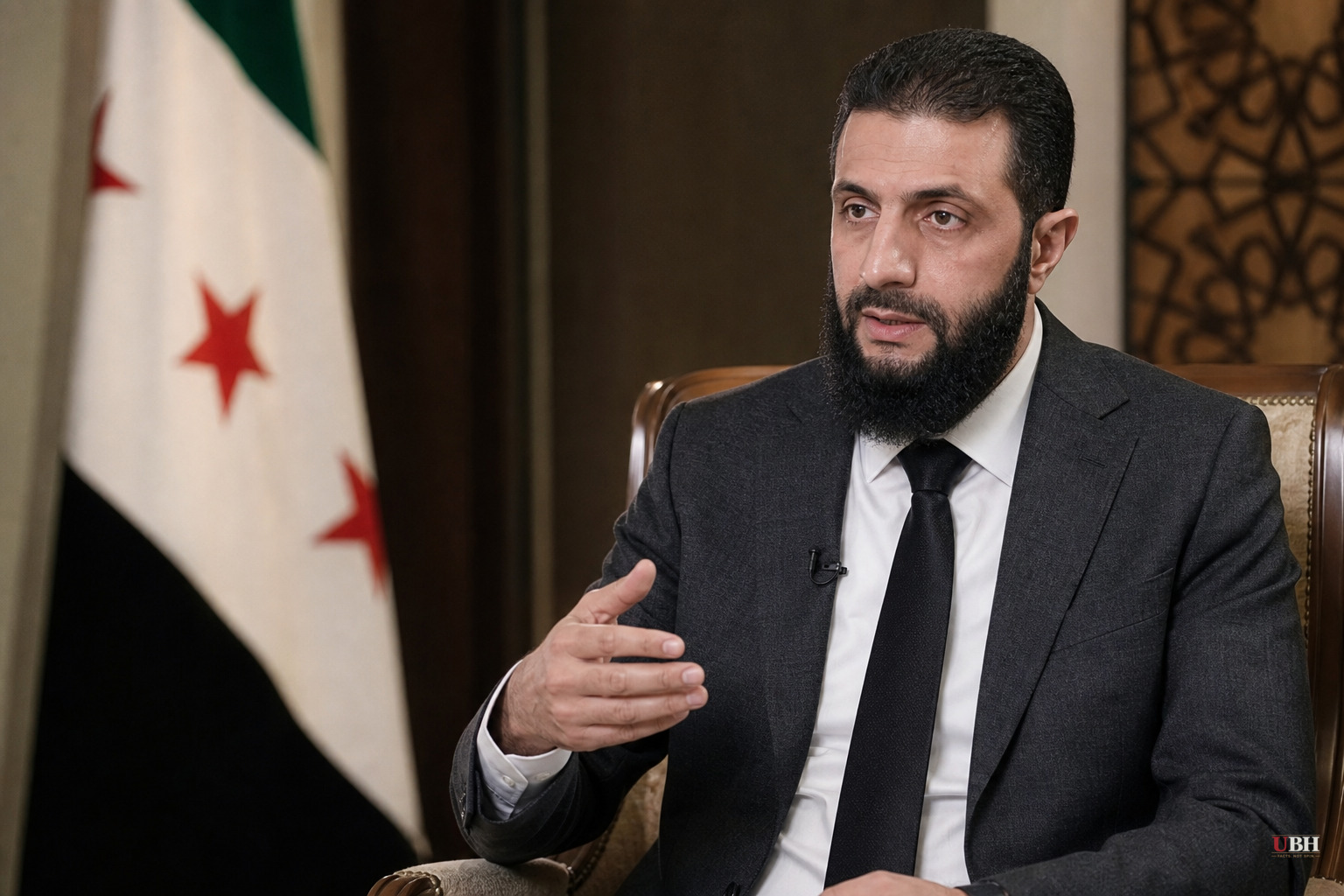
Ahmed al-Sharaa sat down with Al Jazeera's Ali Al Dafiri for an extended interview, the network's first long-form sit-down with the Syrian president since he took power. His answers on Israel, Hezbollah, and Syria's Kurds are the most detailed public account yet of where his government stands roughly a year and a half into rule.
Al-Sharaa told Al Jazeera he's exploring a potential security agreement with Israel. He also said he'll stay out of any military action in Lebanon and won't involve his government in disarming Hezbollah, drawing a hard line between Syria's own security arrangements and Lebanon's separate, combustible fight over the armed group's weapons.
Hezbollah has used Syrian territory for decades as a supply route from Iran. A Syrian government that stays neutral, or actively distances itself, on the disarmament question represents a break from the Assad era, when Damascus and Tehran-backed Hezbollah operated as allies. It's also a signal to Israel and Washington that al-Sharaa wants to be seen as separating Syria from Iran's regional network, without personally picking a fight inside Lebanon.
Who is Ahmed al-Sharaa
Al-Sharaa is the former Abu Mohammed al-Julani, the leader of Hayat Tahrir al-Sham, the group that led the armed offensive that toppled Bashar al-Assad in December 2024, ending 53 years of Assad family rule. Al-Sharaa's HTS has roots in al-Qaeda's Syrian branch, a history he has spent the past year and a half trying to move past through diplomacy and rebranding.
Assad fled to Russia. Al-Sharaa took the presidency and moved fast to reopen doors that had been slammed shut on Damascus for over a decade under Western sanctions and international isolation.
The diplomatic reset
Since taking power, al-Sharaa's government has worked to re-establish ties with regional and global powers that had cut off the Assad regime. Al Jazeera's interview frames this as central to his pitch: that Syria's economy and society stagnated for years under sanctions and isolation, and reconnecting with the world is the precondition for any real recovery.
Syria's economy is in ruins after 13-plus years of civil war layered on top of sanctions regimes from the U.S., EU, and others aimed at the Assad government specifically. Whether those sanctions structures get formally lifted, adjusted, or left in place for the new government is still being worked out capital by capital, and al-Sharaa's diplomatic outreach is clearly aimed at accelerating that process.
The Kurdish question
Al-Sharaa also touted what Al Jazeera describes as a resolution to Syria's long-running conflict with its Kurdish community. Syria's Kurds, concentrated in the northeast and organized under the Syrian Democratic Forces, fought a parallel war against ISIS with U.S. backing while also resisting both Assad and, at times, Turkish-backed factions. Any durable deal there would be a genuinely significant development, given how many past ceasefires and integration promises in that region have collapsed.
Al Jazeera's interview does not detail the specific terms of that arrangement, what power-sharing or autonomy the Kurds actually secured, or whether the SDF's own armed forces are being folded into a national army versus staying separate. The details will determine if this is a real settlement or a temporary truce, and they're worth watching for in follow-up reporting.
The democracy claim, unproven
Al-Sharaa describes his long-term goal as a "gradual" restoration of democracy in Syria and casts himself as building "a modern Arab democracy." Those are his words, delivered to a friendly camera, from a man who took power through an armed offensive rather than an election and who has run a transitional government with himself at the top since January 2025.
Post-revolutionary transitional leaders across the region, from Egypt's post-Mubarak transition to Libya after Gaddafi, have made similar democratic promises that stalled or reversed once power consolidated. Al-Sharaa's own record is as an armed Islamist faction leader, not a democratic organizer, and HTS has been criticized by human rights groups for its conduct governing Idlib province before the fall of Assad. None of that proves he's lying about his intentions. It does mean "gradual democracy" from a man who just seized the state by force is a claim that needs actual elections, an actual constitution, and actual power transfer to verify, not just an interview.
Al Jazeera's own framing leans heavily on al-Sharaa's stated vision without pressing hard on that gap between rhetoric and record, or asking what specific benchmarks, timeline, or international monitoring would back up the democracy claim. The interview is worth watching for the substance on Israel, Hezbollah, and the Kurds. It's less useful as evidence that Syria is actually becoming a democracy rather than being told it will, eventually, by the man currently running it unchecked.
No election has been scheduled. No constitution has been finalized. Those are the next concrete milestones to watch, not the interview itself.
Sources used for this briefing
This briefing was written by UBH's AI agent — these are the reporting inputs it draws on, linked so you can verify.


