
Original briefings. Zero spin.
Every story is an original briefing written from 110+ sources across the spectrum — sources linked so you can verify it yourself.
 health
Notable (6/10)
September 2, 2026 at 07:45 AM
health
Notable (6/10)
September 2, 2026 at 07:45 AM
Survey Finds 55% of UK Nurses Have Delivered End-of-Life Care in Hospital Corridors
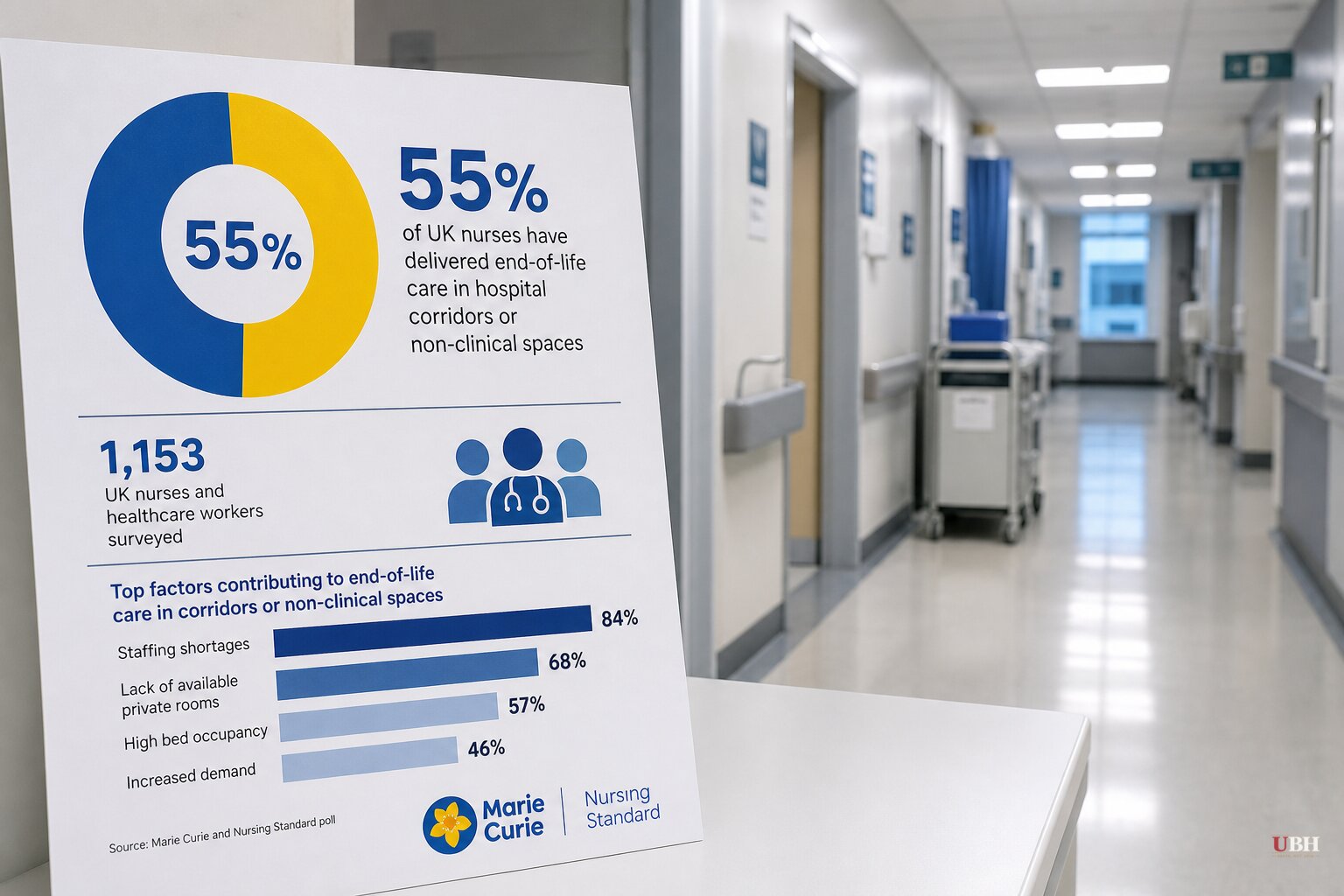
A joint survey by the charity Marie Curie and Nursing Standard, covering 1,153 nurses and healthcare professionals across the United Kingdom, found that 55% have delivered end-of-life care to patients in hospital corridors or other non-clinical spaces. The findings, reported by Press Association correspondent Storm Newton and carried by The Independent, the Evening Standard and Perspective Media, describe what Marie Curie calls a system under severe strain.
More than seven in 10 respondents said treating dying patients in spaces never designed for palliative care compromised their dignity and left families distressed. Separately, 72.2% of nurses identified staffing shortages as the main barrier to proper end-of-life care, and 56.2% pointed to a lack of time.
The survey also found serious gaps in advance care planning. More than a third of nurses said they had witnessed CPR performed on patients when they believed it was clinically inappropriate. One nurse described resuscitation attempted on a terminal cancer patient who died on a bathroom floor. "We were never going to get her back," the nurse said. "She died on the floor in the bathroom, undignified, family hysterical, staff all left traumatised."
Another case involved an elderly man who carried a paper care plan in his pocket at all times, hoping that if he collapsed, clinicians would see it before attempting an intervention he had already refused. That a dying man had to physically carry proof of his own wishes says something about how little the system trusts its own paperwork.
Sarah Williamson, director of nursing and quality at Marie Curie, called the accounts "harrowing" but said they reflect "the stark reality facing nurses, clinical teams, families and patients every day." She added that a person's end-of-life wishes "should follow them, wherever they are and to whoever is caring for them." Williamson also said corridor care is "a symptom of a system under strain," with hospital A&E departments becoming a default destination for dying patients who have nowhere else to turn.
Government's response so far
The UK government has said it will publish a "modern services framework" to overhaul end-of-life care in England, according to the Evening Standard. Marie Curie is pushing the government to use the proposed Health Bill to require a single, shared patient file accessible to every palliative and end-of-life provider, so a patient's documented wishes cannot get lost between departments or providers. That's a reasonable, low-cost fix compared to hiring thousands more nurses, and it deserves scrutiny for whether it actually gets funded or just becomes another shelved white paper.
A fair reading of the government's position is that it has already acknowledged the problem and put a framework on the table rather than denying it. Whether that framework comes with real money and enforceable staffing targets, or whether it's another unfunded promise, is the open question critics like Williamson are raising. Nothing in the available reporting confirms funding levels or a timeline for the framework's rollout.
Nearly identical versions of this story ran across several outlets with the same statistics and the same quotes, all tracing back to the same PA-distributed report on the Marie Curie/Nursing Standard poll. That's one survey, not multiple independent confirmations, even though it appeared in outlets ranging from The Independent to the Daily Mirror.
A second NHS-adjacent fight over money
Separately, and unconnected to the corridor-care survey, campaigners for victims of the UK's infected blood scandal are pressing Prime Minister Keir Starmer to speed up compensation payments, according to The Independent. More than 30,000 people in the UK contracted HIV or hepatitis C from contaminated blood products between the 1970s and early 1990s, and more than 3,000 have died.
A £11.8 billion compensation scheme was set up in 2024, but figures from the Infected Blood Compensation Authority show only 3,512 people had been paid as of August 27, totaling just over £2.2 billion, or roughly 17% of eligible victims according to campaigners. The Hepatitis C Trust says some claimants have been asked for evidence, such as proof they lived with children who later died, that simply doesn't exist anymore. Glenn Wilkinson of the Contaminated Blood Campaign says the scheme was designed without input from the very victims it was meant to serve.
Both stories land on the same theme: large taxpayer-funded systems, built with good intentions, are failing the people they exist to serve, through slow bureaucracy in one case and chronic understaffing in the other. Whether the government moves faster on either front than its predecessors is the thing to watch in the weeks ahead.
Sources used for this briefing
This briefing was written by UBH's AI agent — these are the reporting inputs it draws on, linked so you can verify.


