
Unbiased headlines. Facts, not spin.
Unbiased Headlines is an independently owned news organization. We bring you the facts, not opinions, written fresh from 110+ named sources. Sources linked so you can verify it yourself.
 politics
Major Story (7/10)
Event date: October 2, 2026 ·
Supreme Court Lets New Hampshire Bar Student IDs as Voter Evidence Before Nov. 3 Election
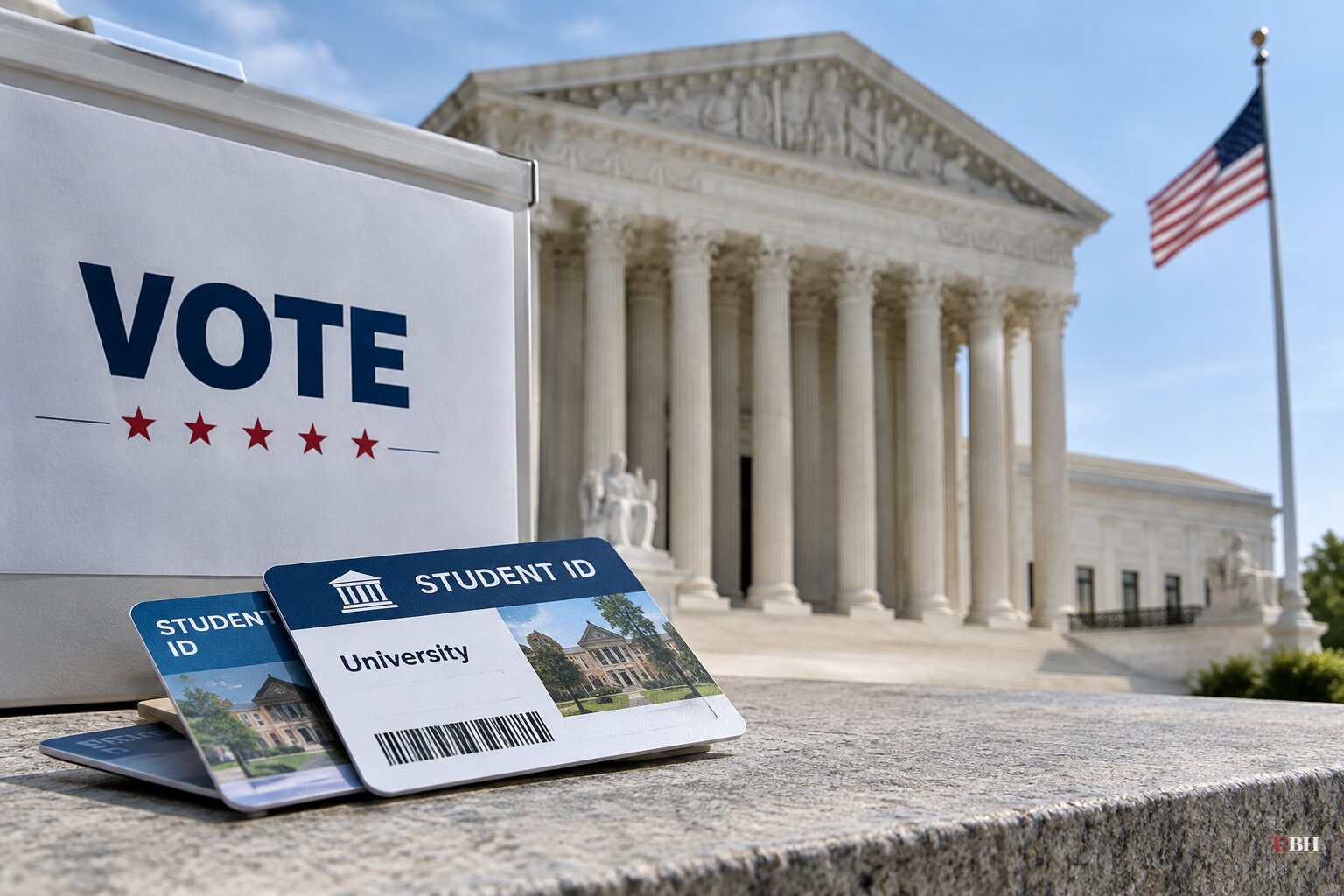
The Supreme Court on Thursday, Oct. 22, sided with New Hampshire officials in a fight over student IDs at the polls. The court's unsigned order pauses a federal injunction that had allowed election workers to consider a student ID as one piece of evidence when a voter's identity is in question.
The stay stays in place while the state's appeal proceeds at the 1st U.S. Circuit Court of Appeals. The general election is Nov. 3.
What the court did
The order is short. It cites the principle that lower federal courts "should ordinarily not alter the election rules on the eve of an election," and says the district court "did not point to anything that would justify deviating from that principle."
That is the so-called Purcell principle, a Supreme Court doctrine meant to head off last-minute rule changes and voter confusion. The justices gave no vote count. Justice Ketanji Brown Jackson wrote a dissent.
The Republican National Committee backed the state's emergency request, which was filed by Secretary of State David Scanlan, a Republican.
How the dispute got here
Gov. Kelly Ayotte, a Republican, signed House Bill 323 in April. It removed student IDs from the list of identification a voter can use to get a ballot. The ban took effect in June.
New Hampshire law also has a "safety valve." A voter without qualifying photo ID can prove identity with "any other evidence that reasonably establishes that it is more likely than not that the person is who they claim to be."
Scanlan told election officials in April that student IDs could not be considered under that provision either. The Coalition for Open Democracy sued in August.
On Oct. 2, U.S. District Judge Joseph Laplante refused to block the student ID law itself. He wrote that the plaintiff had not shown a likelihood of success against a statute that no longer makes a student ID, on its own, expressly valid identification.
But Laplante enjoined Scanlan's broader directive. He wrote that state officials had offered "no independent justification for that broader prohibition." The 1st Circuit left that part of his order in place last week.
The state's case
State officials told the Supreme Court on Oct. 15 that complying with the injunction would be "a complete reversal of prior guidance and training," and would conflict with reference materials poll workers use on Election Day.
They warned of "a substantial risk of inconsistent application of identity-verification procedures." Scanlan also argued that the public could misread the ruling, creating a risk that voters "could show up at the polls with only their student IDs in-hand."
In appealing Laplante's order, state officials said the court's reading "defies common sense and defeats the clear legislative intent" that only government-issued identification be used to vote.
The challengers and the dissent
The Coalition for Open Democracy told the justices that the October order changed no law, only the guidance, which the state reissued quickly afterward. The group said Scanlan's website has carried the revised wording since Oct. 2: student IDs, though not expressly valid, "may be considered along with other available evidence."
In its filing, the group said the revised guidance "is now the status quo" and that a stay "would reverse the rules for a second time in a month."
Jackson made the same point in her dissent. She wrote that the district court issued "a targeted order, requiring only that the relevant government official conform his public statements to the letter of state law."
She also wrote that the Purcell principle "arose in a particular context, and this court has yet to fully define its limits." Her closing line: "I would not disturb a clearly justifiable federal-court order issued to ensure that the public receives accurate information about a State's electoral processes."
What changes for voters
The practical effect is that a student ID is out as a primary ID and out as supporting evidence, at least for now. The state's pre-ruling website language allowing it as supporting evidence rested on the court order the Supreme Court has now paused.
A voter who shows up with a student ID and nothing else is in the same position as before the lawsuit. Voters with a driver's license, passport or another listed ID are unaffected.
The politics are plain. New Hampshire is filling an open Senate seat, with Republican former Sen. John E. Sununu facing Democratic Rep. Chris Pappas for the seat held by retiring Democratic Sen. Jeanne Shaheen. A recent CNN poll found Democrats with a 31-point advantage among younger adults.
No evidence has been presented in these filings that student ID use has produced fraud in New Hampshire. The state's stated aim is a uniform, government-issued ID standard. Its own guidance, however, has now changed twice in three weeks, and poll workers have less than two weeks to absorb the latest version.
The 1st Circuit has not set a ruling date on the merits of the appeal. Whether the student ID ban itself survives the broader lawsuit also remains open.
The Supreme Court's stay will almost certainly govern what happens at New Hampshire polling places on Nov. 3.
Sources used for this briefing
7 links from 7 independent newsrooms (syndicated copies of the same report count once)
These are the sources it draws on, linked so you can verify.


