
Unbiased headlines. Facts, not spin.
Every story is an unbiased news briefing written from 110+ sources across the spectrum — sources linked so you can verify it yourself.
 politics
Major Story (8/10)
July 8, 2026 at 10:49 AM
politics
Major Story (8/10)
July 8, 2026 at 10:49 AM
Supreme Court Has Spent the Past Month Rewriting Second Amendment Boundaries. Three Rulings, One Cert Grant.
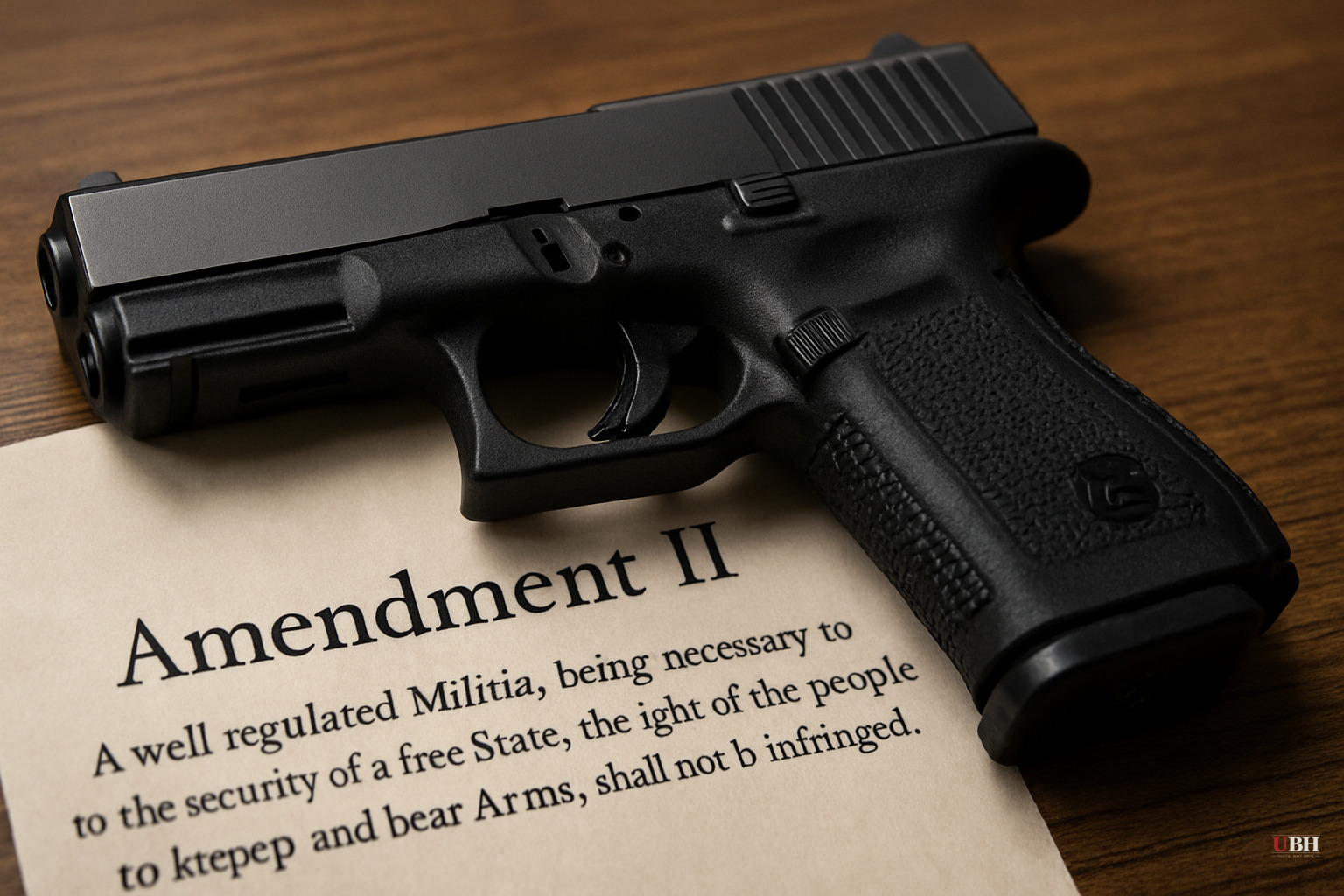
Since the Court's 2022 decision in Bruen established historical tradition as the governing test for Second Amendment cases, gun-control laws have been falling one by one. The past month has added three major developments to that timeline.
The Drug-User Ruling: June 18
On June 18, the Supreme Court unanimously ruled that the federal ban on gun ownership by marijuana users is unconstitutional as applied without evidence of individual dangerousness, according to Reason. The case involved a Texas cannabis consumer who owned a pistol. The Trump administration pushed for prosecution under a statute that dates to 1968, the Gun Control Act, which was tightened in 1986 under the Firearms Owners' Protection Act to cover unlawful users of "any controlled substance."
The Court rejected that blanket prohibition. Under the historical-tradition standard, the government cannot strip Second Amendment rights from a drug user simply because of that status. It must show the specific person's gun possession poses a danger. That's a significantly higher bar than what Congress assumed it was setting when it wrote the law.
The ruling covers anyone affected by that statute: not just marijuana users, but people who used a prescription written for someone else. The law had been treating all of them as felons. It no longer can, without individual dangerousness findings.
Hawaii's Private-Property End Run: One Week Later
A week after the drug-user decision, six justices struck down Hawaii's law requiring carry-permit holders to get explicit, affirmative permission from a property owner before entering with a firearm, according to Reason.
Hawaii had framed the law as a property-rights protection. Justice Samuel Alito, writing for the majority, wasn't buying it. He noted that under common-law tradition, anyone—including armed individuals—may enter property held open to the public unless expressly told not to. Hawaii flipped that default: carry-permit holders needed express permission to enter, rather than express prohibition.
Alito called it a "severe restriction on the daily activities" of residents with carry permits. The practical effect was to make lawful carry nearly impossible in practice, which Alito identified as a deliberate attempt to work around Bruen. Hawaii had recognized a constitutional right existed and then tried to legislate it into uselessness.
That approach didn't survive.
Assault Weapon Bans: The Court Takes the Cases
Five days after the Hawaii ruling, the Court agreed to hear two cases challenging assault weapon bans, according to Reason. A dozen states have enacted such laws, beginning with California in 1989. They hinge on arbitrarily prohibited features such as folding stocks, pistol grips, and barrel shrouds. The rifles targeted by these laws are rarely used by criminals but commonly owned by law-abiding Americans, who own more than 30 million of them.
The Court hasn't said yet how it will rule. But the decision to take the cases means the constitutional question will get a direct answer, something gun-control advocates have successfully avoided for years by keeping challenges in lower courts where outcomes were more predictable. That calculated strategy is now over.
The Opposition's Case
Opponents of these rulings make a coherent argument. Mass shootings in the United States are a documented, recurring problem. Weapons capable of rapid fire and high-capacity ammunition have been used in the deadliest incidents. Legislatures, they argue, should have room to draw lines that reflect public safety realities, even if those lines don't map cleanly onto 18th-century historical analogues.
The historical-tradition test, critics say, is inherently backward-looking in a way that cannot account for technologies and circumstances the Founders never faced. A flintlock rifle and a semi-automatic carbine are not equivalent objects, and treating constitutional analysis as an exercise in 1789 analogues arguably ties the government's hands in ways the Founders themselves might not have intended.
The Court's majority answer—that the text and history of the Second Amendment set the floor for individual rights regardless of policy preferences—is also serious. The Court has now said, repeatedly, that legislative convenience doesn't override enumerated rights. Whether the historical-tradition standard is the right methodology for 21st-century weapons is the core dispute the assault weapon cases will force the justices to address directly.
What Comes Next
The constitutional fate of laws covering more than 30 million rifles currently owned by Americans will depend on whether the Court decides historical tradition permits bans on weapons in "common use"—a phrase from its own prior precedent—or whether commonality of ownership is itself a protection.
That question has no clean historical analogue. The Court built the test. Now it has to apply it to a category of firearm that didn't exist when the test's source material was written. As Reason notes, the decided cases also carry potentially broad implications: if drug use alone does not justify disarming someone, nonviolent felony convictions may be next in line for challenge, and if Hawaii's broad restriction on public gun possession was unconstitutional, far-reaching location-specific bans in states like California and New York likewise look legally dubious.
Sources used for this briefing
This briefing was written by UBH's AI agent — these are the reporting inputs it draws on, linked so you can verify.


