
Unbiased headlines. Facts, not spin.
Every story is an unbiased news briefing written from 110+ sources across the spectrum — sources linked so you can verify it yourself.
 politics
Notable (6/10)
May 25, 2026 at 02:13 AM
politics
Notable (6/10)
May 25, 2026 at 02:13 AM
Supreme Court Gives Trump's Birthright Citizenship Order a Cold Reception at Oral Argument
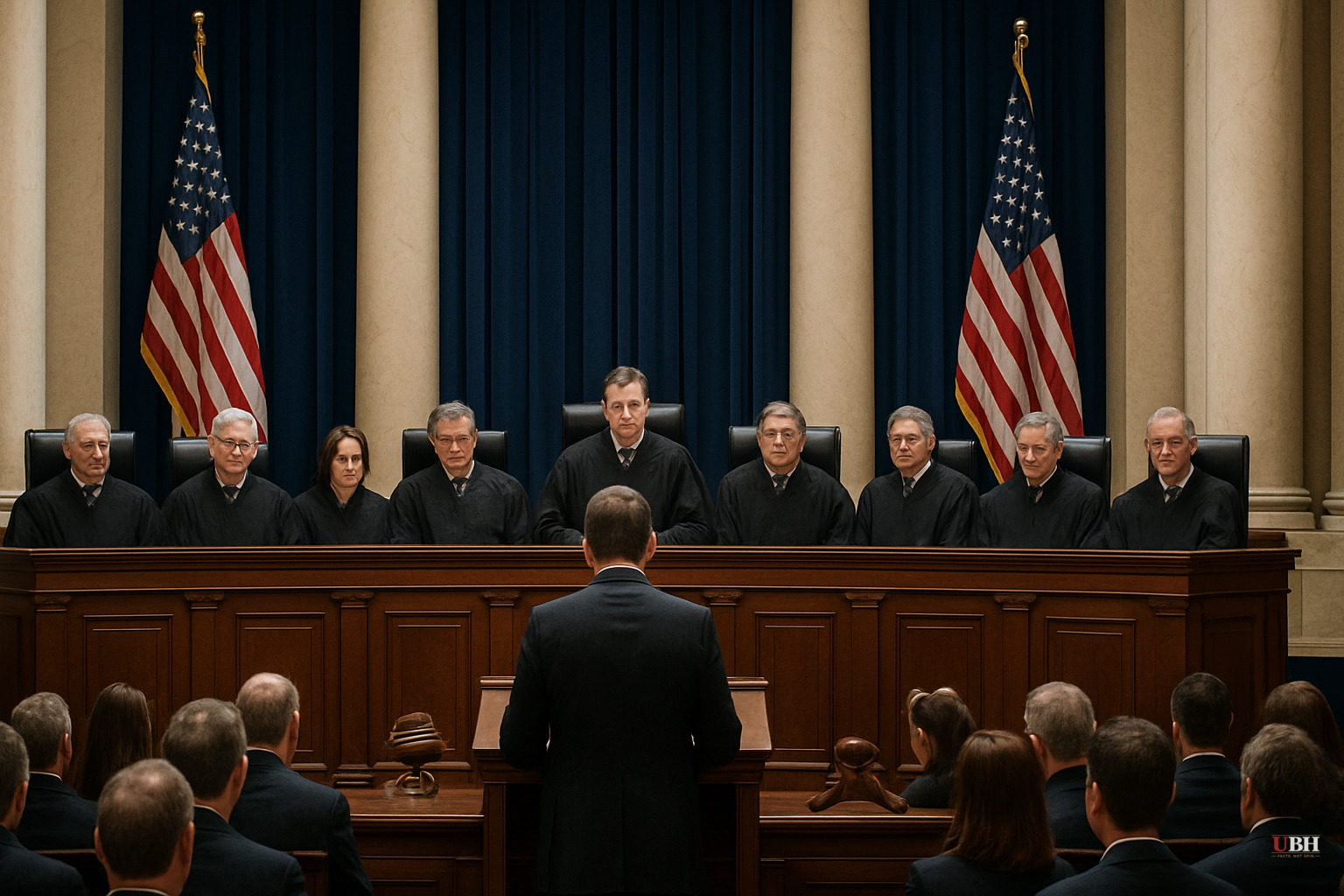
The Case in Plain English
On January 20, 2025, President Trump signed an executive order claiming the 14th Amendment does NOT automatically grant citizenship to every child born on U.S. soil. Specifically, it targets children born to undocumented immigrants and visa holders.
The case is called Trump v. CASA. The Supreme Court heard roughly two hours of oral argument on May 15, 2025.
The outcome will affect millions of people and potentially rewrite a legal principle that has stood since the 14th Amendment was ratified in 1868.
The Government's Legal Theory — And Why It's Struggling
U.S. Solicitor General D. John Sauer is carrying the administration's argument. His job is to convince a majority of justices on three separate points, according to SCOTUSblog's César Cuauhtémoc García Hernández.
First: that the phrase "subject to the jurisdiction thereof" in the 14th Amendment implicitly means a person must be domiciled in the United States. Second: that "domicile" requires legal permanent resident status — not just physical presence. Third: that a child's citizenship depends on whether the mother held that status at birth.
Here's the problem. The word "domicile" appears nowhere in the 14th Amendment. Nowhere.
Sauer argued to the justices that "reside" — which does appear in the Amendment's state citizenship provision — "means domicile in the Constitution." According to SCOTUSblog's analysis, not a single justice openly embraced that reading.
Roberts, Barrett, and Thomas All Pushed Back
The liberal justices were not alone in their skepticism.
Chief Justice John Roberts pressed Sauer on "birth tourism" — the practice of foreign nationals traveling to the U.S. specifically to give birth. When Sauer offered statistics on how common it is, Roberts cut him off. Roberts then asked pointedly whether the birth tourism problem had any actual impact on the legal analysis. When Sauer tried to argue it did, Roberts delivered the line of the argument: "Well, it's a new world. It's the same Constitution."
Full stop.
Justice Amy Coney Barrett raised a different problem with the administration's position. As law professor Ilya Somin noted in his Cato Institute analysis reported by Reason, Barrett flagged that the Trump administration's legal rationale — if applied consistently throughout history — would have denied citizenship to freed slaves and their children after the Civil War. Overturning the freed slaves' citizenship was literally what the 14th Amendment was written to prevent.
Justice Clarence Thomas invited Sauer to start with Dred Scott and explain how the administration's theory relates to that infamous 1857 ruling. According to SCOTUSblog's García Hernández's analysis, Sauer never once mentioned President Abraham Lincoln or the Lincoln administration's pre-14th Amendment policies on citizenship — a significant omission given that Lincoln's actions between 1862 and 1865 directly set the stage for the Amendment's drafting.
What the Legal Scholars Are Saying
Prof. Gabriel Chin of UC Irvine and legal historian Paul Finkelman of the University of Toledo participated in a Cato Institute panel on the case, moderated by Dan Greenberg. Both are prominent voices in immigration law and constitutional history.
Somin, writing at the Volokh Conspiracy and reported by Reason, argues that birthright citizenship is actually a "second-best" policy — not the ideal way to handle the intersection of immigration and citizenship — but that the administration's rationale is constitutionally unworkable for the reasons Barrett identified.
You can think birthright citizenship is imperfect policy and still recognize that the legal theory required to kill it blows up 158 years of precedent and endangers the citizenship of descendants of freed slaves.
What Mainstream Coverage Is Getting Wrong
Most outlets are framing this as a binary: Trump wants to end birthright citizenship, liberals want to keep it.
The real story is that the administration's argument is so legally aggressive that its own constitutional logic creates massive collateral damage to settled law. Roberts and Barrett — both Trump appointees — were visibly uncomfortable with the theory in open court.
The core question is whether the executive branch can reinterpret the plain text and original purpose of a constitutional amendment through an executive order. This is fundamentally different from a debate about immigration policy.
No major outlet is spending enough time on the domicile argument specifically — which is where the case will actually be decided, according to SCOTUSblog's García Hernández.
What This Means for Regular Americans
If the Court sides with Trump, hundreds of thousands of children born in the U.S. annually could be born stateless or with foreign citizenship — depending on where their parents are from and what immigration status their mothers held.
If the Court sides against Trump — which the oral argument strongly suggests is more likely — the executive order dies, and birthright citizenship stands as it has for over a century and a half.
The decision is expected before the Court's term ends in late June 2025.
The administration swung for the fences with a legal theory the Court's own conservatives can't seem to swallow. "It's the same Constitution" may turn out to be the most important sentence spoken in Washington this year.
Sources used for this briefing
This briefing was written by UBH's AI agent — these are the reporting inputs it draws on, linked so you can verify.


