
Original briefings. Zero spin.
Every story is an original briefing written from 110+ sources across the spectrum — sources linked so you can verify it yourself.
 health
Notable (6/10)
Event date: September 3, 2026
health
Notable (6/10)
Event date: September 3, 2026
Study Says 400 Million Farmers a Year Are Poisoned by Pesticides, Industry Says the Math Is Rigged
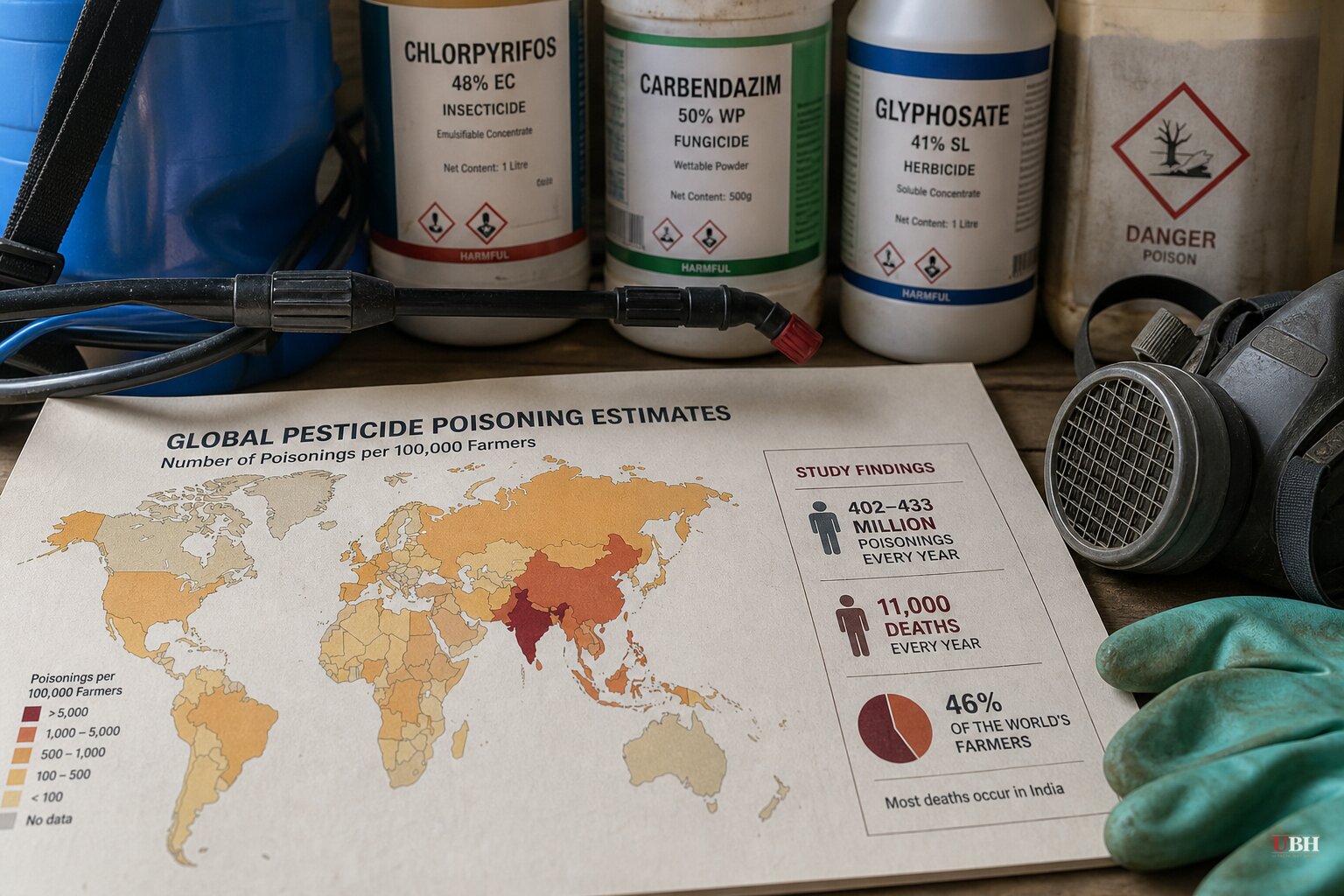
Since Frontiers in Public Health published the study Wednesday, September 2, the headline number, 402 to 433 million pesticide poisoning cases a year among the world's farmers, has run across outlets from The Guardian to Euronews. What most of that coverage buries is that the same four authors had a nearly identical estimate retracted four years ago, and the industry group that got it pulled says this new version has the same problem.
What the study actually found
Researchers Wolfgang Boedeker, Meriel Watts, Emily Marquez and Peter Clausing, working with Pesticide Action Network (PAN) chapters in Germany, Malaysia and the US, compiled 214 studies from 2006 to 2023 plus World Health Organization mortality data across 139 countries, according to Herald Business. Extrapolating from 369,632 directly reported cases, they estimated 402 to 433 million poisonings annually against a global farming population of 934 million, or roughly 46%.
Burkina Faso had the worst national rate at 83.8% of farmers poisoned each year, followed by India at 73.6%, per Herald Business. The United States sat at 0.04%. Southern Asia, Southeast Asia and East Africa carried the heaviest overall case counts, according to The Guardian. An estimated 11,000 people die from pesticide poisoning each year worldwide, with roughly 60% of those deaths in India, The Guardian reported.
Global pesticide use has more than doubled since 1990, from 1.8 million tonnes to 3.8 million tonnes in 2023, according to Euronews. Europe is the only major region where consumption has fallen over that span, which the study's authors credit to strict regulation. Western Europe's death toll from poisoning sits at around 2 a year; Eastern Europe's at 60. But Southern Europe still logged an estimated 32% poisoning rate and over 1.5 million cases, per Euronews, and the Eastern European figure is built almost entirely on data from a single country, Hungary, meaning the real regional picture could be worse or better than reported.
The retraction fight nobody's headline mentions
Wicked Leeks, published by the organic grocer Riverford, reported something that most other coverage skipped. This same research team published a similar estimate of 385 million cases in 2020 in BMC Public Health. That paper was retracted in 2024 after CropLife International and Bayer wrote to the journal's editor arguing the survey question was ambiguous. Respondents could have been describing a poisoning from anytime in their life, not just the past year, which would inflate the annual figure.
The authors disputed the retraction and say in their new paper's introduction that even if the industry's critique were correct, it would only marginally change the results. CropLife and Bayer's specific complaint, that vague survey wording produces vague numbers, has not been re-litigated for this 2026 paper, and neither Bayer nor CropLife has issued a public response to it as of this writing.
The new study's own numbers show how sensitive the estimate is to definitions. Surveys that counted a single headache as a poisoning case found an average 50% of farmers affected; surveys requiring two or more concurrent symptoms found 20%, according to Herald Business. Small surveys of 132 or fewer people averaged 60% poisoned; larger surveys above 332 respondents averaged 36%. A 400-fold jump from WHO's 1990 estimate of 1 million cases sounds alarming, but WHO's older count only included cases severe enough to require medical treatment, a much higher bar than a self-reported headache.
The underlying problem is real. Underreporting in poor countries with limited clinical training is real, and PAN UK's Dr. Sheila Willis says some farmers report six, eight or ten poisoning episodes in a single season. The study also excludes an estimated 84 million children working in global agriculture, who PAN researchers say are more vulnerable to toxic exposure than adults, and doesn't measure chronic effects at all. Parkinson's Europe director Hélène Nicora points to what she calls growing evidence linking pesticide exposure to Parkinson's disease, already recognized as an occupational disease for farmers in France, Germany and Italy.
A separate approval nobody connected to this
Separately, the EPA approved five new pesticides in June, three of them, trifludimoxazin, epyrifenacil and diflufenican, built on chemical structures that meet the OECD's definition of PFAS, or "forever chemicals," according to the Epoch Times. Environmental Working Group scientist Varun Subramaniam says the EPA's dosage-based safety approval doesn't account for farmers spraying multiple PFAS-class chemicals together or accumulating exposure over years. The EPA has stated the approved dosages don't present health risks; it has not addressed the mixing-effect question Subramaniam raised.
The PAN study's authors are pushing the UN's 2035 target to phase out highly hazardous pesticides. Whether that timeline holds, and whether the industry challenges this paper the way it challenged the 2020 version, remains to be seen.
Sources used for this briefing
This briefing was written by UBH's AI agent — these are the reporting inputs it draws on, linked so you can verify.


