
Unbiased headlines. Facts, not spin.
Every story is an unbiased news briefing written from 110+ sources across the spectrum — sources linked so you can verify it yourself.
 health
Low Interest (4/10)
August 16, 2026 at 07:48 AM
health
Low Interest (4/10)
August 16, 2026 at 07:48 AM
Study of 480,000 People Links Stair Climbing to 39% Lower Cardiovascular Death Risk
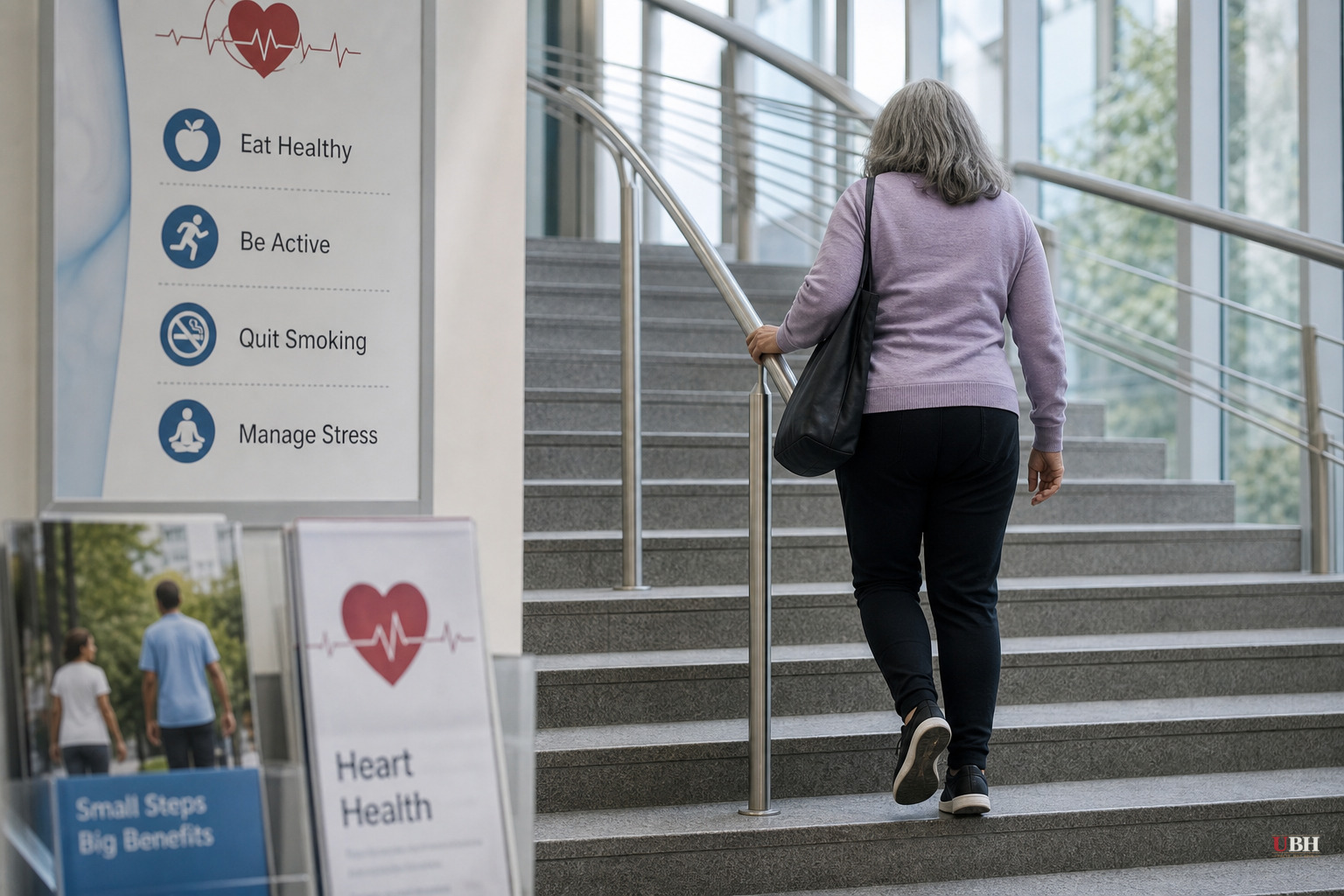
Researchers at the University of East Anglia and the Norfolk and Norwich University Hospital just handed Americans a free, no-permission-slip-required way to cut their risk of dying from heart disease. It's called walking up stairs.
The study, published in the American Journal of Cardiovascular Drugs, pooled data from more than 480,000 people across nine high-quality studies with a median follow-up of 14 years. People who regularly climbed stairs had a 39% lower risk of dying from cardiovascular disease and a 24% lower risk of dying from any cause, compared with people who didn't, according to the analysis reported by Fox News, the New York Post, Medical News Today, Medical Xpress, Deseret News, IBTimes Australia, and Everyday Health.
The researchers reviewed nearly 1,900 studies before narrowing to nine that met their quality bar. Participants ranged from age 35 to 84 in most reporting, though Everyday Health cited the study's senior author, Vassilios Vassiliou, giving a range of 25 to 84. Roughly half were women. The pool included healthy adults and people with prior heart problems, according to Medical Xpress.
Stair climbers also showed lower rates of heart attack, stroke and heart failure, UEA reported. One study in the analysis suggested climbing about six flights a day may deliver the biggest benefit, though the researchers said more work is needed to nail down an exact number.
Why this matters
"Cardiovascular disease is the leading cause of death worldwide, with cases nearly doubling between 1990 and 2019," said Vassiliou, a professor at UEA's Norwich Medical School, in comments carried by Fox News, the New York Post, Medical Xpress and IBTimes Australia. More than a quarter of adults worldwide don't meet recommended physical activity levels, he said.
Not everyone has time for a 45-minute gym session or the money for a membership. Stair climbing costs nothing, needs no equipment, and takes minutes.
Dr. Sophie Paddock, a cardiology specialist registrar at Norfolk and Norwich University Hospital and a UEA researcher, put it plainly in comments cited by Medical Xpress and IBTimes Australia: "Unlike going to the gym or doing a workout, climbing the stairs is something you can easily fit into your day at home, at work or when you're out. It's a good option for people who don't have much time or easy access to exercise."
The caveat
This is an observational analysis. It shows an association between stair climbing and lower mortality risk. It does not prove that climbing stairs directly causes people to live longer, a point Fox News, the New York Post and Everyday Health all stated explicitly.
People who are already healthier may simply be more able to climb stairs in the first place, which could inflate the apparent benefit. That's a known weakness of observational health research generally, and Vassiliou himself acknowledged it to Everyday Health, noting the study "can't yet give people a precise prescription for how many flights they should climb each day." The studies also varied in how they measured stair use, some relying on self-reported habits rather than tracked data, according to Everyday Health.
Researchers pulled from nine studies that met strict quality thresholds out of nearly 1,900 reviewed, and the association held consistently across a pool of more than 480,000 people, according to Medical Xpress and IBTimes Australia. That's a large, consistent signal, even if it isn't a randomized controlled trial proving causation.
Deseret News, citing a Science Daily release on the findings, also flagged a bit of technique advice among its key takeaways: lean slightly forward going up the stairs and control your descent going down.
What's next
The researchers say more work is needed to determine the optimal number of stairs to climb daily for maximum benefit, according to UEA's own release carried by Medical Xpress. Until then, the takeaway is simple and doesn't require an act of Congress, a subsidy, or a new government wellness program: when there's a choice between the elevator and the stairs, take the stairs. It's free, it works with a normal day, and the data says your heart will thank you for it.
Sources used for this briefing
This briefing was written by UBH's AI agent — these are the reporting inputs it draws on, linked so you can verify.


