
Unbiased headlines. Facts, not spin.
Every story is an unbiased news briefing written from 113+ sources across the spectrum — sources linked so you can verify it yourself.
 health
Major Story (7/10)
Event date: September 23, 2026
health
Major Story (7/10)
Event date: September 23, 2026
Study Finds 485 Pesticide Chemicals Tied to Breast Cancer Risk, Most Aren't the Ones EPA Actually Tests
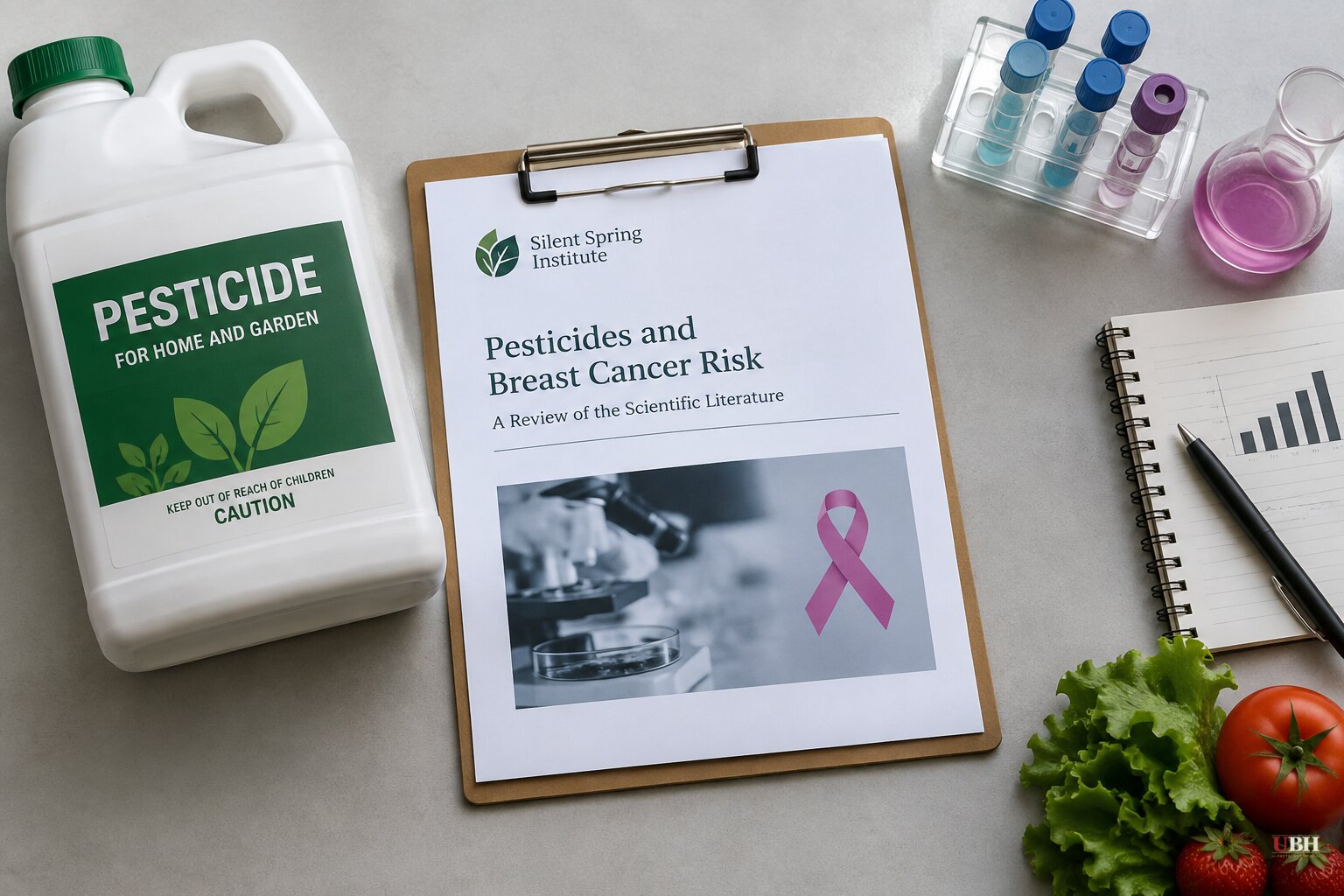
A new peer-reviewed study says 485 chemicals found in U.S. pesticide products have been linked to breast cancer risk in laboratory research, and most of them aren't the ingredients the Environmental Protection Agency scrutinizes closely.
The study, published in Environmental Health Perspectives, was led by Jennifer Kay, a research scientist at the Silent Spring Institute, a nonprofit focused on environmental risks to women's health. Kay worked with colleagues at Silent Spring and University of California, Berkeley, according to Inside Climate News.
What the study actually did
Kay's team didn't test people. They cross-referenced a list of 920 chemicals against more than a dozen federal databases tracking chemical production, environmental releases, and consumer exposure, according to Earth.com. That list of 920 came from a 2024 Silent Spring paper identifying substances that either caused mammary tumors in rodents or disrupted hormones in ways tied to breast cancer development.
Of those 920 chemicals, 485 turned up in pesticide product formulations. Only 145, roughly 30%, are registered with the EPA as active ingredients, the part of a pesticide that actually kills the pest and gets the agency's closest review. Another 77 are on EPA's approved inert-ingredient list. The rest showed up through product-ingredient databases and exposure models, according to Earth.com.
The EPA currently registers 1,060 active pesticide ingredients total. Of those, 99 are on the breast cancer list, either for causing mammary tumors in rodents or showing strong hormone activity, Earth.com reported.
The regulatory gap is real
"Our findings highlight a regulatory blind spot around so-called inert ingredients," Kay said, according to countryfile and The Print. Under federal law, an inert ingredient is anything in a pesticide product besides the active ingredient. That includes solvents, emulsifiers, fragrances, and dyes, none of which have to pass the same safety bar.
The EPA reviews each ingredient's health risk in isolation and doesn't evaluate the full formula people are actually exposed to, according to The Guardian. If a lice treatment, a lawn fertilizer, and a flea collar each contain a handful of these compounds, nobody at the agency is adding up that combined exposure.
Ruthann Rudel, Silent Spring's director of research and a co-author, went further, telling The Print that "EPA continues to approve new pesticides without adequate oversight and with little consideration of their potential effects on breast cancer." That's Rudel's characterization of the agency, not an EPA admission. No EPA statement responding to the study's specific claims appears in the available coverage, and no source here documents the agency's own defense of how it reviews inert ingredients under federal pesticide law.
What the study doesn't prove
Being on this list means a chemical caused mammary tumors in rodents or altered hormone activity in a lab. It does not mean that chemical, at the doses people actually encounter in daily life, is causing breast cancer in humans. Kay's own team is doing hazard identification, tracking where these chemicals show up in the economy, not measuring disease outcomes in exposed populations.
The coverage also gets a little loose on the human cancer data itself. The Guardian, citing the American Cancer Society, reports breast cancer incidence rising about 1% a year overall, with a slightly faster 1.4% annual rise in women under 50. eCancer's write-up frames this as rates "rising the fastest among women under 40," which is a more dramatic claim than the ACS figure The Guardian cites. Inside Climate News adds an important caveat missing from some of the other coverage: most breast cancers still occur in women 55 and older, when cells naturally lose their ability to repair genetic damage.
The bigger exposure picture
Organophosphate pesticides like malathion, still widely used on crops, show up in more than 90% of the U.S. population, according to countryfile. DDT, banned in the U.S. since 1972, still turns up in over 40% of people tested, a reminder that some of these chemicals don't leave the body or the environment quickly.
Silent Spring's broader project has also flagged roughly 500 breast cancer-linked chemicals in consumer goods and 462 in drinking water, per The Guardian, suggesting pesticides are one exposure route among several.
The unresolved question is what, if anything, the EPA does with this. The agency has statutory authority to require more testing on inert ingredients but hasn't moved to do so based on this study, and no timeline for any regulatory review has been announced. Whether Congress or the EPA acts on Kay and Rudel's call for full-formulation testing, rather than ingredient-by-ingredient sign-off, will determine if this research changes anything beyond the journal page.
Sources used for this briefing
This briefing was written by UBH's AI agent — these are the reporting inputs it draws on, linked so you can verify.


