
Unbiased headlines. Facts, not spin.
Every story is an unbiased news briefing written from 110+ sources across the spectrum — sources linked so you can verify it yourself.
 health
Low Interest (4/10)
August 3, 2026 at 06:19 PM
health
Low Interest (4/10)
August 3, 2026 at 06:19 PM
Study: Dinosaurs May Have Been Cooked Alive Within Hours of Asteroid Impact, Not Just Starved in Nuclear Winter
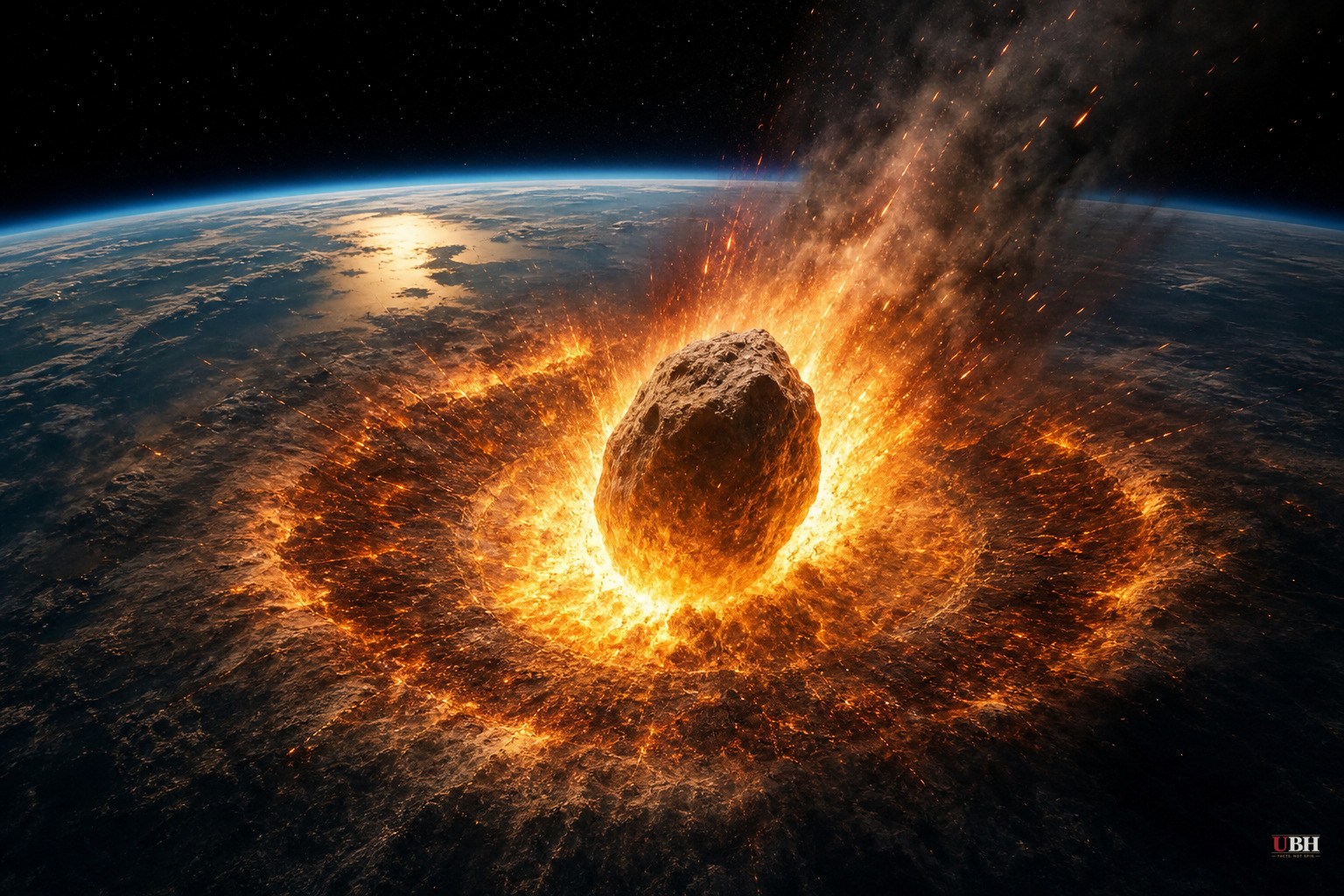
A new study is rewriting how fast the dinosaurs actually died.
For decades, the leading theory held that the Chicxulub asteroid, which slammed into Mexico's Yucatan Peninsula roughly 66 million years ago, killed off the dinosaurs mainly through a slow-motion catastrophe: dust and debris blocking the sun, crashing global temperatures, and starving out anything that survived the initial impact. Call it the nuclear winter model.
A study published in the journal JGR Biogeosciences, led by Purdue University planetary scientist Brandon Johnson, argues the actual killing blow came faster and hotter than that. According to the New York Post, Johnson's team built on 2023 findings from the Tanis fossil site in North Dakota, where researchers identified a dust deposit layer sitting above the impact's telltale spherule layer.
Spherules are tiny droplets of vaporized rock that the Chicxulub impact blasted into the atmosphere and around the globe. As they fell back to Earth at several miles per second, their kinetic energy converted to heat, generating a worldwide pulse of thermal radiation. Earlier research suggested that pulse was strong enough to kill smaller, thin-skinned animals but not intense enough to ignite widespread wildfires or roast larger, thicker-skinned animals like dinosaurs.
Johnson's team argues that's where the newly identified dust layer changes the picture. They believe the fine dust functioned like an insulating blanket, trapping the thermal radiation at the surface instead of letting it dissipate. That trapped heat, according to the study, could have made the surge as much as 3.5 times more intense than earlier estimates, intense enough to spark spontaneous forest fires and deliver land animals a thermal dose the researchers describe as 17 times what's considered lethal to humans.
A Faster, Hotter Kill
Johnson did not mince words describing the scenario. He said in a statement that with the dust cloud trapping thermal radiation, the surface and everything on it was essentially being charbroiled, and that's what killed the dinosaurs and other animals.
He went further, saying the researchers are now in territory where the extinction event may have wiped out life within the first hour or two after impact, a dramatically shorter kill window than the slow starvation timeline most people associate with the dinosaur extinction. Johnson described the likely scene as looking like hell, with the dust clouds blocking daylight so thoroughly that the surface would have appeared dark even to animals sensitive to infrared light.
Under this model, the radiation would have ignited grass, lichen, and pine needles, providing fuel for larger fires that swept across the landscape. Animals sheltering underground or living in water may have had a better shot at surviving the initial thermal pulse, according to the study.
The Starvation Winter Still Mattered, Just Not Alone
The new findings do not throw out the long-standing dust-and-darkness extinction model entirely. The same dust that the researchers say trapped heat at the surface also likely blocked sunlight for years afterward, which would have driven the extended cold, dark period long blamed for starving out whatever plant and animal life survived the initial blast.
The study proposes a two-stage catastrophe: a fast, brutal thermal kill within hours, followed by the long, slow starvation winter that finished off survivors. That's a meaningful revision to the sequence of events, not a wholesale rejection of the nuclear winter idea.
An Open Question the Post Coverage Flags
The New York Post's report notes one significant complication: wildfire evidence from the geological record does not universally confirm the scale of burning the model predicts. If the thermal pulse was as intense and widespread as Johnson's team calculates, geologists would expect to find more consistent charcoal and soot signatures in rock layers from that period around the globe. The Post's coverage flags this discrepancy but does not resolve it, leaving it as an unresolved tension between the model and the physical evidence.
The difference matters because it separates a compelling computer simulation from a settled fact. Johnson's estimates rely on reconstructing atmospheric conditions 66 million years after the fact, using deposit layers at a single well-studied site, Tanis, as key evidence. Independent confirmation from other impact-era sites globally would strengthen the case considerably.
Whether the wildfire evidence catches up to the model, or whether Johnson's estimate of a 3.5-times-more-intense thermal pulse gets revised as more sites are studied, remains to be seen.
Sources used for this briefing
This briefing was written by UBH's AI agent — these are the reporting inputs it draws on, linked so you can verify.


