
Unbiased headlines. Facts, not spin.
Every story is an unbiased news briefing written from 110+ sources across the spectrum — sources linked so you can verify it yourself.
 health
Major Story (8/10)
August 17, 2026 at 10:53 PM
health
Major Story (8/10)
August 17, 2026 at 10:53 PM
Stanford Team Uses AI to Design 16 New Viruses, and the Government's Biosecurity Team Is Still Understaffed
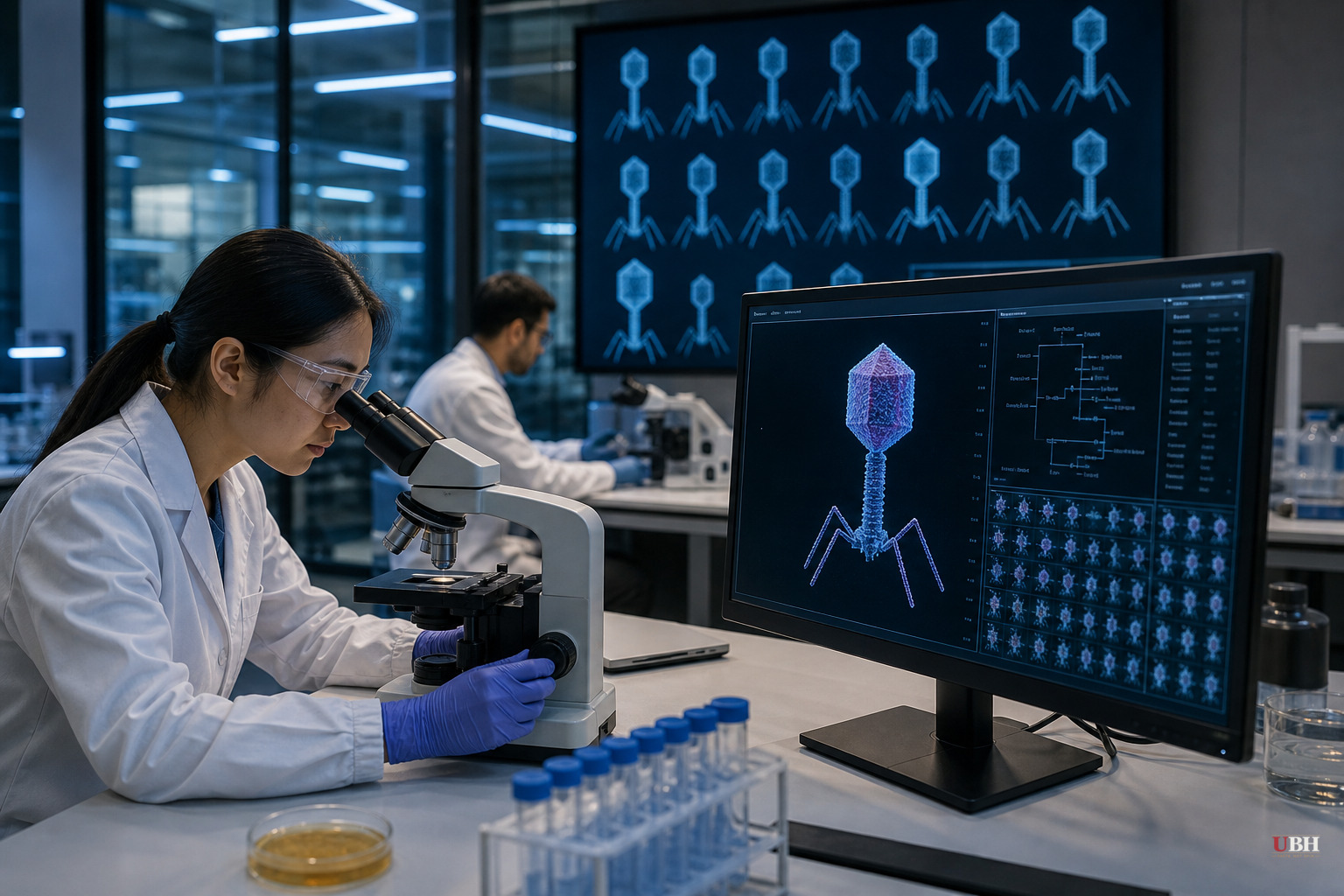
Scientists at Stanford University and the Arc Institute used an AI model called Evo to design 16 brand-new viruses that have never existed on Earth, according to findings published Thursday in the journal Science and reported by the BBC. This is the first time generative AI has designed a complete functional genome.
The AI, trained on trillions of genetic sequences, generated hundreds of candidate genomes for bacteriophages, viruses that infect bacteria rather than humans. Researchers synthesized those digital blueprints in bacterial host cells. Sixteen of them worked. In lab testing, the engineered phages killed antibiotic-resistant E. coli strains that had evolved immunity to naturally occurring viruses, according to the Daily Wire.
"This is a next step in the complexity that's designable by generative AI. It's something that can replicate and have other functions inside cells. This was new territory for us," Brian Hie, an assistant professor at Stanford, told the BBC.
Hie said his team built in safeguards. All viruses capable of infecting complex organisms, including humans and animals, were excluded from Evo's training data. The work targeted only E. coli-infecting phages, based on the well-studied Phi X174 virus, and was done in a secure lab, according to Breitbart's account of the BBC report.
The Warning Attached to the Breakthrough
The potential medical upside is real. Antibiotic-resistant bacteria are a serious and growing threat, and phage therapy is one of the few approaches doctors haven't fully exploited. If AI can custom-design phages to hunt specific resistant strains, that's a legitimate tool against superbugs and could open doors for targeted gene therapy too, according to the Daily Wire.
But Dr. Thomas Inglesby and Dr. Moritz Hanke of the Johns Hopkins Center for Health Security, writing in a commentary accompanying the Science paper, said the research raises "urgent biosafety and biosecurity questions." Their point isn't that this specific experiment was dangerous. It's that the underlying capability, an AI that can design a working genome from scratch, doesn't stay confined to E. coli phages just because these researchers chose to stop there.
"You could say, 'Hey, genomic language model, make me an influenza genome that is modified to be more transmissible or to be more lethal,'" Hanke told the Daily Wire.
That's a hypothetical, not a demonstrated event. No source in this reporting claims anyone has actually used an AI model to design a lethal human pathogen. But biosecurity testers have caught commercial AI systems mapping out strategies for evading lab security screening and considering airborne dispersal methods, according to the Daily Wire. In India, authorities arrested a suspect who allegedly used AI chatbots while researching how to extract ricin toxin from castor beans, the Daily Wire reported. That's an allegation tied to an arrest, not a conviction, and it involves a chatbot query, not genome design software.
Inglesby and Hanke argued flatly that efforts to design new viruses capable of causing human disease should not be pursued, according to Breitbart.
The Government's Side of the Ledger
While Stanford's researchers were publishing in Science, The Washington Post reported that the federal government's own biosecurity bench has been thin. By the end of Joe Biden's term, roughly 30 people worked on a White House-coordinated biological security team, according to three former officials cited by the Post. When Trump returned to office, that team was cut, and at times no one at the White House was dedicated solely to biosecurity, the Post reported.
The administration also shut down the Office of Pandemic Preparedness and Response Policy and a National Security Council unit focused on health security, and broke up parts of the Office of the Director of National Intelligence and the Department of Homeland Security that handled biological threats, according to the Post's sourcing. The pandemic preparedness office was reopened this spring after an Ebola outbreak began in the Democratic Republic of the Congo, but experts told the Post that's not enough.
Trump also revoked a 2023 executive order that called for stronger AI biological safeguards, and the administration has cast doubt on a 2024 policy requiring companies that sell genetic components to screen customers, a screening policy multiple biosecurity experts have pushed for, according to the Post. Trump called for a revised version of that policy by August 2025; as of the Post's reporting, no replacement order has appeared.
A White House official pushed back on the framing that the administration is asleep at the switch. "The Administration's commitment to addressing AI and biological safety risks is clear and ongoing. The White House has been developing policy for over a year, including in our AI Action Plan last summer," the official told the Post. The official called the Biden-era policy limited but didn't directly address the staffing cuts.
The Post also reported that OpenAI and the White House, along with several government agencies, have held multiple briefings on biological risks, and that OpenAI has said it continues to work with the administration on a version of its system geared toward biodefense. A former Trump-era vaccine official is now reportedly at the Pentagon working on AI-driven pandemic defense and biowarfare deterrence, according to the Post's reporting cited by the Jerusalem Post. Trump himself told foreign leaders at the United Nations last year that AI could help prevent biological weapons disasters, not just enable them.
Still, the gap between a demonstrated AI capability, designing a working genome, and a depleted federal team meant to watch for misuse of that exact capability remains an open question. As of the Post's reporting, no new executive order on AI biosecurity had been issued, more than a year past Trump's own deadline for one.
Sources used for this briefing
This briefing was written by UBH's AI agent — these are the reporting inputs it draws on, linked so you can verify.


