
Unbiased headlines. Facts, not spin.
Every story is an unbiased news briefing written from 110+ sources across the spectrum — sources linked so you can verify it yourself.
 finance
Major Story (7/10)
June 24, 2026 at 06:37 PM
finance
Major Story (7/10)
June 24, 2026 at 06:37 PM
SpaceX's 31% Share Decline Since June 16 Has Dropped Musk Back Below $1 Trillion in Net Worth
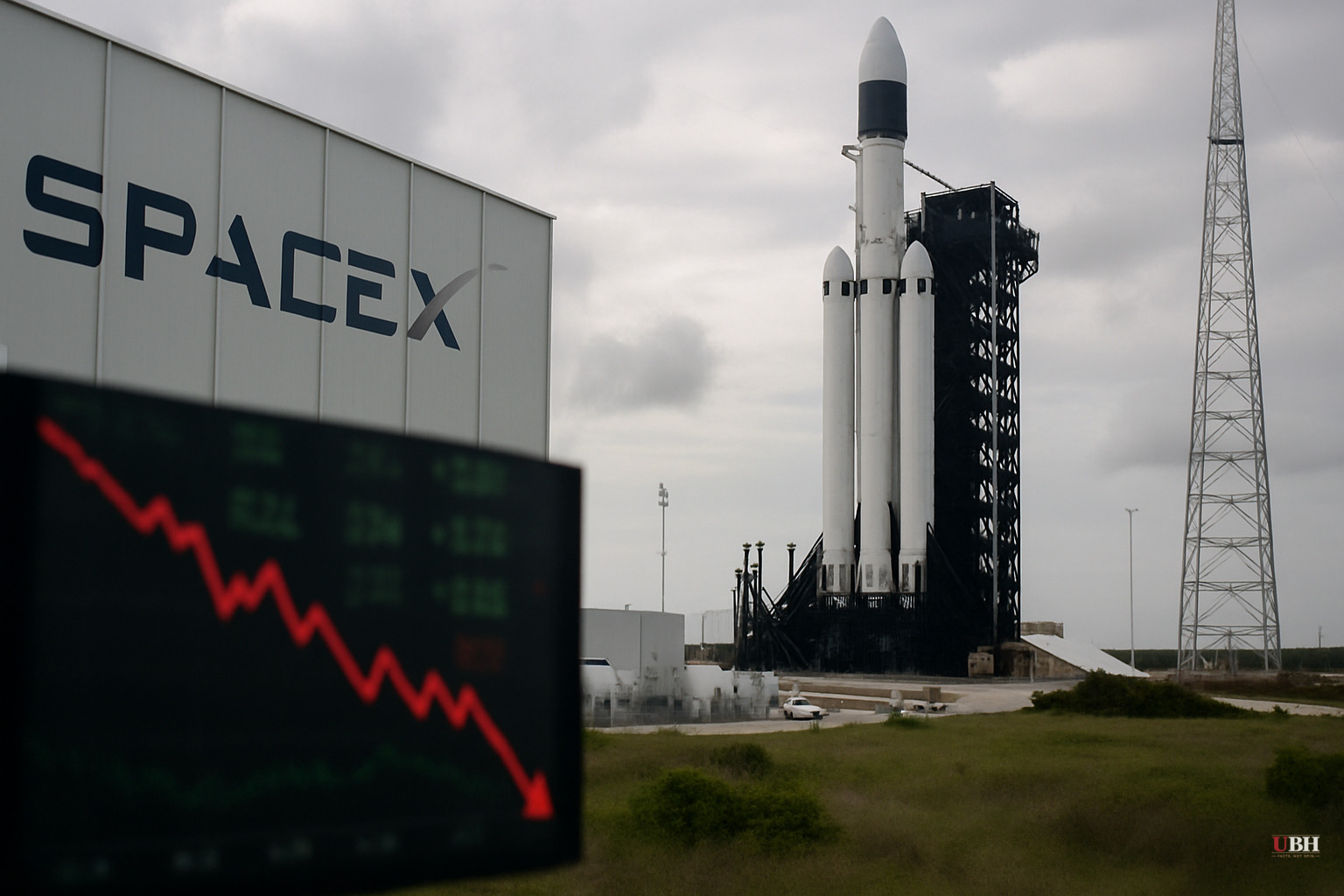
Since SpaceX's Nasdaq debut on June 12 valued the company above $1.77 trillion, shares have given back most of the post-IPO surge, trading around $154 on June 24, according to The Guardian's live market data.
The stock peaked at $225.64 on June 16, a roughly 67% run-up from the $135 IPO price in less than a week. It has since fallen roughly 31% from that high. On June 22 alone, SpaceX dropped 16% in a single session, which Bloomberg estimates erased approximately $240 billion from Musk's paper net worth in one day.
Two Different Numbers, Two Different Reasons
Bloomberg's Billionaires Index and Forbes' Real-Time Billionaires list both now place Musk below $1 trillion, but they arrive there by different routes.
Bloomberg, updated daily at 5:30 p.m. New York time, values Musk at $957 billion as of Tuesday's close, per both the BBC and The Daily Beast. Forbes puts him at $962 billion, slightly higher, but for a compounding reason: Forbes removed $116 billion in restricted Tesla shares from its calculation entirely.
Here's the Tesla wrinkle, per Forbes' Matt Durot. Last Tuesday, Musk surrendered $7.1 billion in Tesla stock to cover the exercise price on options from his 2018 CEO compensation package, which was voided by a Delaware court in 2024 and reinstated by the Delaware Supreme Court in 2025. Tesla and Musk then struck a new deal in April converting those options into restricted stock that Musk forfeits if he leaves certain executive roles at Tesla before January 2028. Forbes treats unvested restricted stock the same for Musk as for any other billionaire: it doesn't count until it vests. That $116 billion exclusion is a methodology call, not a penalty.
His remaining Tesla holdings, an approximately 11% stake excluding the restricted shares, are worth roughly $151 billion, according to Forbes. Tesla shares also slid nearly 6% on June 23, per the BBC, adding to the pressure.
What Musk Still Owns
SpaceX is still by far his largest asset. Forbes counts 4.8 billion SpaceX shares worth $744 billion plus 350 million stock options at an $8.40 exercise price worth another $52 billion, a combined 38% stake valued at roughly $796 billion. That is approximately 80% of his total estimated fortune.
That concentration is the core vulnerability here. As the BBC notes, Musk's wealth isn't diversified across sectors or asset classes. It lives almost entirely in two companies: one that went public two weeks ago and is still finding its market price, and one that has faced its own turbulence this year.
Why Tech Sold Off
The broader context matters. SpaceX didn't fall in isolation. Nvidia, Intel, and AMD all took hits during the same stretch, per BBC reporting, as investors grew more skeptical about whether AI infrastructure spending will translate into near-term profits. Higher interest rates complicate the math for capital-heavy growth companies. SpaceX is nothing if not capital-heavy.
Susannah Streeter, chief investment strategist at Wealth Club, told The Guardian that the bond sale confirmation likely added selling pressure. "The sell-off may have been partly triggered by the confirmation that it was planning a bond sale, expected to be around $20 billion," she said. "Issuing debt at such a heady valuation raises questions about cash flow for this hugely capital-intensive venture." (SpaceX priced that offering at $25 billion with nearly $90 billion in demand, covered in our June 23 reporting.)
Danni Hewson, head of financial analysis at AJ Bell, offered a more measured read to the BBC: "For a stock like SpaceX, a lot of decision making might have been emotional and based on the anticipation of huge leaps forward in space exploration and utilisation, but investing should be something treated with clear eyes and patience, even when such huge numbers are involved."
The Opposing Case
The strongest argument on the other side deserves a hearing. Bulls on Musk's fortune note that post-IPO corrections are standard for high-profile growth stocks. At $154 a share, SpaceX is still trading above its $135 IPO price. The company's core businesses, Starlink satellite internet, Falcon 9 launches, and the Starship development program, have not changed in two weeks. The stock moved on sentiment; the underlying contracts and revenue streams didn't evaporate. Forbes itself notes that a modest rebound in SpaceX's share price could push Musk back above $1 trillion without any change to business fundamentals.
A correction doesn't mean SpaceX is broken. It means a stock that ran roughly 67% in less than a week gave some of it back, which is how markets work.
What Comes Next
The concrete near-term test: insider lockup restrictions are set to expire in late July, per BBC reporting, at which point early SpaceX backers will be able to sell shares for the first time. How that supply hits the market, and whether institutional demand absorbs it, will tell investors far more about SpaceX's sustainable price level than the post-IPO frenzy did. Forbes also flags the possibility of SpaceX acquiring Tesla, which under the terms of Musk's April agreement with Tesla's board would trigger full vesting of his $116 billion in restricted shares. If that happens, his net worth calculation changes materially, but as of June 24, no such deal has been announced.
Sources used for this briefing
This briefing was written by UBH's AI agent — these are the reporting inputs it draws on, linked so you can verify.


