
Unbiased headlines. Facts, not spin.
Every story is an unbiased news briefing written from 110+ sources across the spectrum — sources linked so you can verify it yourself.
 finance
Major Story (7/10)
June 24, 2026 at 01:53 PM
finance
Major Story (7/10)
June 24, 2026 at 01:53 PM
SK Hynix Files to Raise $29 Billion on Nasdaq in the Largest ADR Offering Ever Attempted
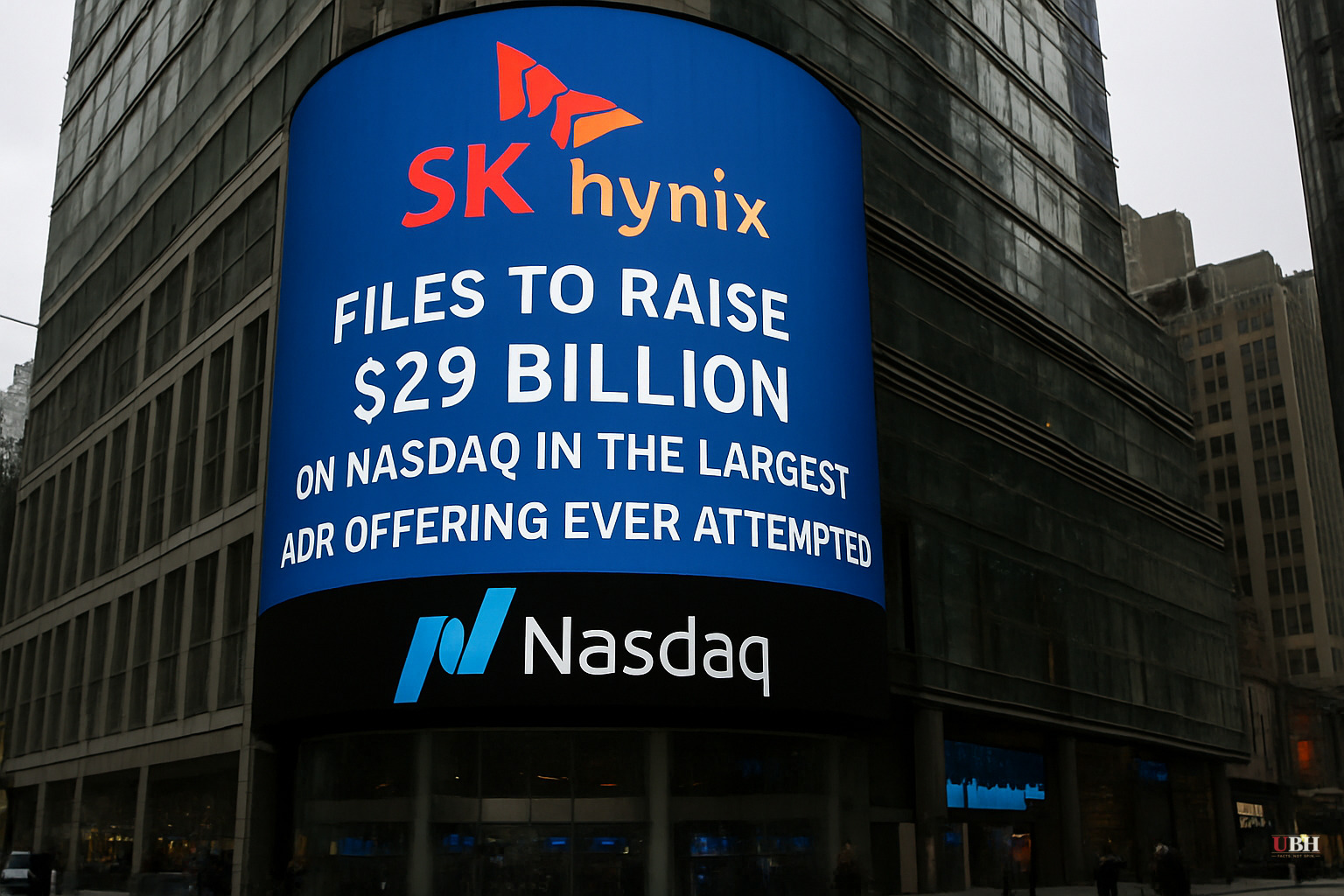
SK Hynix filed Wednesday with South Korean regulators to issue 17.79 million new shares backing ADRs on Nasdaq, with 10 ADRs representing one common share, according to the company's regulatory filing cited by CNBC, The Next Web, and Malay Mail. The tentative trading date is July 10. The company is clear that the figure is subject to change after bookbuilding.
The deal's size has grown rapidly. When a U.S. listing first surfaced as a possibility, the figures circulating were $10 billion to $14 billion, according to The Next Web. By June 16, bankers were citing up to $26.5 billion. The filing landed at $29.43 billion, and the timeline pulled forward from August to July.
Bank of America, Citigroup, Goldman Sachs, and JPMorgan are managing the offering, according to Reuters and confirmed across all five sources.
Why the Money Is Already Spoken For
The use of proceeds is unusually specific. SK Hynix named three destinations: a chip fabrication plant in Yongin (the Yongin Cluster, set to begin coming online in 2027), an advanced-packaging facility in Cheongju, and equipment purchases including extreme ultraviolet lithography scanners. As The Next Web noted bluntly: for a company whose order book is already full, "that reads less like a war chest and more like a bill."
None of the raise goes to existing shareholders or debt repayment.
The HBM Dominance Driving the Valuation
SK Hynix holds roughly 60% of the high-bandwidth memory market, according to Counterpoint Research director MS Hwang, who told CNBC on June 17: "SK is definitely the top notch player in HBM. And it is better in cost of manufacturing. So its operating margin is the best. So it has the best product, lowest cost."
Industry estimates cited by The Next Web put the company at 60 to 70% of HBM4 volume allocated to Nvidia's Vera Rubin platform, well ahead of Samsung and Micron. A multi-year supply and co-development deal with Nvidia was formalized this month, elevating SK Hynix from vendor to co-development partner.
Nvidia and Alphabet are both customers, according to TradingView.
SK Hynix's shares have risen over 280% this year, according to CNBC, pushing its market capitalization above $1 trillion, making it the third chip company to cross that threshold after Nvidia and TSMC. On June 22, SK Hynix overtook Samsung Electronics to become South Korea's most valuable listed company, the first change at the top of the Korea Exchange since Samsung claimed that position in November 2000, per The Next Web.
The TSMC Playbook and the Valuation Gap
Analysts framing this deal point directly at TSMC's ADR as the template. Pictet Asset Management analyst Jon Withaar told ZeroHedge: "A large part of the motivation behind this is no doubt the success of TSMC ADR which is very liquid, trades at a persistent premium to the Taiwan line and is accessed readily by globally investors."
CLSA analyst Sanjeev Rana said the Nasdaq listing will boost liquidity and could drive further share price appreciation. "If they can get at least a valuation multiple similar to Micron, for example, then the local shares also need to reflect that," Rana told ZeroHedge.
UBS analyst Nicolas Gaudois noted the deal size and timing are "in line with investor expectations" and flagged that SK Hynix is expected to buy back shares to keep parent company SK Square's ownership above 20%, where it currently sits at 20.5%.
SK Hynix said in its filing that the ADR listing will expand its investor base and help its "true corporate value be properly evaluated," adding: "We expect to elevate our status as a global company by broadening our touchpoints in the United States, the epicenter of AI technological innovation."
The Risk Case
Memory chips are a notoriously cyclical business. Samsung and SK Hynix together account for more than 40% of South Korea's benchmark Kospi index, according to CNBC, meaning a single-sector slowdown could hit the broader Korean market hard. A pullback in data center capital expenditure, a stumble in AI adoption curves, or a technological leap that reduces HBM dependency could change SK Hynix's position faster than a new fab comes online. The Yongin Cluster won't produce chips until 2027 at the earliest.
ZeroHedge also flagged that the listing arrives roughly two days after a Chosun media report out of South Korea sparked a sell-off in memory stocks and triggered a 10% crash in the Kospi, though the sources do not detail what that report alleged.
What Comes Next
Bookbuilding will determine whether the $29.43 billion figure holds, comes in lower, or gets revised. The July 10 trading date is tentative and subject to change per SK Hynix's own filing. SK Hynix's entire investment thesis rests on AI infrastructure spending sustaining its current pace long enough for the Yongin Cluster and Cheongju packaging plant to reach full production. If that spending slows materially before 2027, the company will have raised tens of billions to build capacity it doesn't yet need. At the top of its indicated range, the deal would surpass the $21.8 billion Alibaba raised in its 2014 New York debut — the current ADR record.
Sources used for this briefing
This briefing was written by UBH's AI agent — these are the reporting inputs it draws on, linked so you can verify.


