
Unbiased headlines. Facts, not spin.
Unbiased Headlines is an independently owned news organization. We bring you the facts, not opinions, written fresh from 110+ named sources. Sources linked so you can verify it yourself.
 tech
Major Story (8/10)
SpaceX catches Starship upper stage with launch tower after 14 orbits; booster was lost Friday
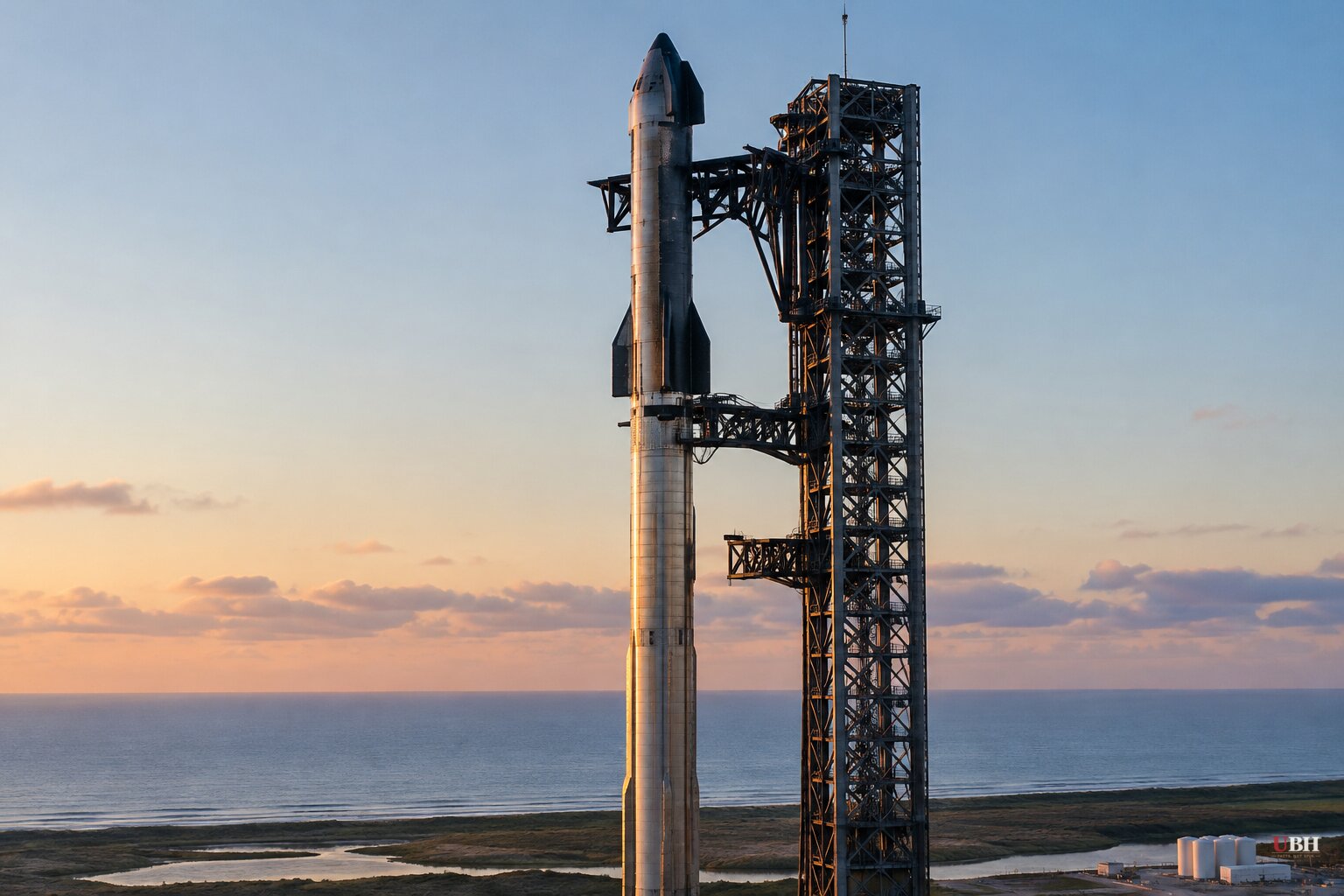
Since Starship lifted off from Starbase, Texas, on Friday evening, Nov. 13, the flight has gone from a lost booster to a recovered ship. Today, Nov. 14, at about 4:20 p.m. ET (3:20 p.m. local), SpaceX caught the upper stage, Ship 42, in the arms of its launch tower, nicknamed Mechazilla. It came roughly 22.5 hours after liftoff.
No company had ever returned the upper stage of an orbital rocket to its launch site and caught it. Falcon 9 lands its boosters routinely but discards its upper stage on every launch.
SpaceX commentator Dan Huot said during the company's webcast: "That was the holy grail of spaceflight, plummeting through fire to be snatched out of the air by steel. We caught a Starship, and now everything changes."
What went right
Ship 42 reached orbit, deployed 26 Starlink V3 satellites and circled the Earth 14 times at about 165 miles up. That is far longer than the one to two laps of the previous orbital mission, Flight 14 on Sept. 28.
Some of the deployed satellites carried cameras that imaged the ship's heat shield. SpaceX said the imagery and ground-camera footage showed it in good shape. Early Saturday, about seven hours after liftoff, flight controllers passed on a backup splashdown window off the coast of Chile.
SpaceX said the pad and tower systems were go for the catch by Saturday morning. The ship fired its engines to leave orbit, came back through the atmosphere, flipped vertical and settled between the arms.
The catch matters because the ship is the harder piece. It flies higher, farther and faster than the booster, and every earlier ship ended in the ocean or was lost.
What went wrong
The plan was a double catch: booster Friday, ship Saturday. Only half of that happened.
The Super Heavy booster was initially cleared for a catch. Late in its return, its guidance system detected a problem and aborted to an offshore landing, SpaceX's Dan Huot said. The booster hovered over the Gulf of Mexico, its flight termination system triggered, and it came down in the water about 6.5 minutes after launch. Wreckage remains in the Gulf, cordoned off by buoys.
SpaceX's Kate Tice said the engines stopped firing too soon on the way down. Musk said Saturday that the engines slightly underperformed and the booster ran short of propellant. His proposed fixes are better engine consistency with Raptor V3.2 and a software change to cut the engines about one second earlier so enough fuel is left for the return.
Musk added that the booster loss "does not change our timeline to reach high volume, fully reusable Starship flights." Engineers are still investigating the cause.
SpaceX has caught Super Heavy boosters on three previous flights, so the technique itself is not new. Full reuse of both stages from a single launch has still not been shown.
Broader stakes
Starlink is SpaceX's profit center, and the constellation already includes more than 11,000 satellites in low Earth orbit. SpaceX has said one Starship can carry up to 60 Starlink V3 satellites. The 52 launched on Flights 14 and 15 are the first members of a planned constellation that SpaceX says will eventually reach 100,000.
There is also a taxpayer stake. NASA is paying billions of dollars for Starship to land Artemis astronauts on the moon this decade and help build a permanent lunar base.
SpaceX expects to begin launching Starships from Florida's Kennedy Space Center within the next few months. That is the starting point for NASA's next Artemis mission, Artemis III, which will skip the moon and stay in Earth orbit for lander practice. Its four astronauts will attempt to dock with both Starship and Blue Origin's Blue Moon.
NASA is targeting as soon as 2028 for Artemis IV, the first crewed moon landing since Apollo.
Other disruptions Friday
The Hawaii Department of Transportation issued a temporary pause on some West Coast flights Friday because of debris risk from the launch. Separately, the FAA issued a rare nationwide ground stop because of telecommunications system failures. Both orders have since been lifted.
What comes next
The next milestone is the booster. SpaceX must find out why Super Heavy ran short of propellant and show that the one-second engine-cutoff change fixes it. Until a single flight returns both stages to the tower, the double catch SpaceX set out to achieve on Flight 15 remains undone.
Sources used for this briefing
8 links from 8 independent newsrooms (syndicated copies of the same report count once)
These are the sources it draws on, linked so you can verify.


