
Unbiased headlines. Facts, not spin.
Unbiased Headlines is an independently owned news organization. We bring you the facts, not opinions, written fresh from 110+ named sources. Sources linked so you can verify it yourself.
 tech
Notable (6/10)
Event date: November 19, 2026 ·
SonicWall Tells Customers to Retire Gen 6 Firewalls as Patches End for Every Model, Critical Flaws Included
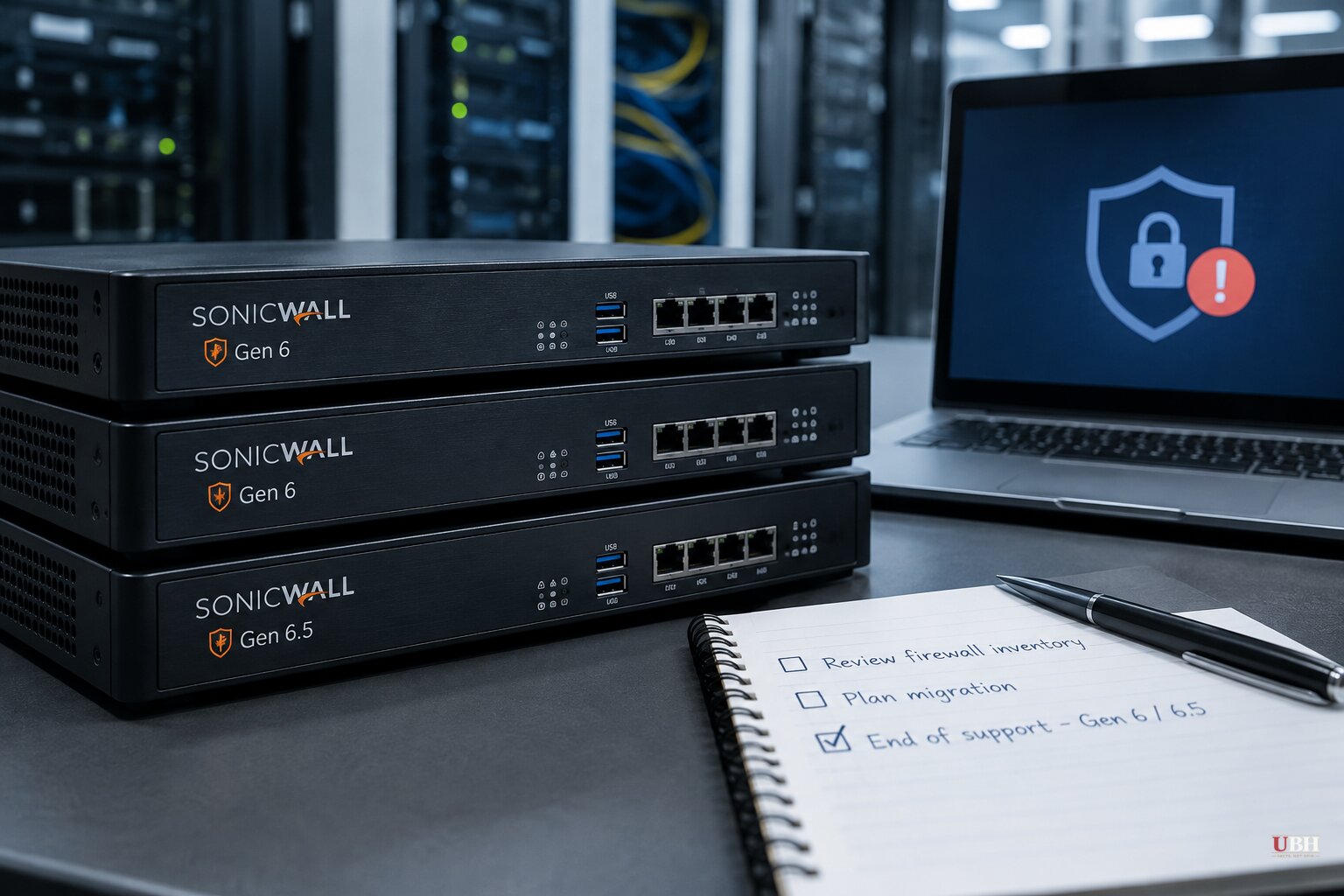
Since F5, PHP and Drupal pushed out batches of critical patches this week, another edge-device warning has landed, and this one is about patches that will never come. On Wednesday, Nov. 18, SonicWall published a product advisory telling customers still running Generation 6 firewalls to replace them immediately and stop using them at the internet edge.
The advisory covers every Gen 6 and Gen 6.5 firewall running SonicOS 6.x, including Gen 6 NSv virtual firewalls. SonicWall says it no longer releases firmware updates or security patches for them, "whatever the severity of a newly found vulnerability, including Critical."
What SonicWall is and is not saying
The advisory does not announce a new bug. SonicWall has not identified a new vulnerability or a confirmed attack campaign against Gen 6 gear.
What it does say is a prediction. "We expect internet-facing Gen 6 firewalls to be actively targeted," the company wrote, adding that any Gen 6 unit still in service should be treated as "a high-risk exposure."
The company's reasoning is that a patch for a flaw affecting several firewall generations goes only to the supported ones. The public advisory then tells attackers where to look, and Gen 6 stays open permanently. SonicWall describes this as "every fix is a map."
The end-of-support calendar
Support did not end all at once. According to SonicWall's published dates:
- NSA 2600: March 8, 2024
- TZ300 and TZ300W: Jan. 23, 2025
- SuperMassive 9200 to 9800 and NSsp 12400 and 12800: Feb. 20, 2026
- SOHO, SOHO W, TZ300P, NSa 9250, 9450, 9650 and the NSv 10 to NSv 1600 virtual units: April 16, 2026
- NSa 2650: May 1, 2026
- TZ400, TZ400W, TZ600, TZ600P, NSA 3600 and NSa 3650: Aug. 1, 2026
- TZ350, TZ500, SOHO 250 families, NSA 4600, 5600, 6600 and NSa 4650, 5650, 6650: Oct. 1, 2026
So some customers have been running unpatched hardware for more than two years. The newest batch, which includes small-office models such as the TZ350 and TZ500, lost support seven weeks ago.
The numbers behind the urgency
SonicWall cites the Verizon 2025 Data Breach Investigations Report: edge devices and VPNs were the target in 22% of breaches that began with an exploited vulnerability, up from 3% a year earlier.
It also cites CSO Online's October 2026 figures. The median time from disclosure to confirmed exploitation fell from 120 days in 2025 to 80 days in the first half of 2026, and 141 flaws were exploited from January to August 2026, more than in all of 2025.
Google's Mandiant M-Trends report, published in March 2026, goes further. It estimates the mean time to exploit has turned negative, at about -7 days, meaning exploitation on average begins before a patch exists. Cisco Talos' 2025 Year in Review found 23% of CVEs discovered that year directly affect network devices such as VPN appliances, firewalls, load balancers and routers.
SonicWall's claim that attackers are using automation and AI to find unsupported devices, read patches and build exploits faster is the company's own assessment. Mandiant's report also describes attackers' growing use of AI.
Gen 6 has been hit before
Two exploited flaws are tied to Gen 6 hardware. CVE-2024-40766, an access-control flaw whose National Vulnerability Database entry lists Gen 5 and Gen 6, was added to CISA's Known Exploited Vulnerabilities catalog on Sept. 9, 2024, with known ransomware use. The SonicWall advisory names it.
CVE-2024-12802 is an SSL VPN multifactor bypass tied to how account names are handled when the appliance is joined to Active Directory. ReliaQuest reported intrusions using it in February and March 2026 and assessed with medium confidence that this was its first use in the wild. It is not in the CISA catalog. ReliaQuest says a Gen 6 firmware update alone leaves the flaw open until six manual LDAP reconfiguration steps are completed.
A third flaw adds an open question. CVE-2026-19868, an SSL VPN SAML authentication bypass, was added to the CISA catalog on Nov. 6. SonicWall lists it against Gen 7 and Gen 8 only, so its Gen 6 status is not stated.
What customers are told to do
SonicWall's remedy is replacement with a Gen 8 firewall running SonicOS 8. The company says customers need not rebuild their configurations, because supported settings from SonicOS 6.5 move over through the in-product import or the NSM Migration App. It recommends authorized partners to plan the move.
Until the swap, SonicWall advises:
- Disable WAN management interfaces.
- Disable SSL VPN, or restrict it to known source addresses.
- Remove unused services and interfaces.
- Enforce multifactor authentication on remote-access and admin accounts.
- Reset local passwords.
- Monitor logs for unauthorized access.
The stakes are spelled out in the company's own words: "One breach reaches everything." A compromised perimeter firewall gives attackers a foothold for credential theft, lateral movement and ransomware deployment.
The next thing to watch is whether the CISA catalog or SonicWall's supported-generation advisories name a new flaw that reaches Gen 6. For CVE-2026-19868, SonicWall has not said whether Gen 6 units are affected, and under its stated policy, no fix would follow if they are.
Sources used for this briefing
8 links from 8 independent newsrooms (syndicated copies of the same report count once)
These are the sources it draws on, linked so you can verify.


