
Unbiased headlines. Facts, not spin.
Unbiased Headlines is an independently owned news organization. We bring you the facts, not opinions, written fresh from 110+ named sources. Sources linked so you can verify it yourself.
 tech
Breaking / Critical (9/10)
Broadcom Patches Critical vCenter Flaw That Google Says China-Linked Hackers Exploited Since September
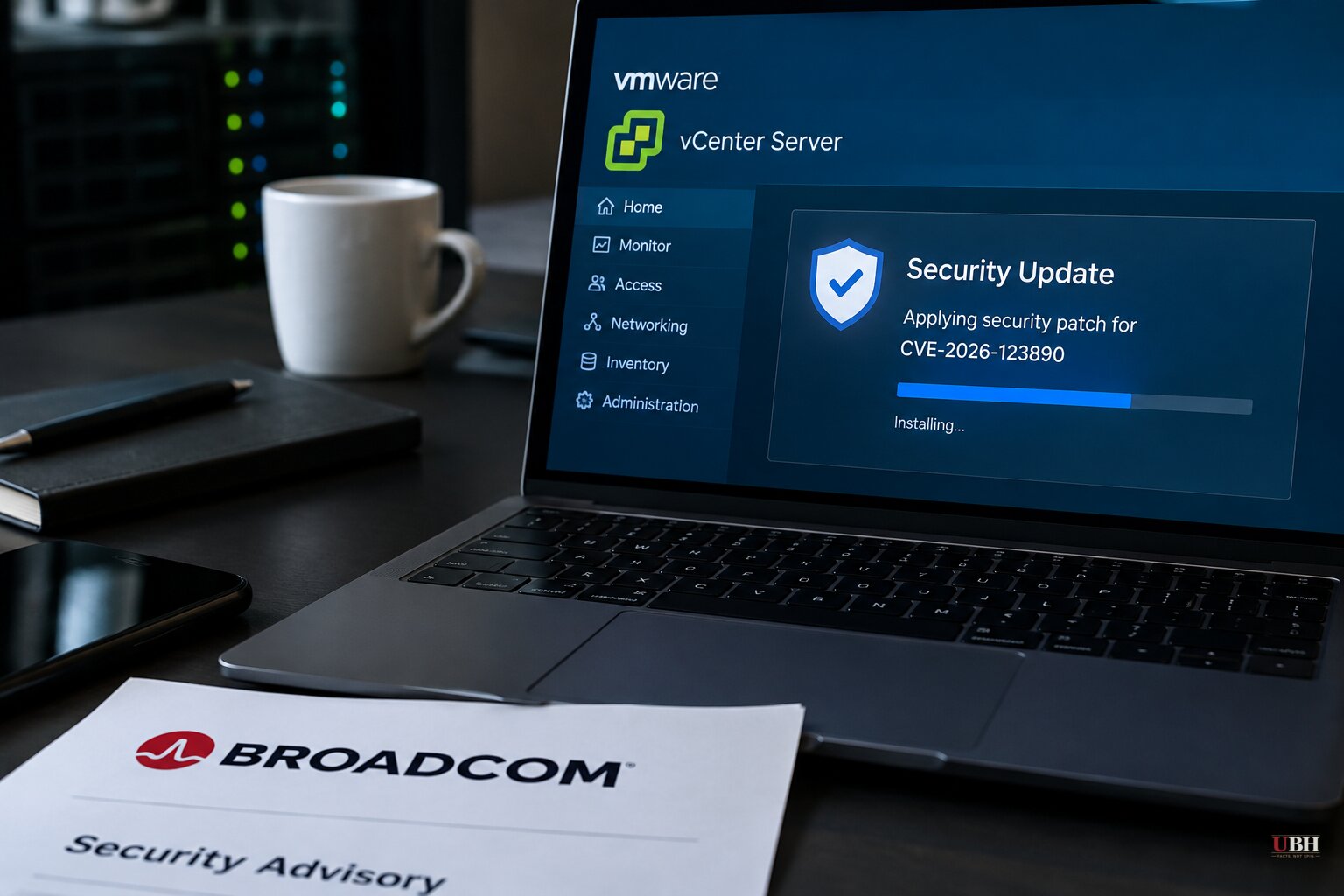
Broadcom released emergency fixes today, Thursday, Nov. 19, for a critical flaw in VMware vCenter Server that a suspected Chinese state-sponsored hacking group was already using in September.
The bug is tracked as CVE-2026-123890 and carries a CVSS score of 9.8 out of 10. It sits in the VMware Directory Service. An attacker with network access to a vulnerable vCenter server needs no password and no user interaction to get in.
What the flaw does
Broadcom's advisory, VMSA-2026-0009, says a malicious actor with network access "may exploit this issue to bypass authentication and gain unauthorized access to the system." Administrative control of vCenter means control of every virtual machine it manages.
Google's Mandiant and Google Threat Intelligence Group describe the mechanics. The bug is an unauthenticated session key disclosure in the Secure Remote Password mechanism, reachable over DCE/RPC. Exploiting it creates an authenticated session as administrator@vsphere.local.
From there, an attacker can run arbitrary commands and pull files, including the data.mdb directory database, through the vmdird RPC interface.
The French outlet IT Connect adds that the interface listens on TCP port 2012 and that the unique identifiers it generates rely on predictable timestamps. That lets an attacker recover the shared session key without a password.
The advisory also covers four other vulnerabilities, in VMware SDDC Manager and VMware Tools for Windows. Broadcom calls the vCenter update an emergency change. It says there are no official workarounds, though network restrictions and firewall controls can reduce exposure. The flaw applies whether or not Enhanced Linked Mode is turned on.
The attack Google documented
Mandiant says the suspected PRC-nexus group ARMORY CASTLE, formerly tracked as UNC5221, exploited the bug in early September 2026. Its forensic evidence shows the group used a custom Golang tool called BONESAW.
The VMware attack was one stage of a larger intrusion. The same campaign used CVE-2026-102764, a zero-day in BeyondTrust Remote Support that Google wrote about on Oct. 15 and that BeyondTrust patched in BT26-05. Mandiant says that bug has been exploited since late August.
After breaching the BeyondTrust appliance, the attackers moved to an internal Linux appliance. They planted SLIMSAVAGE web shells, escalated to root and scanned the network for VMware systems. BONESAW then hit vCenter.
According to Google's analysis, the tool created a Single Sign-On administrator account and copied the directory database. It also took the SAML token-signing key, the vCenter master key and the PostgreSQL password file. With a stolen signing key, attackers can forge authentication tokens and regain administrative access.
The group then moved on to ESXi hosts and copied Windows NTDS and registry files off virtual machine disks.
Google's researchers say the campaign used two zero-days and three sets of malware built for the targeted devices, "indicating deep platform expertise and substantial resource backing." ARMORY CASTLE has a record of exploiting zero-days in Citrix NetScaler and Ivanti Connect Secure devices.
Broadcom's position
Broadcom's advisory does not say the flaw was exploited in the wild, and the company has not confirmed exploitation. It credits Mandiant with reporting the vulnerability. Mandiant's report is the source for the exploitation claim, and it attributes the activity to a "suspected" state-sponsored actor. Google's published analysis describes a single victim environment. The scale of the campaign beyond that has not been disclosed.
As of Thursday afternoon, the flaw was not listed in CISA's Known Exploited Vulnerabilities catalog.
Who needs to patch
Fixed versions are vCenter 9.1.1.0200, 9.0.2.0200 and 8.0 U3m, and VMware Cloud Foundation 5.2.5. The updates are cumulative. Broadcom says vCenter Quick Patch cannot apply them individually.
vCenter 7.0 has no published fix. Customers on extended support have to contact Broadcom. Versions 6.5 and 6.7 are past end of support and were not evaluated. Broadcom says to treat them as affected. ESX hosts are not affected by this advisory.
Google recommends applying the patches immediately. The security firm Rescana warns that patching alone may not be enough. The attacker in Google's report kept access through stolen keys and extra accounts, which a patch does not remove. Rescana advises administrators to hunt for signs of compromise on any vCenter reachable from untrusted networks since early September.
This is not the first recent vCenter session key problem. A separate flaw, CVE-2026-59309, was patched in July 2026 and exposed the same kind of key through LDAP rather than RPC.
What remains open
Broadcom has not said when Mandiant reported the flaw or how long the fix took to build. The company has also not said whether it knows of exploitation beyond the incident Google documented.
For organizations stuck on vCenter 7.0, there is no patch to install. They are left with the network restrictions Broadcom recommends and a direct request to Broadcom's support channel.
Sources used for this briefing
6 links from 6 independent newsrooms (syndicated copies of the same report count once)
These are the sources it draws on, linked so you can verify.


