
Unbiased headlines. Facts, not spin.
Unbiased Headlines is an independently owned news organization. We bring you the facts, not opinions, written fresh from 110+ named sources. Sources linked so you can verify it yourself.
 tech
Major Story (7/10)
CISA Adds Four Exploited Flaws to Its KEV Catalog: Synology, LiteLLM, Apache Axis, REDCap
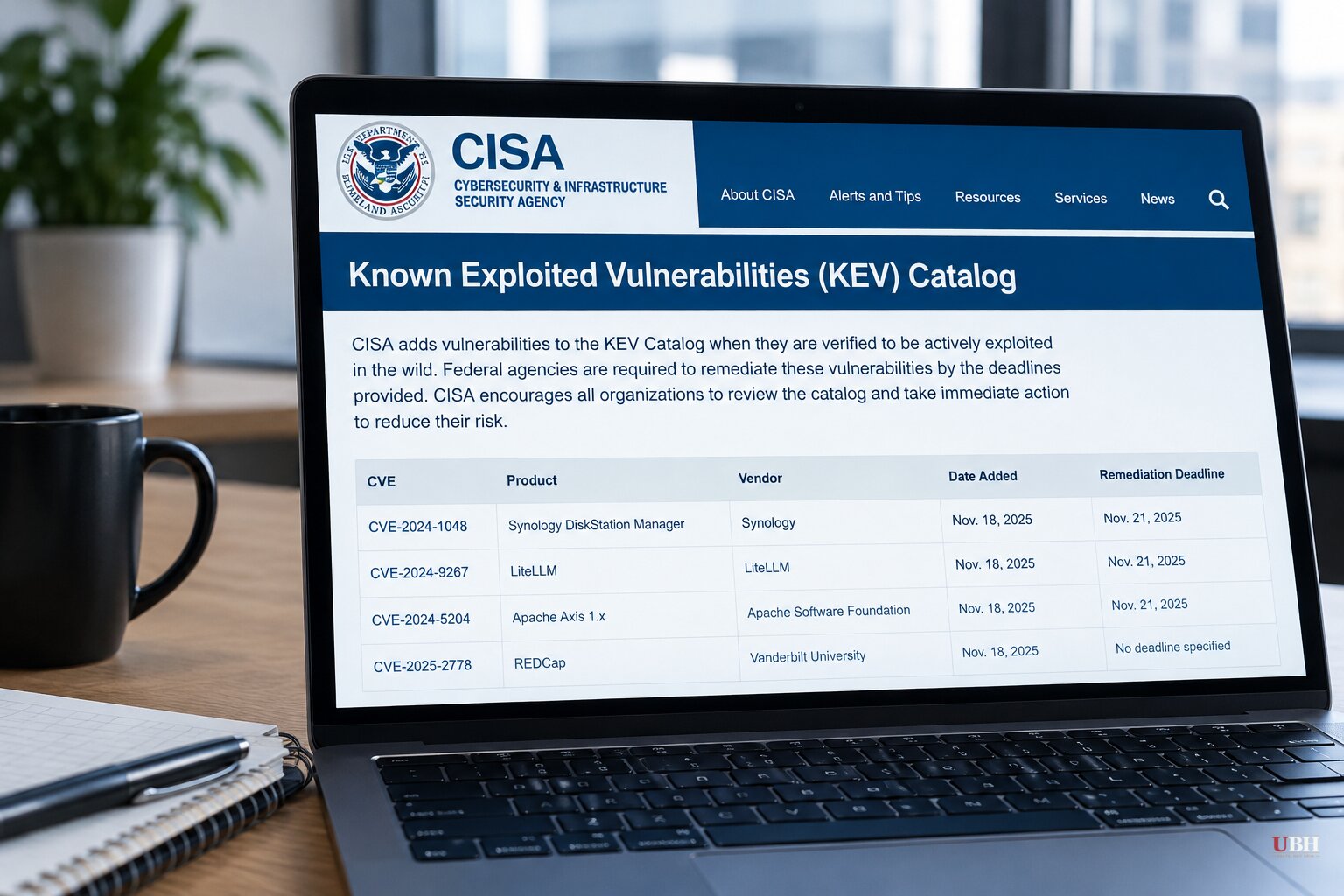
The Cybersecurity and Infrastructure Security Agency added four vulnerabilities to its Known Exploited Vulnerabilities (KEV) catalog on Wednesday, Nov. 18, citing evidence of active exploitation. The affected products are Synology DiskStation Manager (DSM), BerriAI's LiteLLM, Apache Axis and Vanderbilt University's REDCap research data platform.
All four can allow code execution. Most carry a CVSS score of 9.8. The LiteLLM flaw is rated 8.8.
CISA has not described the scope of the attacks. Its catalog lists ransomware involvement as unknown for all four entries, and its alert did not name any malware.
The four flaws
Synology DSM (CVE-2024-10441). This is an output-handling flaw in a system service that lets a remote attacker run code with no login and no user action. Separate incident reporting has tied Synology attacks to C3RB3R ransomware. Administrators should install the latest supported release for their device, not just the older fixed builds listed in earlier advisories.
LiteLLM (CVE-2026-40217). The bug sits in the custom guardrail testing feature. Code meant to run inside a restricted test environment can escape it. By default it requires proxy administrator credentials, which is why it scores lower than the others. The maintainers fixed it in version 1.83.11.
Google Threat Intelligence Group has separately reported attackers abusing LiteLLM to turn limited-access inference keys into administrative credentials and set up persistence in LLMjacking attacks, where stolen access to AI services is abused. Nothing published links that activity to a different CVE.
Apache Axis (CVE-2026-90436). An unauthenticated attacker can run code on a vulnerable server through Axis 1.x, a discontinued Java SOAP library. Apache does not plan an official fixed release. A patch is available on GitHub, and developers recommend moving to another SOAP engine such as Apache Axis2/Java. Exploitation of this flaw has been reported alongside the "4EverAble2Shell" vulnerabilities in N-able N-central to deploy cryptocurrency miners.
REDCap (CVE-2026-90817). This code injection flaw lets an unauthenticated attacker execute code through crafted HTTP requests that reach an unintended controller route from a public survey context. CISA noted that exploitation requires knowledge of a valid public survey hash. REDCap's advisory lists versions 16.0.49, 17.3.10, 17.4.4 and later as not vulnerable. Cryptomining malware has been documented in a REDCap incident.
Those are incident-specific findings. CISA's listing confirms exploitation of each flaw, not that the same attackers used all four.
What Rapid7 saw inside a Confluence server
The Axis flaw reaches well beyond Axis users. Atlassian Confluence Data Center uses the library for its XML-RPC and SOAP APIs. Atlassian said an instance is vulnerable only if the "Remote API (XML-RPC & SOAP)" setting is enabled. That setting has been off by default for new installs since Confluence 3.0 and was removed entirely in Confluence 10.0.
Rapid7 detected exploitation against a Confluence Data Center customer environment, flagged on Nov. 13. Attackers ran shell commands and scripts pulled from temporary Pinggy and Cloudflare Tunnel domains, then began enumerating the system.
Rapid7 said that just over three minutes after the first execution, the attackers were authenticating to MySQL with Confluence's own database credentials. They queried page bodies, application links, and attachments with names tied to credentials, tokens, VPN configurations and private keys.
Rapid7 said the attackers' scripts were likely AI-generated. The scripts combed Confluence's default attachment directory, parsed Office documents, searched for credentials and hunted for payment card numbers, using Luhn checks to weed out false positives.
The attackers also queried the internal Atlassian Crowd API for users and group memberships and attempted AS-REP Roasting, a Kerberos credential-harvesting technique. Those attempts failed. They did obtain a service account credential and queried a production cloud data warehouse. About 12 hours after the first exploit request, the attacker signed in to Microsoft 365 as an integration service account.
For Confluence Data Center, the fix is an upgrade to 9.2.28 or an unaffected 10.x release.
Deadlines
CISA's catalog entries set a Nov. 21 remediation deadline for the Synology, REDCap and Apache Axis flaws, with forensic triage required. LiteLLM's deadline is Dec. 2, without the triage requirement. The entries also point to CISA's BOD 26-04 guidance, which calls for discontinuing affected products when mitigations are unavailable.
The deadlines apply to federal civilian agencies. Everyone else is on their own clock, and attackers are already working these flaws.
Apache Roller developers separately confirmed active exploitation of an XML-RPC deserialization flaw that allows unauthenticated remote code execution. It affects older releases and was fixed in 6.1.6 and later. It is not one of the four KEV additions.
The open problem
Synology and REDCap have vendor patches. Axis 1.x is end-of-life, and the project will not ship an official fix. Any organization running software that quietly bundles the library has to ask its vendors whether Axis is inside, and wait for answers. Three of the four deadlines fall on Nov. 21, and CISA has not said how many federal systems are affected.
Sources used for this briefing
7 links from 7 independent newsrooms (syndicated copies of the same report count once)
These are the sources it draws on, linked so you can verify.


