
Original briefings. Zero spin.
Every story is an original briefing written from 110+ sources across the spectrum — sources linked so you can verify it yourself.
 health
Low Interest (4/10)
Event date: September 4, 2026
health
Low Interest (4/10)
Event date: September 4, 2026
Small Greek Study Finds More Microplastics in Lungs of Cancer Patients, But Can't Say Why
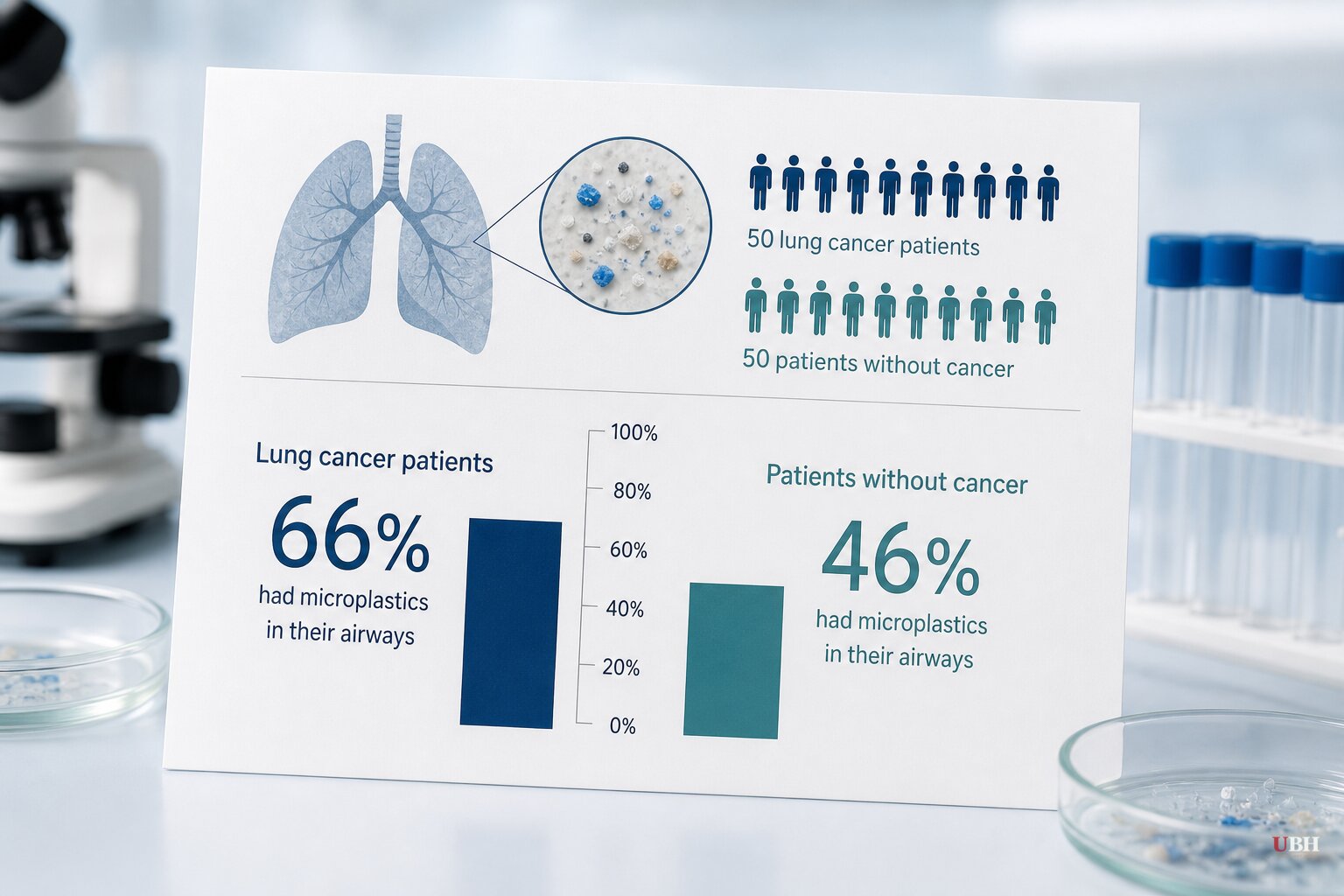
Doctors in Greece found more plastic particles lodged in the lungs of cancer patients than in patients without cancer, according to research presented at the European Respiratory Society Congress in Barcelona.
The study is small. It's observational. And the man who ran it says flatly that it doesn't prove microplastics cause cancer. Every outlet covering this story should have led with that caveat. Most did. The Express did not, calling the study "groundbreaking" in its headline while the actual researcher was busy telling reporters the opposite.
What the study actually did
Dr. Ilias Dimeas of University College Dublin School of Medicine and the University of Thessaly in Larissa, Greece, led a team that studied 100 patients undergoing bronchoscopy at University Hospital of Larissa for lung symptoms, according to the European Respiratory Society. Bronchoscopy involves threading a flexible scope into the lungs to look around and take samples.
Every patient gave a lung-wash sample, where saline rinses out part of the lung to collect cells and debris. Half the patients also had a small tissue sample taken directly from the lung.
Of the 100 patients, 50 were later diagnosed with lung cancer. Fifty were not. Researchers found 232 microplastic particles total across all the samples, according to Medical Xpress, and 70% of all patients had detectable microplastics in at least one sample.
The numbers behind the headline
Among lung-wash samples specifically, 66% of cancer patients had detectable microplastics compared with 46% of non-cancer patients, according to MedPage Today, a difference that hit statistical significance (P=0.044). Cancer patients had a median of one microplastic particle detected in their lung wash, versus roughly zero in the comparison group (P=0.045).
After Dimeas's team adjusted for smoking history, age, and sex, the link between microplastic burden and lung cancer stayed statistically significant, with an odds ratio of 2.00 and a 95% confidence interval of 1.01 to 3.95, per MedPage Today. Note that confidence interval: it barely clears 1.0. That's a real but weak signal, not a slam dunk.
The most commonly identified plastics were polypropylene and polyethylene, according to Quomi, both everyday materials used in packaging, textiles, and household goods.
One odd wrinkle: when researchers compared lung-wash and tissue samples from the same patient, higher microplastic levels in one sample often meant lower levels in the other, according to News Medical. Since lung-wash samples pull from airspaces and tissue samples come from inside the lung structure itself, the researchers think this points to microplastics settling unevenly across different parts of the lung, not a measurement error.
What Dimeas himself says, and doesn't say
Dimeas was careful in his own comments. "This type of study doesn't tell us why we found more microplastics in the samples from lung cancer patients," he said in a press release cited by MedPage Today. "Microplastics could contribute to inflammation or other biological processes that may contribute to diseases like cancer, but it is also possible that diseased lungs simply retain particles differently than healthy lungs."
A cancerous lung might just trap and hold onto foreign particles differently than a healthy one, independent of any plastic-causes-cancer mechanism. The study can't distinguish between those two explanations.
Ria Devereux, PhD, of the University of East London, reviewed the work independently and was blunter still. "This study is an important preliminary study, but it does not establish that microplastics are a cause or risk factor for lung cancer," she said, per MedPage Today. Devereux wanted more detail the study didn't provide: patients' occupational exposures, air pollution history, other underlying lung disease, cancer type and stage, and prior medical treatments.
The obvious caveats nobody should skip
This was one hospital, 100 patients, and a comparison group that wasn't cancer-free. Controls were people undergoing bronchoscopy for lung symptoms who simply didn't get a cancer diagnosis. Smoking remains the established leading cause of lung cancer, and air pollution is an established risk factor, according to Quomi. Microplastics are not currently classified as either.
Dimeas said his team has already started lab experiments to figure out what types of plastic are involved and how they interact with lung cells, and are separately examining samples from patients with chronic respiratory conditions to see if microplastics track with lung scarring, according to Earth.com.
The question this study raises but cannot answer: does inhaled plastic actually drive disease, or does disease change how lungs handle whatever junk floats through the air. That distinction requires bigger cohorts, multiple hospitals, and controls that isolate occupational and pollution exposure. That's something Devereux flagged and something this 100-patient snapshot was never built to deliver.
Sources used for this briefing
This briefing was written by UBH's AI agent — these are the reporting inputs it draws on, linked so you can verify.


