
Original briefings. Zero spin.
Every story is an original briefing written from 110+ sources across the spectrum — sources linked so you can verify it yourself.
 tech
Notable (6/10)
August 31, 2026 at 07:57 AM
tech
Notable (6/10)
August 31, 2026 at 07:57 AM
SK Hynix Reportedly In Talks With Intel Foundry to Break TSMC's Grip on AI Memory Chips
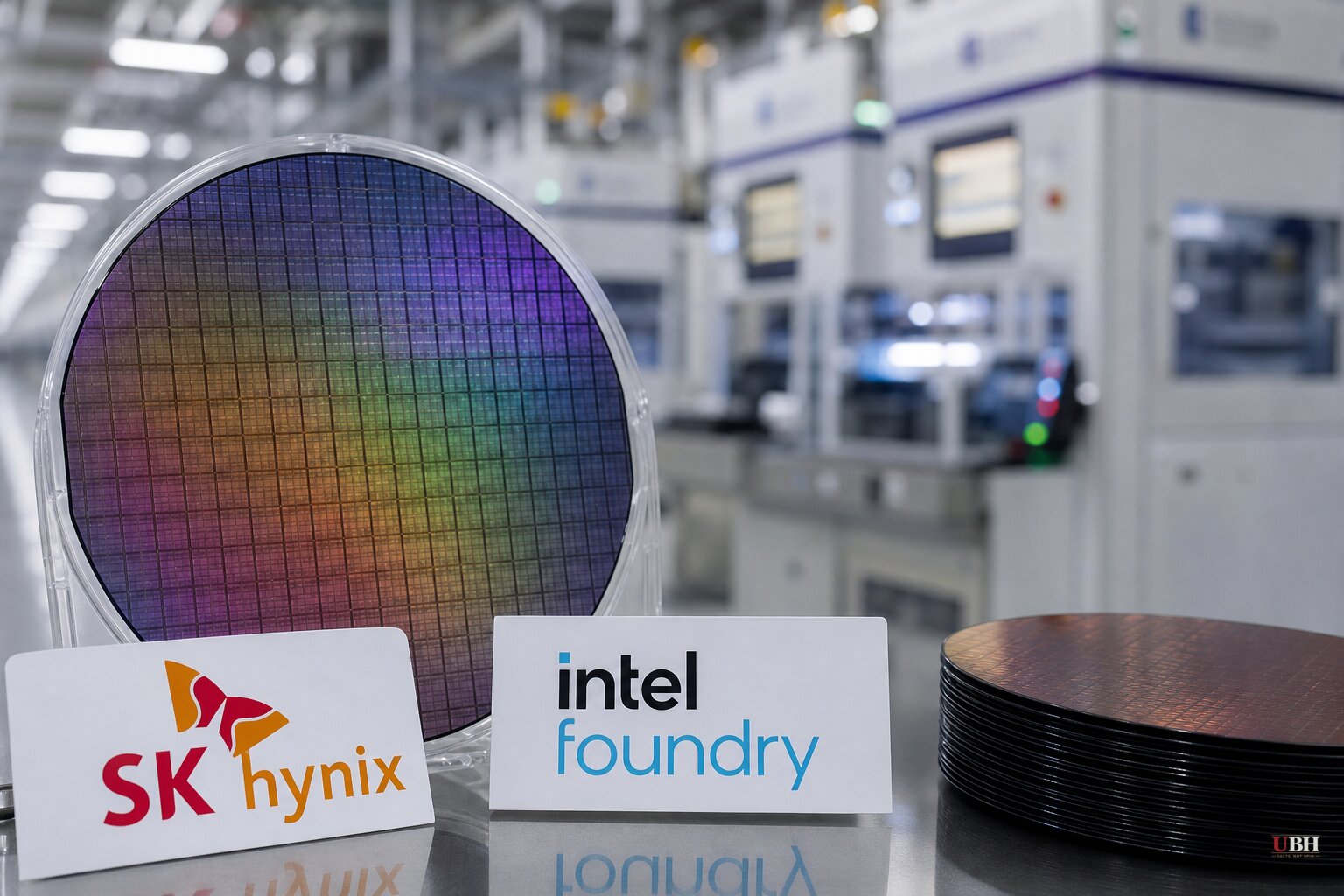
SK Hynix, the company that supplies most of the high-bandwidth memory chips running AI data centers, is reportedly weighing Intel's foundry business as a second source for a critical component in its next-generation HBM4E memory, according to South Korean outlet Herald Business (also cited by other outlets as Herald Economy, a sister publication). The reporting has been picked up and repeated across at least six English-language outlets, but it traces back to that one Korean report.
The component in question is the base die, the logic chip at the bottom of an HBM stack that connects the memory to processors like Nvidia GPUs. SK Hynix made these in-house through the HBM3E generation, then shifted to Taiwan Semiconductor Manufacturing Co. starting with HBM4, using TSMC's 12-nanometer-class process, according to TradingKey and multiple other outlets citing the same Korean reporting.
The economics are lopsided. Industry estimates cited by Herald Business and repeated by All Weather Finance, TradingKey and Crypto Briefing put the cost of a TSMC-made HBM4 base die at three to four times the cost of the DRAM core dies SK Hynix makes itself. Because HBM products run on long-term supply agreements that limit SK Hynix's ability to pass rising costs to customers, that gap eats straight into margins.
Intel's pitch centers on its EMIB packaging technology as an alternative to TSMC's CoWoS. Crypto Briefing and KuCoin both reported early assessments suggesting EMIB could cut packaging costs by roughly 50% in some use cases versus CoWoS, though neither outlet named who produced that estimate or under what conditions it would hold.
There's a personnel thread to note. Intel recently hired Seok-Hee Lee, a former SK Hynix CEO, according to BigGo Finance. That hire, plus separate market chatter about SK Hynix potentially helping operate Intel's delayed Ohio fab, has fueled speculation the relationship could extend beyond base dies into broader manufacturing cooperation. StockTwits reported that SK Hynix denied being a partner for the Ohio fab when that rumor surfaced in July.
And the company's response to this latest report matters. BigGo Finance reported that SK Hynix said "some details" in the Herald Business story were inconsistent with the facts, but the company did not deny that discussions with Intel are taking place. TradingKey went further, reporting that the plan is still under evaluation with no finalized scope or timeline, and that SK Hynix's likely path is to run TSMC and Intel simultaneously as base-die suppliers starting with HBM4E, not to drop TSMC.
That last point is where some coverage gets muddled. Crypto Briefing and KuCoin both framed the story with language suggesting SK Hynix would simply move production to Intel, without making clear that TSMC would remain a supplier. TradingKey's reporting, along with aroged's, is explicit that this is meant to be a dual-sourcing arrangement, not a switch. Readers relying only on the Crypto Briefing or KuCoin framing would come away thinking TSMC gets cut out entirely, which none of the underlying Korean reporting actually claims.
Markets took the story seriously even before U.S. exchanges opened for the week. StockTwits reported that Intel shares moved in thin overnight trading late Sunday, dropping nearly 2% before recovering to be down about 0.5%, while SK Hynix's U.S.-listed shares were down 1.5% at the time of that report. Those are overnight, low-volume moves, not a regular Nasdaq or NYSE session, since U.S. markets had not opened as of Monday morning.
The backdrop is a memory market racing to keep up with AI chip demand. SK Hynix shipped 12-layer HBM4E samples to customers in June, hitting 16 gigabits per second in data transfer speed, according to TradingKey. The company is also sinking more than $4 billion into an advanced packaging plant in West Lafayette, Indiana, that KuCoin and Crypto Briefing both report is targeting volume production in the second half of 2029. Samsung, meanwhile, is developing its own 4-nanometer foundry process specifically for HBM4 base dies, according to Crypto Briefing, which would let Samsung skip outside foundries altogether.
None of this is finalized. No contract has been announced, no dollar figures on a deal have surfaced, and SK Hynix has publicly pushed back on at least part of the reporting. The open question is whether Intel Foundry, still working to prove it can execute at TSMC's level, actually lands a marquee AI customer, or whether this ends up another rumor that fizzles the way the Ohio fab speculation did in July.
Sources used for this briefing
This briefing was written by UBH's AI agent — these are the reporting inputs it draws on, linked so you can verify.


