
Original briefings. Zero spin.
Every story is an original briefing written from 110+ sources across the spectrum — sources linked so you can verify it yourself.
 tech
Notable (5/10)
Event date: August 25, 2026
tech
Notable (5/10)
Event date: August 25, 2026
OpenAI Reportedly Bought Tens of Thousands of Mac Minis and Mac Studios for AI Training
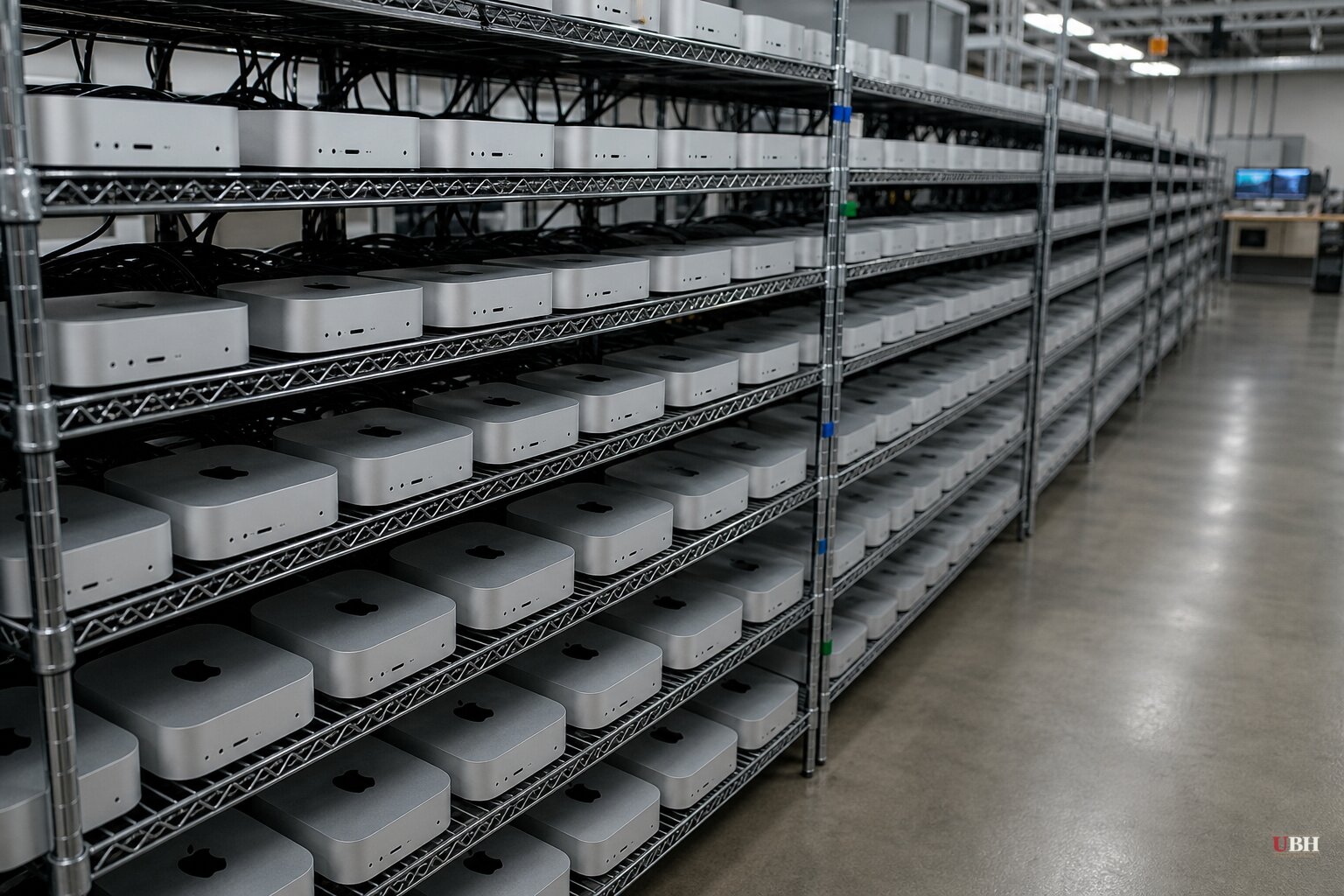
OpenAI has spent the past several months quietly buying up tens of thousands of Apple Mac mini and Mac Studio desktops, according to a report from The Information. The machines aren't going toward the massive GPU clusters OpenAI typically leases for pre-training large language models. Instead, they're reportedly feeding reinforcement learning pipelines and the training of "computer-use agents," AI systems designed to operate a computer the way a person would: clicking through software, editing code, organizing email, summarizing documents across multiple steps.
Neither OpenAI nor Apple has issued a public statement confirming the purchase, its scale, or its timing. The "tens of thousands" figure, the purchase timeline, and the stated use case all trace back to The Information's sourcing, repeated by outlets including MacRumors, VideoCardz, Wccftech and the Free Press Journal without independent verification of exact unit counts or dates. No procurement filing has surfaced publicly. The number should be read as reported, not confirmed.
Why Macs, of all things
The technical explanation multiple outlets converge on is memory architecture, not brand loyalty. Apple's unified memory design pools RAM across the CPU and GPU on a single chip. Nvidia GPUs, by contrast, use separate video memory and system memory, which creates a data-transfer bottleneck.
That distinction matters less for transformer pre-training, the matrix-math-heavy process that made Nvidia the default choice for frontier AI labs. It matters more for reinforcement learning with computer-use agents, which requires an AI to run inside an operating system, observe the screen, take an action, get feedback, and repeat that loop millions of times. That workload is memory-bound and comparatively light on raw parallelism. Apple's architecture turns out to be a practical fit rather than an exotic one.
OpenAI isn't alone in reaching this conclusion. Anthropic is reportedly renting Mac mini capacity through Amazon Web Services for similar reinforcement learning tasks, rather than buying the hardware outright.
Apple moves up its own product calendar
Apple normally refreshes Mac hardware around new iPhone launches. It didn't wait this time. On August 25, 2026, five days before The Information's report surfaced, Apple rolled out an updated Mac mini with M6 and M5 Pro chip options and a Mac Studio refresh built around M5 Max and M5 Ultra configurations, with added support for linking multiple units together, according to coverage from MacRumors and Wccftech.
The demand crunch shows up in delivery windows. Buyers ordering high-RAM Mac mini and Mac Studio configurations have seen wait times stretch from Apple's usual roughly two weeks to as long as two months for some Mac Studio configurations, according to the Free Press Journal. Apple's Mac segment posted roughly $10.3 to $10.4 billion in revenue last quarter, up close to 29% year-over-year, making it the fastest-growing product line in the company, ahead of iPhone and iPad, per figures cited by Crypto Briefing and KuCoin.
Apple held an enterprise event called "Business at the Park" on June 23 at Apple Park, attended by executives from Disney and Ford, Anthropic co-founder Jared Kaplan, and both Tim Cook and John Ternus, described in that report as Apple's outgoing and incoming CEOs respectively. That detail comes from a single account of the event and hasn't been independently corroborated elsewhere in the available reporting.
Nvidia isn't sitting still
The same week this reporting circulated, Nvidia's RTX Spark, a compact AI-PC chip pairing a Grace Arm CPU with Blackwell graphics, sold out to distributors months ahead of its scheduled fall 2026 launch. Asus told investors on an earnings call, as quoted by VideoCardz, that "the market response has far exceeded our expectations" and that its planned initial quantities were "already fully pre-ordered by our channel partner."
Two hardware shortages in the same news cycle don't automatically mean AI labs are strangling the consumer PC market. Apple's own sales bump could reflect ordinary consumer interest in running AI locally rather than a single company's bulk orders. Reporting from these outlets doesn't disentangle how much of the Mac demand surge is OpenAI-driven versus broader retail interest in local AI hardware.
The scale of the purchase, the exact dollar figure, and the precise timeline remain attributed to The Information's reporting rather than an on-record disclosure from either company.
Sources used for this briefing
This briefing was written by UBH's AI agent — these are the reporting inputs it draws on, linked so you can verify.


