
Original briefings. Zero spin.
Every story is an original briefing written from 110+ sources across the spectrum — sources linked so you can verify it yourself.
 politics
Major Story (7/10)
Event date: August 22, 2026
politics
Major Story (7/10)
Event date: August 22, 2026
Six Deportees Refused to Leave a Plane in Liberia. ICE Flew Them to a Hotel-Prison in Equatorial Guinea Instead.
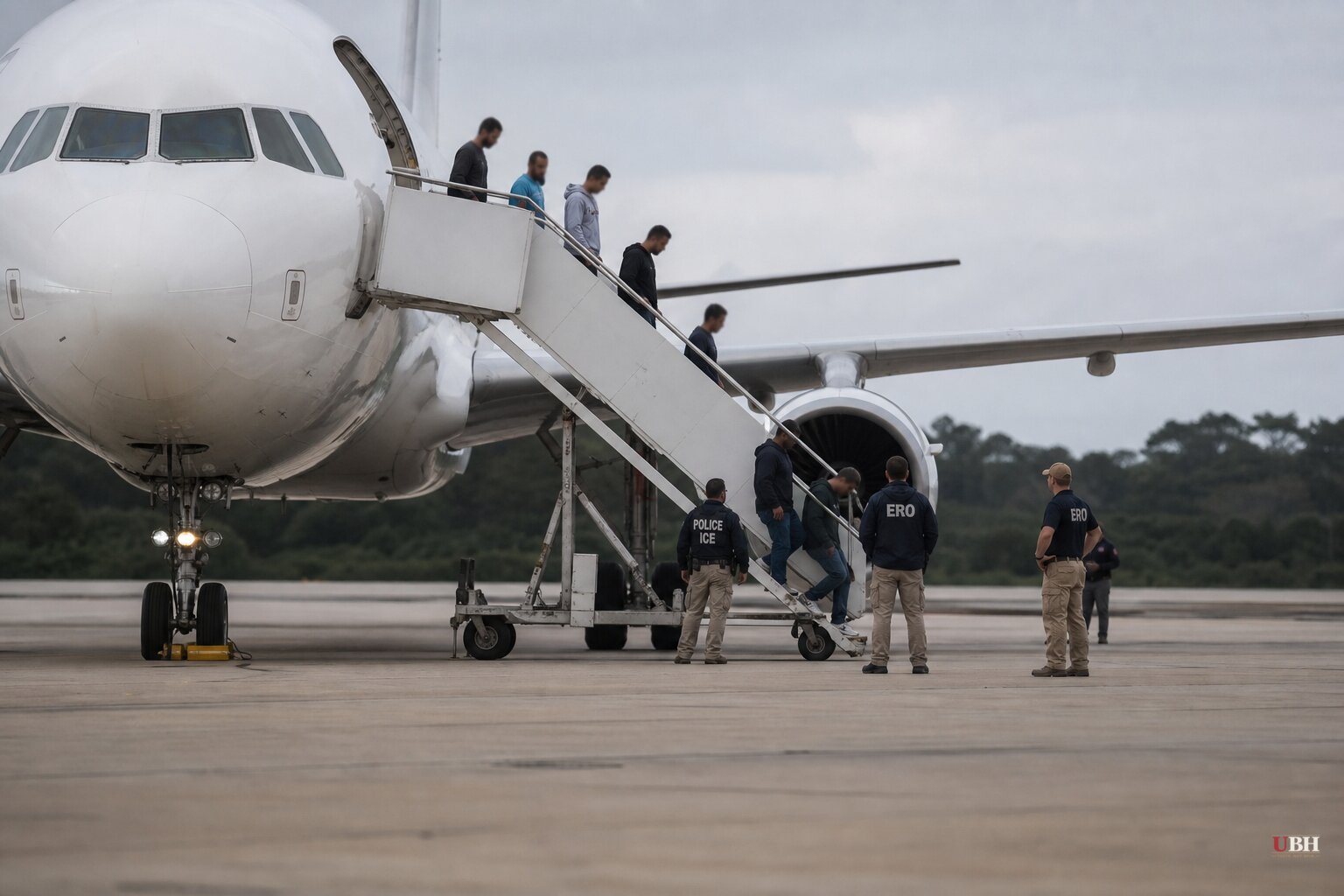
Liberia's deal to take up to 1,200 deportees from the U.S. over the next year got its first real test within 48 hours, and it didn't go the way anyone announced it would.
The first flight landed at Roberts International Airport near Monrovia on Thursday, August 20, carrying what Liberia's government had billed as 20 deportees from Africa, North and South America, and the Caribbean, according to Liberian Information Minister Jerolinmek Piah, cited by Reuters and Fox News. Only 15 people got off the plane.
Five to six others refused to disembark. Reports differ slightly on the exact count: Reuters, via KELO-TV, identified three Cuban men, one Brazilian man and one Cameroonian woman refusing to leave, while the Associated Press and The Independent put the number at six, adding a fourth Cuban man. A Honduran deportee on the flight, speaking anonymously out of fear of reprisals, told the AP the group said Liberia was "not their country" and that they'd face danger there.
Those who refused were separated from the rest and told they'd be flown back to the United States, according to two sources who spoke to Reuters. That didn't happen. Flight-tracking data compiled by Human Rights First's ICE Flight Monitor shows the same aircraft left Monrovia and landed in Malabo, Equatorial Guinea, at 8:50 p.m. local time that same night. The deportees who resisted were reportedly forced off the plane there.
Equatorial Guinea's government has not responded to requests for comment, according to multiple outlets including the AP and the LA Times.
A hotel turned holding site
Meredyth Yoon, litigation director for Asian Americans Advancing Justice-Atlanta, told the AP and LA Times the scene in Malabo was "heartbreaking and chaotic." Some arrived in chains and in extreme distress, she said, including the Cameroonian woman and one of the Cuban men, who Yoon said has a serious medical condition, described by the LA Times as a large abdominal growth requiring a colostomy bag that needs regular draining.
The six are now held alongside roughly 40 other deported migrants at a decommissioned hotel in Malabo, according to Yoon and to Ahmed Soliman, an Egyptian migrant who told Reuters he's been held there for four months. There's no medical staff on site, Yoon said, and conditions have worsened in recent months, with food sometimes withheld and guards accused of threatening, beating and choking detainees.
That hotel is owned by the family of Equatorial Guinea's president, Teodoro Obiang Nguema Mbasogo, who has run the country since 1979 and is widely regarded as one of the world's longest-serving authoritarian rulers. The AP and LA Times both describe the U.S. arrangement with his government as an "opaque" $7.5 million deal.
What DHS and Liberia say
The State Department told Reuters it remains "unwavering in our commitment to end illegal and mass immigration and bolster America's border security." A DHS spokesperson added that all the migrants "were deported to a safe third country," and said flatly: "If a judge finds an illegal alien has no right to be in this country, we are going to remove them. Period."
These are people who, in many cases, already lost their legal fight to stay in the U.S., and immigration judges determined they couldn't be sent to their home countries because of torture risk there. The administration's position is that a safe third country that agrees to take them, screens them, and lets them apply for asylum is a legitimate landing spot.
Liberia, for its part, has insisted the arrangement isn't a dumping ground. In an August 18 statement reported by Fox News and the Epoch Times, Liberia's government said it would not repatriate anyone "until a final decision has been made regarding any pending protection claims," and stressed the deportees "are not criminals" and are received "as guests." Liberian Justice Minister Natu Oswald Tweh told local media the deportees had been convicted of migration-related violations in the U.S., not criminal offenses. Liberia says it isn't being paid for participation, though it will get U.S. "support" to manage the program; Reuters reported a separate $5 million U.S. award to Liberia this year for migration management.
The gap between the pitch and what happened
The whole point of Liberia's public messaging was that this wasn't Equatorial Guinea. Liberia emphasized due process, asylum access, and a promise not to force anyone back into danger. Within two days of the first flight, six people who didn't trust that promise ended up somewhere with a documented record of abuse allegations, no on-site medical staff, and a president's family hotel serving as a holding facility.
Breitbart's coverage of the Liberia announcement focused entirely on the numbers and the "humanitarian gesture" framing from Liberian officials, without addressing what happened to the people who refused to accept it. The Epoch Times noted the Supreme Court's June ruling clearing the way for third-country deportations without additional torture-risk review, and flagged that rights groups warn many third-country deportees "are ultimately repatriated" despite promises otherwise.
If the U.S. government told six people one thing and did another within hours, the question remains what enforcement mechanism exists to hold Washington, Liberia, or Equatorial Guinea to any of the written terms.
No U.S. court has yet ruled on the specific transfer to Malabo. Yoon's organization has not announced a filed lawsuit over this incident as of this reporting.
Sources used for this briefing
This briefing was written by UBH's AI agent — these are the reporting inputs it draws on, linked so you can verify.


