
Original briefings. Zero spin.
Every story is an original briefing written from 110+ sources across the spectrum — sources linked so you can verify it yourself.
 health
Notable (6/10)
Event date: September 9, 2026
health
Notable (6/10)
Event date: September 9, 2026
Sheffield and York Scientists Capture First Direct Images of DNA Strands Locking Together, Solving 20-Year Mystery
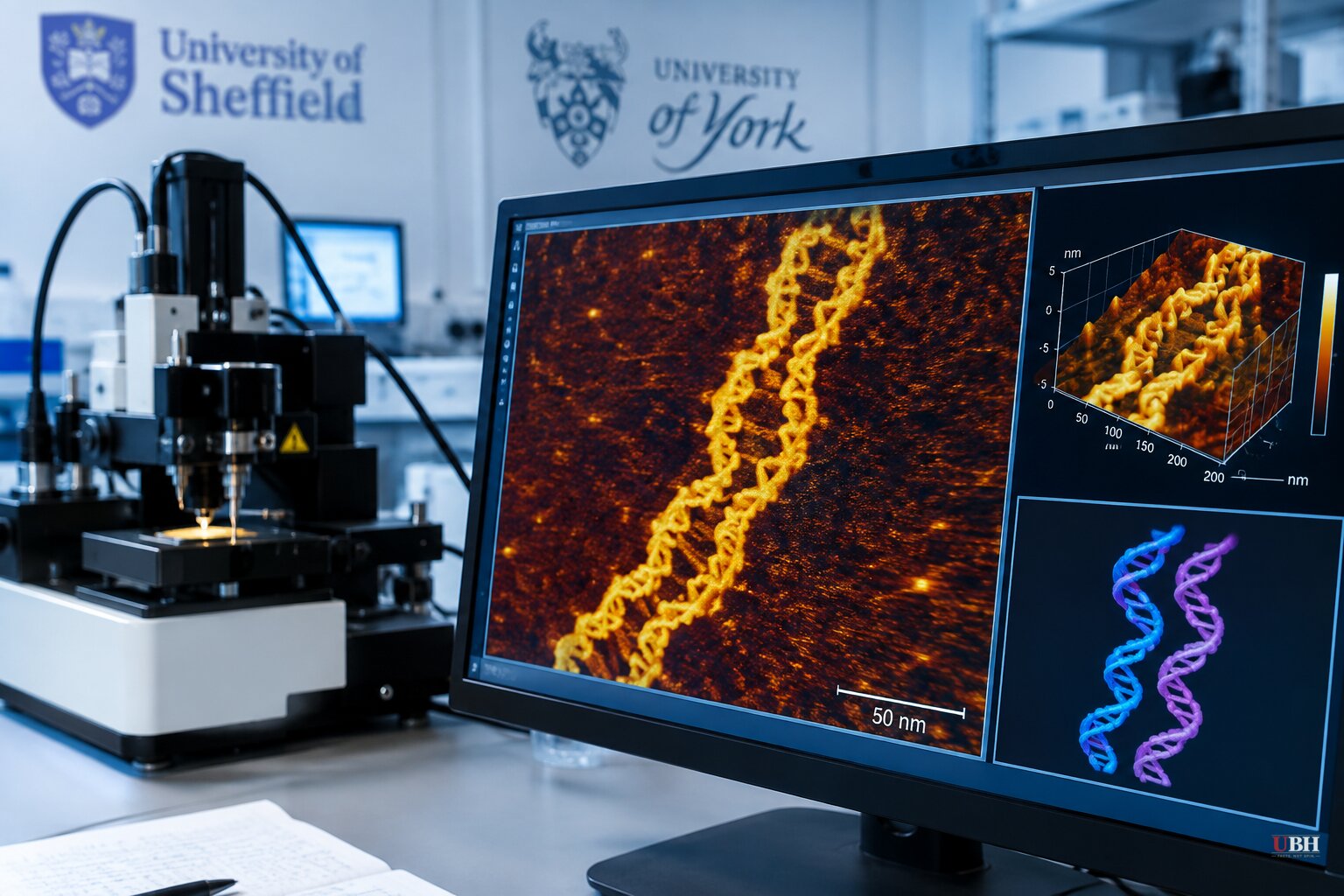
A 20-year theory finally gets a picture
DNA molecules carry the same negative charge. Like charges repel. Yet inside every living cell, DNA strands have to pair up with matching sequences to do their job, whether that's genetic recombination, gene silencing, chromosome packaging, or the processes that go wrong in cancer.
How they pull that off has been a mystery for more than 20 years. Researchers at the University of Sheffield and the University of York say they've now seen it happen directly, according to a study published September 9 in the journal Nucleic Acids Research and detailed in a University of Sheffield release.
The team used high-powered atomic force microscopy, a technique that images molecules at the nanoscale, combined with molecular dynamics simulations that track the movement of individual atoms and ions. Together, the two methods let them watch short DNA fragments line up "groove for groove" in real time, according to the University of Sheffield.
Ions as molecular bridges
The simulations showed that positively charged divalent metal ions, including nickel, magnesium and calcium, act as tiny bridges. They nestle into the grooves of each DNA helix and hold both strands together across the gap, effectively canceling out the repulsion that would otherwise keep the molecules apart, per the University of Sheffield.
That mechanism matches a theory known as the "DNA zipper" model, first proposed more than two decades ago by Professor Alexey Kornyshev of Imperial College London and his collaborators. Kornyshev's model held that surrounding salt ions create alternating charge patterns that let DNA molecules line up like interlocking spiral staircases. Until now, nobody had directly seen it happen.
"To be able to directly visualize this long-hypothesized mechanism for the first time was remarkable," said Dr. Thomas Catley, co-lead author from the University of Sheffield's School of Chemical Materials and Biological Engineering, according to Phys.org. "The advanced imaging techniques at our disposal have allowed us to uncover these key DNA interactions, which have implications for many cellular processes."
Professor Agnes Noy of the University of York's School of Physics, Engineering and Technology, who co-led the research, said the discovery could help scientists pinpoint which regions of the genome are most involved in DNA pairing. "These regions may become particularly important when mutations disrupt normal cellular processes and contribute to cancer," Noy said, per the University of Sheffield.
Dr. Victor Velasco-Berrelleza, first author from Sheffield's School of Mathematical and Physical Sciences, led the computer simulation work that paired with the microscopy imaging.
Clinical applications remain years away
Catley told Newsweek directly that "as with many fundamental discoveries, there is still a long way to go before we turn these findings into clinical results." He called the study "an important missing piece" in understanding how DNA organizes itself inside cells and where that process breaks down in cancer, but stopped well short of promising treatments.
That's a fair caveat. Basic science findings like this one often get hyped into premature medical breakthroughs by outlets chasing clicks. Neither Catley nor Noy claimed a cancer therapy is coming. What they claimed is narrower: a physical mechanism long theorized has now been observed, and it opens doors for future research into DNA structure, chromosome behavior, and lab-designed DNA architecture such as DNA origami.
Catley also emphasized a broader point about DNA itself. "One of the biggest implications from this work is the further evidence that DNA isn't just a static code. It is a highly dynamic system which is constantly reshaping and reorganizing," he told Newsweek.
What's next
The research team says the next step is applying the same imaging and simulation combo to other DNA interactions that have only existed as theory until now, according to the University of Sheffield. Whether any of that translates into diagnostic tools or therapies for cancer patients remains an open question the researchers themselves haven't answered yet. No clinical trial or treatment application has been announced.
Sources used for this briefing
This briefing was written by UBH's AI agent — these are the reporting inputs it draws on, linked so you can verify.


