
Unbiased headlines. Facts, not spin.
Unbiased Headlines is an independently owned news organization. We bring you the facts, not opinions, written fresh from 110+ named sources. Sources linked so you can verify it yourself.
 health
Notable (6/10)
Event date: October 20, 2026 ·
Share of Employers Covering GLP-1 Weight-Loss Drugs Falls to 53%, WTW Survey Finds
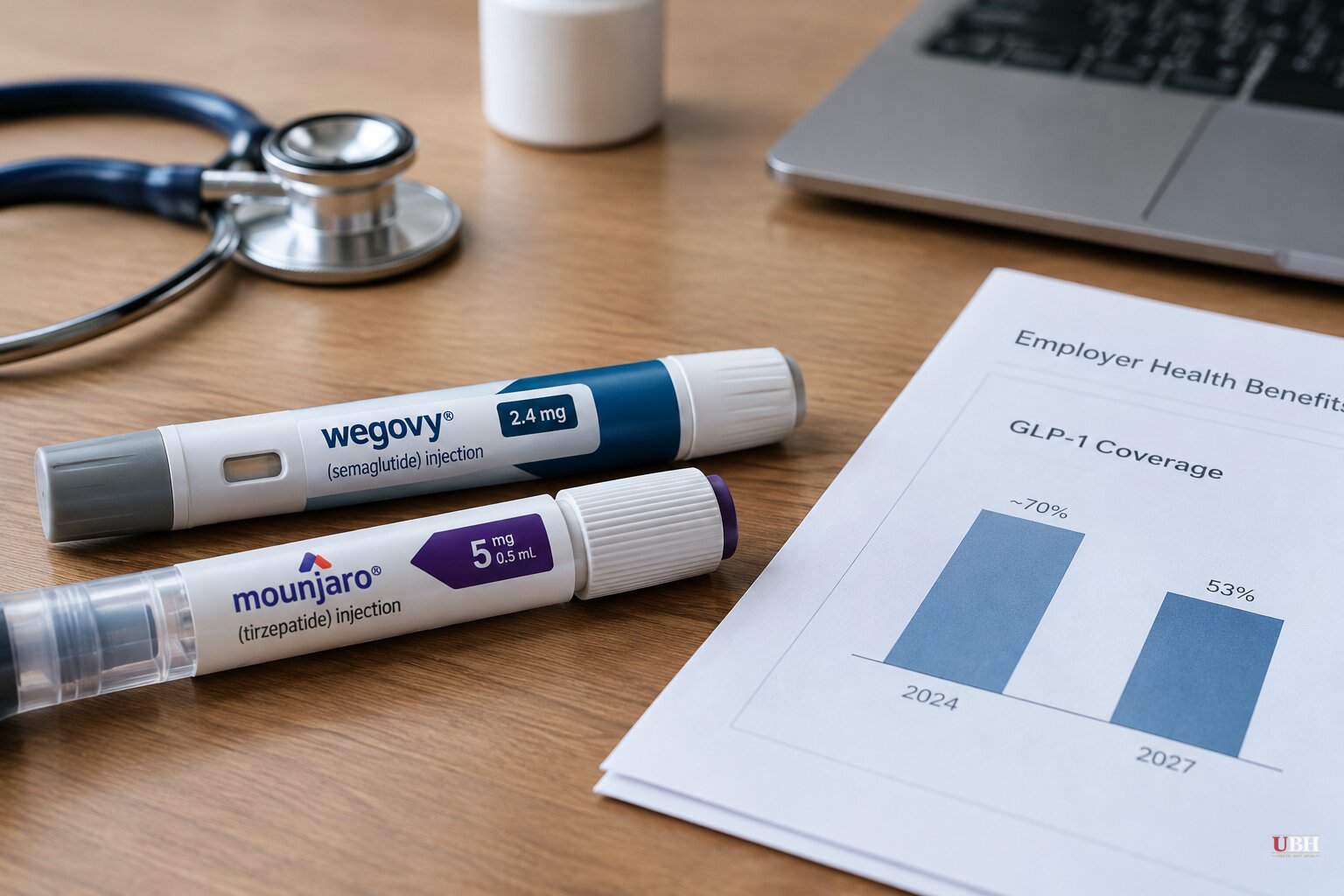
With open enrollment under way, employer plans are now trimming coverage of GLP-1 weight-loss drugs for 2027.
A WTW health benefits survey, fielded over the summer and due out in full Wednesday, Oct. 28, found that 53% of employers with more than 100 workers cover GLP-1s for weight loss. That is down from 57% in 2025 and the first decline in three years. Another 16% cover the drugs today but are considering dropping them, up from 9% a year ago.
The price tag employers are citing
The drugs typically cost employers in the mid-$500s to mid-$600s per user each month. Marsh, in a survey of more than 1,800 U.S. employers, projects health cost per employee will rise 8.2% on average in 2027, the biggest jump since 2003. Marsh attributes a full percentage point of that growth to GLP-1 use.
Aon is more pessimistic on the overall bill. It forecasts employer healthcare costs rising 9.5% next year, and Todor Penev, the firm's head of U.S. health analytics, said "the affordability crisis is real."
Workers are already absorbing the squeeze. KFF's Employer Health Benefits Survey found worker premium contributions rose 9% this year to nearly $7,500 for family coverage, while raises averaged 3.7%.
"Employers are really balancing empathy with economics," said Caroline Susie, a principal in Marsh's total health management practice.
Surveys disagree on the baseline
The numbers differ depending on who was counted. A Business Group on Health survey of 127 large employers found coverage for weight management fell from 72% in 2025 to 60% in 2026, and 14% have dropped or plan to drop it by 2027. Vox, citing the 2026 landscape, put coverage at roughly two-thirds of private employer plans. The WTW sample covers a broader set of companies than the large-employer group, so the figures are not directly comparable. The direction is the same in all of them.
Not everyone is walking away
Some employers say the spending is justified. Bank of America CEO Brian Moynihan told CNBC in August the bank spends "about $250 million or more on GLPs," up from zero four or five years ago. "We see a great impact on the employees," he said. "Believe me, we're pounding everybody on price and trying to get as cheap [as possible]. But our view is that [because of] the long-term health benefits... it's a good investment."
The sharper argument against dropping coverage comes from health economists. Dan Sacks, a healthcare economist at the University of Wisconsin-Madison, told Vox that an employer or insurer making these decisions "doesn't necessarily care if they're saving Medicare money." Vox's argument is that because workers change jobs, employers have little reason to pay for a drug whose payoff in heart and kidney health comes years later.
The cost side is also large nationally. Total U.S. spending on GLP-1 receptor agonists rose from $13.7 billion in 2018 to $71.7 billion in 2023, according to a JAMA Network Open research letter by AMA and CDC researchers. Diabetes-approved products made up 89% of the 2023 total, so the weight-loss share of that figure is much smaller.
What employers are offering instead
Some employers are steering workers to manufacturers' cash-pay channels, such as Novo Nordisk's NovoCare or Eli Lilly's LillyDirect. WTW found 8% of employers have done so and 28% are planning or considering it. Seth Friedman, pharmacy and health plans practice leader at Gallagher, estimated that 20% to 30% of the firm's clients have dropped coverage for 2027 and are sending employees the direct route.
Others are substituting a third-party weight management program, which employees may find a thin replacement for a covered prescription.
A middle path arrived Oct. 13, when benefits administrator Alight, based in Deerfield, Illinois, announced a GLP-1 health reimbursement account. Employers set a fixed budget and reimburse eligible drug costs rather than leave coverage open-ended inside the health plan. Alight says the HRA can run alongside HSA and high-deductible plans under IRS rules. Alight also reports GLP-1s made up 42% of the prescriptions it reviewed for members in 2026, up from 32% in 2024. That figure comes from Alight's own client base and has not been independently verified.
The tax structure matters. An integrated HRA has no IRS-set contribution cap but is hard to pair with an HSA-eligible plan. A standalone excepted-benefit HRA can cost workers their HSA eligibility if it pays before the deductible is met, so employers often restrict it.
What comes next
Employees on these drugs face a decision at open enrollment: pay cash, switch to a direct-purchase program, or stop. Vox reports people are weighing exactly that. The full WTW survey on Wednesday should show how many employers are moving from "considering" to dropping for plan year 2027, and whether capped reimbursement accounts like Alight's gain traction as a compromise.
Sources used for this briefing
6 links from 4 independent newsrooms (syndicated copies of the same report count once)
These are the sources it draws on, linked so you can verify.


