
Unbiased headlines. Facts, not spin.
Unbiased Headlines is an independently owned news organization. We bring you the facts, not opinions, written fresh from 110+ named sources. Sources linked so you can verify it yourself.
 health
Notable (6/10)
Sandoz Asks EU for Anti-Dumping Probe as China Supplies 86% of Bloc's Penicillin Imports
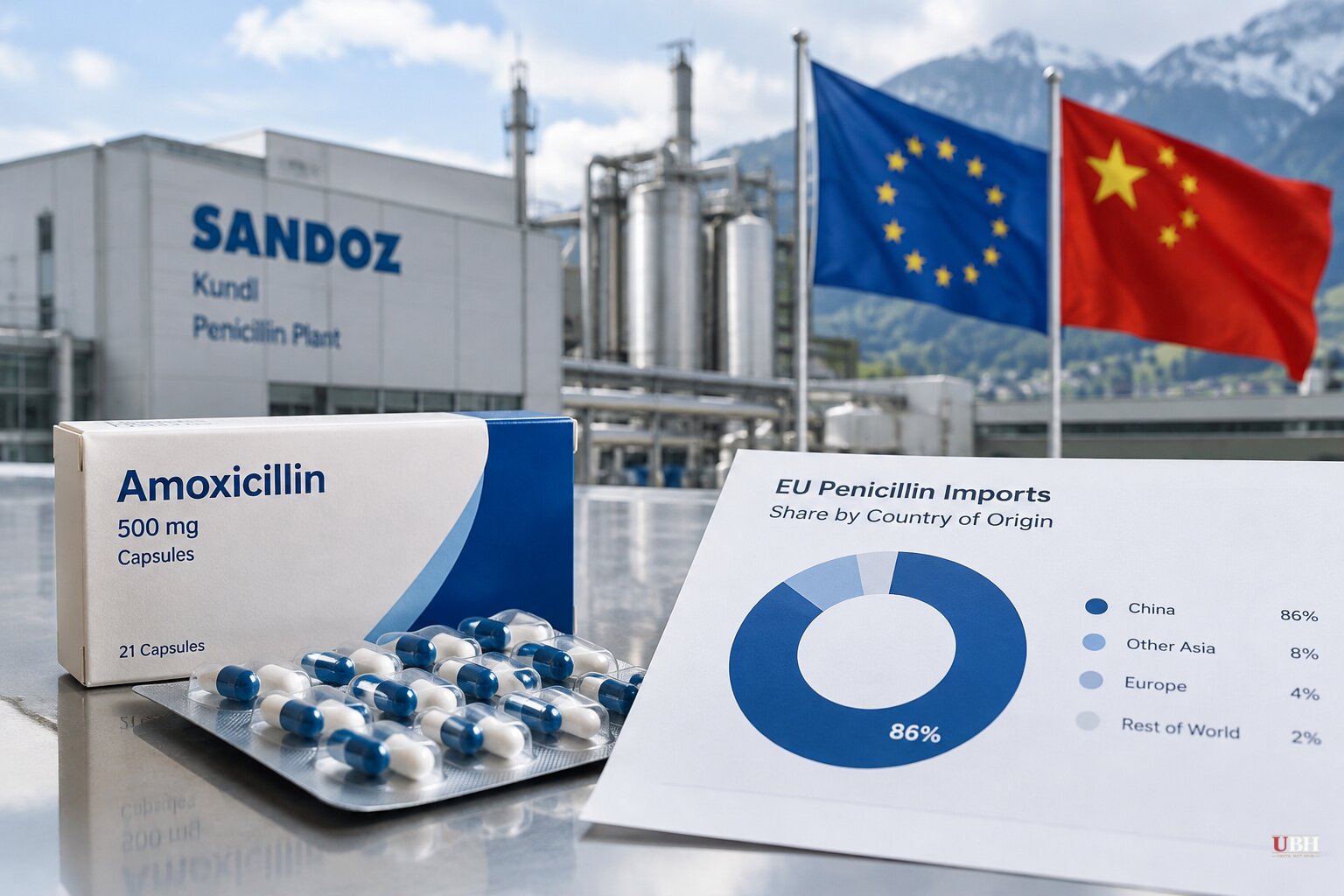
Europe's last fully integrated penicillin factory sits in the Austrian Alps, and its owner says it can't survive at current prices.
Sandoz, the Swiss drugmaker, runs the plant in Kundl. It is the only site in Europe that makes penicillin from start to finish, active ingredients included. In May, the company filed a complaint with the European Commission asking for an anti-dumping investigation into Chinese imports of the active ingredient used in amoxicillin.
If the Commission opens a probe and finds dumping, the result could be tariffs on Chinese product.
The numbers behind the complaint
Eurostat data shows China supplied 86% of EU imports of penicillins and their derivatives last year. In 2019 the figure was 44%.
European exports of these products are now barely a fifth of the record level reached in the early 2000s. China is the world's largest exporter of antibiotic ingredients. Europe administers roughly 1.5 billion daily doses of these drugs every year, and China dominates the manufacture of the ingredients.
Other producers have already announced plant closures or moved production to China. That leaves Kundl as the lone holdout.
What Sandoz says
"We're now the last remaining penicillin manufacturer left in the Western world," CEO Richard Saynor said. "Do you really want to be in a world where all of your antibiotics come from Asian suppliers? I don't think you do."
Sandoz accuses Chinese manufacturers of "market-distorting behavior" that lets them undercut rivals and "flood" global markets with ultracheap ingredients. "We're competing with heavily subsidized Asian players," Saynor said. Those are Sandoz's allegations. The Chinese foreign ministry, asked about trade differences with the EU, said they could be resolved through dialogue and consultation and that China "consistently opposes all forms of trade protectionism."
In written evidence to British lawmakers, Sandoz said production at Kundl is not commercially viable unless governments pay more for penicillin. It also called Europe's reliance on China an "Achilles heel" and warned that supply could become a "tool of economic coercion or hybrid warfare" during diplomatic tension.
Stephanie Jedner, who manages the Kundl site, told Reuters that if the plant closed, Europe "would be fully dependent" on China.
The price problem
The UK's National Health Service pays £1.06 ($1.41) for a 21-pack of 250mg amoxicillin capsules, according to the British National Formulary.
Saynor has pointed to candy as the benchmark. "Why should we sell a pack of antibiotics more cheaply than a Mars bar?" he asks, and he told Reuters it saddens him that a pack of antibiotics sells for less than a pack of Ricola candies in Switzerland or a Mars bar in the UK.
The other side of that ledger is real. Falling prices are a boon for cost-conscious European governments running public healthcare programs. Cheap Chinese supply is exactly what keeps those budgets down. Sandoz is asking those same governments to pay more, and to consider tariffs that would push prices up further.
Taxpayers are already in this
Sandoz asked for trade action just three years after a €200 million ($225 million) expansion at Kundl that included €50 million in public funds. Taxpayers have already put money into the plant, and the company says that wasn't enough to make it viable.
The EU's Critical Medicines Act, aimed at improving the availability and production of key medicines such as antibiotics and painkillers, was provisionally approved in May. Saynor calls it a step in the right direction. He also says the hard part is unresolved.
"What's not clear is how that then translates into European governments paying a little bit more for these drugs," Saynor said. "As always, everyone agrees with you, but the moment you ask for the check, everyone has suddenly left the table."
What comes next
Two decisions will determine whether Kundl keeps running. The first is whether the European Commission opens the anti-dumping investigation Sandoz requested in May. The second is whether any European government is willing to pay more per pack of amoxicillin to keep a domestic supplier alive.
Sandoz has put the plant's commercial viability on the table. Neither Brussels nor national health ministries have answered yet.
Sources used for this briefing
7 links from 4 independent newsrooms (syndicated copies of the same report count once)
These are the sources it draws on, linked so you can verify.


