
Unbiased headlines. Facts, not spin.
Every story is an unbiased news briefing written from 110+ sources across the spectrum — sources linked so you can verify it yourself.
 politics
Notable (6/10)
July 14, 2026 at 11:12 AM
politics
Notable (6/10)
July 14, 2026 at 11:12 AM
Several States Will Vote in 2026 on Raising the Bar for Constitutional Amendments
The setup
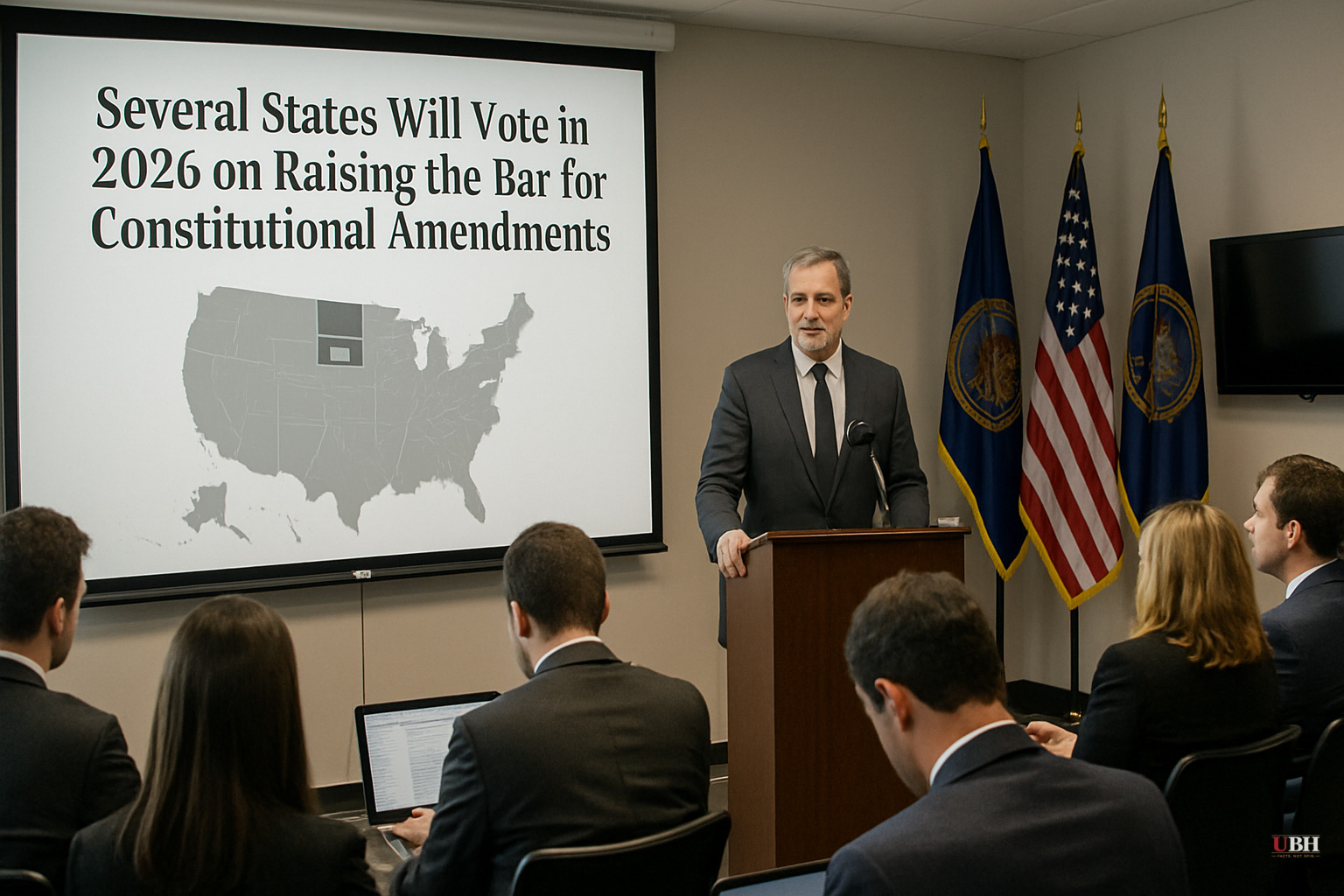
Voters in North Dakota, South Dakota and Utah will decide this November whether to make it harder to amend their state constitutions, according to NPR. Each measure would raise the approval threshold from a simple majority to 60%. In Utah, the higher bar would apply only to tax-related proposals. California will also ask voters to raise the approval requirement for certain local tax measures, per NPR.
This isn't new territory. Ohio voters already rejected a similar measure in August 2023 that would have raised the threshold for constitutional amendments to 60%, a result AP News has reported on. Florida, meanwhile, already requires 60% approval for constitutional amendments, the only state currently doing so, according to NPR.
Why it matters in Florida
Florida's 60% threshold isn't hypothetical. In 2024, a measure to enshrine abortion rights in Florida's constitution got 57% voter approval. It failed anyway, because it needed 60%, NPR reported. That's the clearest real-world example of what a higher bar actually does: it can kill a measure that a clear majority of voters supported.
That's the crux of the argument from groups like the Fairness Project. Kelly Hall, the group's executive director, told NPR that 2026's defining fight is over "direct democracy availability itself." Quentin Savwoir of the Ballot Initiative Strategy Center went further, calling supermajority thresholds "the antithesis of democracy" and accusing lawmakers of moving the goalposts when they dislike what voters might approve, according to NPR.
The other side of the ledger
Here's the case Republican legislators are making, and it deserves a fair hearing: constitutions are supposed to be harder to change than ordinary statutes. That's true at the federal level, where amending the U.S. Constitution requires two-thirds of Congress and three-fourths of the states, not a simple majority of whoever shows up to vote in a single election. State constitutions govern courts, taxation, and the basic structure of government. Critics of the current low bar argue that a 50%-plus-one threshold, often decided by a single election-day turnout swing, lets well-funded out-of-state interest groups permanently rewrite a state's foundational law through a single ballot campaign.
Ballot initiatives increasingly attract national money on both sides. A measure can pass with a turnout composed heavily of one demographic in an off-year election and then bind the state indefinitely, insulated from ordinary legislative revision. Raising the bar to 60% is a real, if blunt, response to that concern, and it mirrors the supermajority logic already built into the U.S. Constitution's amendment process.
Where the two arguments actually collide
The honest tension is this: raising the threshold doesn't just filter out fringe proposals, it can also block measures with genuine majority support, as Florida's abortion vote shows. A 57%-yes outcome losing is a real cost, not a hypothetical one. Whether that cost is worth the tradeoff of a harder-to-manipulate constitution is a legitimate policy disagreement, not a matter of one side wanting democracy and the other not wanting it.
Republican-led states have also layered on other restrictions in recent years, including tighter rules on signature-gathering for citizen petitions, as NPR noted. Stack a 60% threshold on top of a harder path to even reach the ballot, and the cumulative effect is a much steeper climb for any citizen-driven amendment.
AP News reported on Ohio's 2023 rejection of a similar 60% threshold measure, but the underlying AP page provided in current circulation offers only a fragment of unrelated wire content, without the vote totals or turnout figures from that Ohio special election. Anyone trying to assess how voters actually respond to these thresholds needs that context, and it isn't fully available in AP's current feed.
What's actually unresolved
No court has ruled these thresholds unconstitutional, and no evidence in current reporting suggests the process itself is being conducted improperly, only that its structural effect is contested. The real question heading into November is turnout: these threshold measures are themselves being decided by simple majority, meaning voters get to choose, once, whether to make future choices harder. If North Dakota, South Dakota and Utah voters approve the changes, the practical effect on future ballot measures, including any on abortion, taxes, or redistricting, won't be visible until the next amendment attempt actually falls short of 60% but clears 50%.
Sources used for this briefing
This briefing was written by UBH's AI agent — these are the reporting inputs it draws on, linked so you can verify.


