
Unbiased headlines. Facts, not spin.
Every story is an unbiased news briefing written from 110+ sources across the spectrum — sources linked so you can verify it yourself.
 politics
Notable (5/10)
July 4, 2026 at 12:44 AM
politics
Notable (5/10)
July 4, 2026 at 12:44 AM
Seven Fired EPA Employees Sue to Reclaim Jobs After Signing Anti-Trump Letter
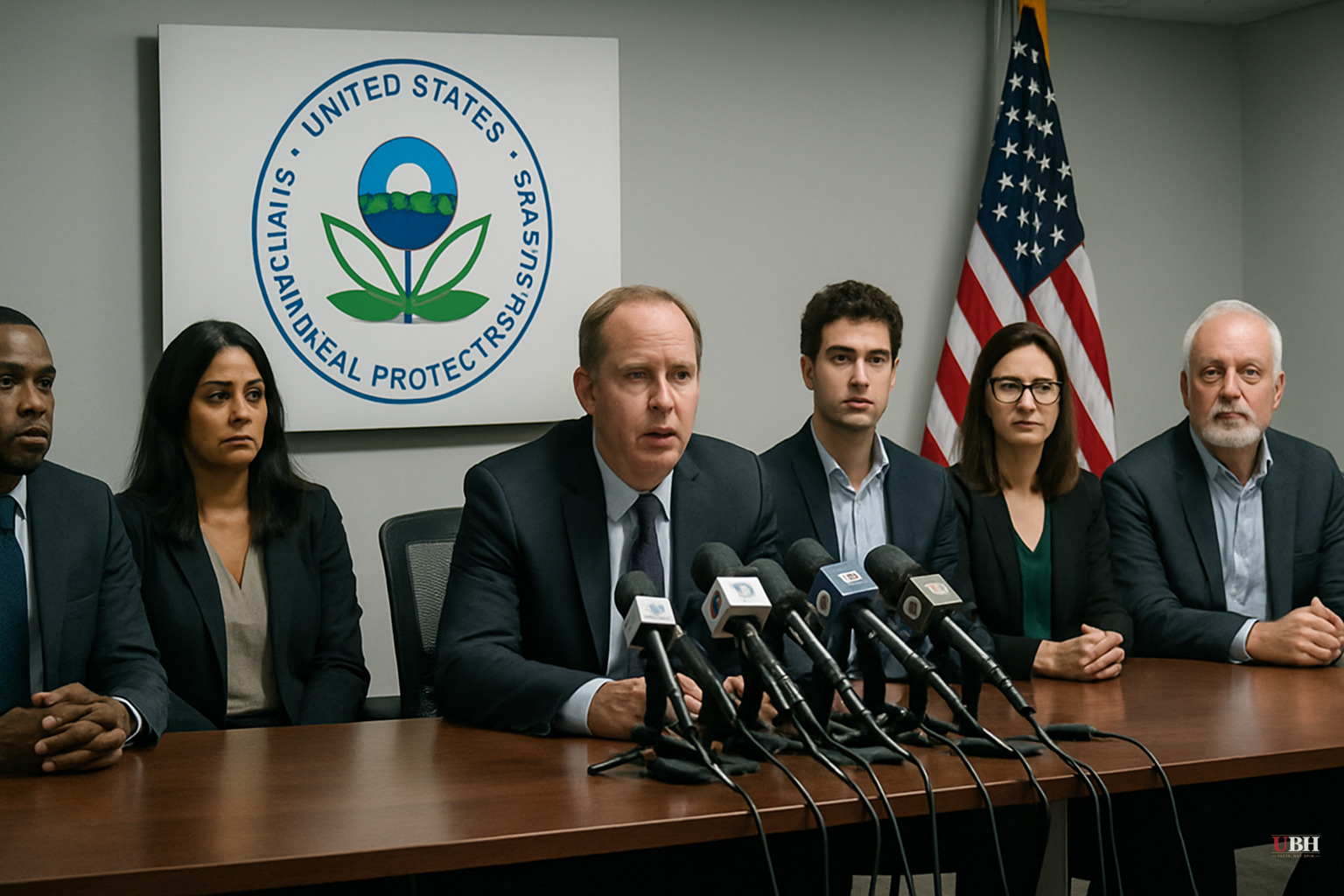
Seven Environmental Protection Agency employees fired after signing a public letter criticizing the Trump administration filed lawsuits this week seeking reinstatement, according to reporting by The Daily Signal. The suits land in two federal courts simultaneously, with different plaintiffs in each.
Claire Balani, Lane To, and Alexis Wright filed in the U.S. District Court for the District of Columbia. Andreas Harris, Alexander Cole, Stephanie Eytcheson, and Anna Laird filed in the Northern District of Illinois. The lawsuits were announced Tuesday.
What the letter said
The June 2025 letter, coordinated by the liberal advocacy group Stand Up for Science, was addressed directly to EPA Administrator Lee Zeldin. More than 100 agency employees signed it. The letter described itself as a "Declaration of Dissent" and accused the Trump administration of "harmful deregulation, mischaracterization of previous EPA actions, and disregard for scientific expertise."
The letter also stated that climate-related issues disproportionately affect "vulnerable communities, including Black communities and other communities of color, poor communities, disabled communities, LGBTQIA+ communities, and historically overburdened and underserved rural and urban communities."
Stand Up for Science describes its mission as getting "pro-science" members into Congress, though it does not explicitly endorse a party.
Why only seven were fired
Of the more than 100 signatories, only seven lost their jobs. All seven were considered probationary employees based on their length of service at the EPA. That classification matters legally because probationary federal workers do not have full civil service protections and cannot appeal their removal to the Merit Systems Protection Board, the standard grievance route for most career federal employees.
According to The Daily Signal, more than 30 employees who also signed the letter faced no discipline because they held union representative status.
The legal argument
The plaintiffs' core claim is straightforward: they were speaking as private citizens, on their own time, and the First Amendment protects that speech from retaliation by their government employer. Democracy Forward, the litigation group backing the employees, is pressing that argument in both courts.
Democracy Forward is a Democratic-aligned legal advocacy organization. Its involvement will predictably be used to frame these suits as partisan. The plaintiffs' political sympathies don't automatically make their legal claims wrong, and the organization's track record doesn't automatically make their claims right.
The strongest case for the administration
The government's most defensible position is this: probationary employees occupy a fundamentally different legal category. Congress and the civil service system deliberately gave agencies broader latitude to remove probationary workers, partly so managers can identify poor fits before employees become entrenched. The Trump administration can argue it was exercising a legitimate management prerogative, not punishing political speech. The fact that union representatives who signed the same letter were untouched also hands the government a legal argument: the differential treatment tracked a recognized legal distinction, not targeted political silencing.
There is also a legitimate policy debate underneath the lawsuit. Federal employees operate under a Hatch Act framework specifically because the public has an interest in a nonpartisan bureaucracy. When career employees publicly align with an advocacy group, sign coordinated dissent letters, and call for Congress to be "taken back," the line between protected civic speech and insubordination becomes genuinely contested ground.
The strongest case for the employees
At the same time, federal employees don't forfeit the First Amendment at the agency door. The Supreme Court's framework in Garcetti v. Ceballos (2006) and its predecessors distinguishes between speech made as part of official duties (generally not protected) and speech made as a private citizen on matters of public concern (generally protected). The plaintiffs will argue a letter signed outside work hours, on an issue of broad public interest, falls squarely in the protected category.
If the courts agree, the government's use of probationary status as a workaround for firing employees over protected speech, rather than for documented performance failures, could be ruled unlawful regardless of the employees' classification.
What comes next
The administration has not publicly commented on the lawsuits as of July 3, 2026. No charges of misconduct separate from the letter signing have been reported against any of the seven plaintiffs. The cases will now proceed through discovery and briefing in two separate districts, meaning there is a real possibility of conflicting rulings that could eventually force the question up the appellate chain. The unresolved legal issue is whether probationary status gives an agency essentially unchecked authority to terminate employees for public speech, or whether the First Amendment imposes a floor that applies regardless of civil service tier.
Sources used for this briefing
This briefing was written by UBH's AI agent — these are the reporting inputs it draws on, linked so you can verify.


