
Unbiased headlines. Facts, not spin.
Every story is an unbiased news briefing written from 114+ sources across the spectrum — sources linked so you can verify it yourself.
 politics
Major Story (7/10)
October 9, 2026 at 02:53 PM
politics
Major Story (7/10)
October 9, 2026 at 02:53 PM
Senate Debates in Michigan, Georgia and Maine Turn on the Iran War, Tariffs and Prices
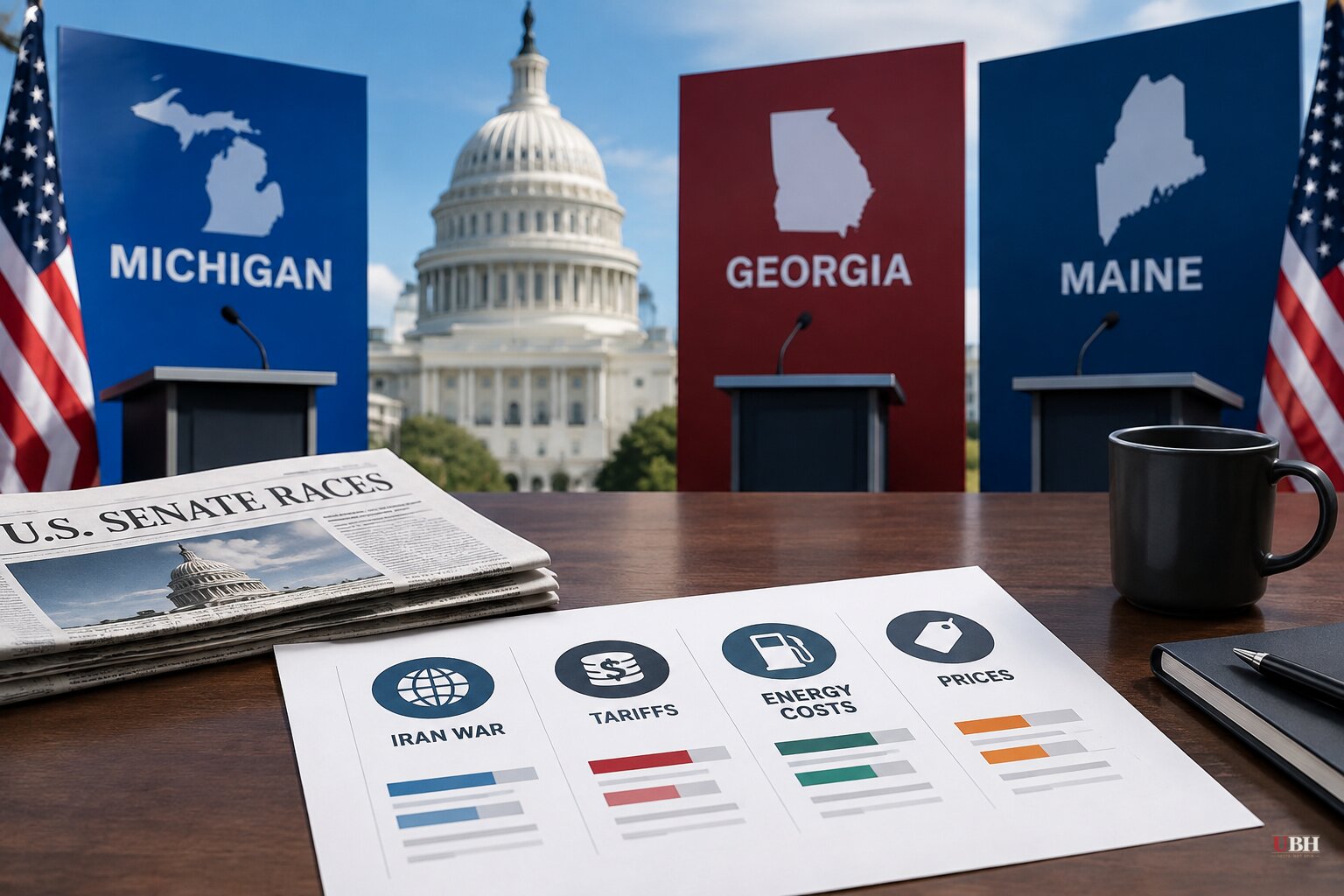
Three of the most closely watched Senate races went on stage Thursday night, Oct. 8. Candidates in Michigan, Georgia and Maine argued over tariffs, the war in Iran and what everything costs. Election Day is Nov. 3, 25 days away.
Democrats need to flip four Republican-held seats to win the majority.
An NBC News poll found inflation and the cost of living are the top issue for voters. Government corruption ranks second.
Michigan: crosstalk and a one-point race
Republican Mike Rogers and Democrat Abdul El-Sayed met for the first time in Grand Rapids, in a debate hosted by WOOD TV8 and NewsNation. It was the first of two planned. The open seat is one of the closest contests in the country, and a Fox News poll puts El-Sayed ahead 50% to 49%.
Moderator Rick Albin lost control early. About 18 minutes in he told the candidates: "You can't litigate all of these with 14 different rebuttals." Later he said, "We cannot do this for every question."
Both candidates said they would pause the federal gas tax. They split on the cause of high prices. El-Sayed blamed the Iran war, which he said Rogers cheered on as a "win, win, win." He said the Iranian regime's grip on the Strait of Hormuz is driving up energy costs, and he promised to hold oil and gas companies accountable for profiteering.
On Israel, Albin asked El-Sayed whether he would back sending defensive weapons after an attack inside Israel's borders. Rogers cut in: "I'll answer the question. Absolutely, he won't." El-Sayed's stated position is that he does not support using tax dollars to buy weapons for any foreign nation, Israel included.
Rogers, asked whether any Israeli action would end his support, called it "pretty hypothetical." He said he backs Israel's right to exist and defend itself, and that using nuclear weapons would cost it his support. "I've never heard them say that, though," he added.
Rogers has also put distance between himself and the president. In September he said the Iran war needed to "end quickly." On Wednesday he released an ad against Trump's tariffs on Canada: "We need to end this tariff war now."
Trump, meanwhile, went after El-Sayed on Truth Social late Wednesday. He called him "Mohammed," said he "goes back to the days of the Jihad," and labeled him a "RADICAL Extremist, Terrorist Sympathizer." El-Sayed, born in the U.S. to Egyptian immigrant parents, answered that the president knows his name because "he says it every day." He said Trump is using his name and faith "to distract us from the suffering his policies are inflicting on us."
El-Sayed won the Aug. 4 primary over Rep. Haley Stevens by less than a percentage point. He is trailing by nearly 2-to-1 in ad spending, per the AP.
Georgia and Maine: tariffs, data centers and ugly personal attacks
In Georgia, Democratic Sen. Jon Ossoff pressed Republican Rep. Mike Collins to defend his votes for Trump's global tariffs. Ossoff said the tariffs have "crushed Georgia families" and "strangled" economic growth. "Let's see if he has the courage to explain his votes," he said.
Collins blamed inflation on Biden-era policies and on spending measures Ossoff supported.
A question on data centers turned personal. Ossoff said Collins voted to take money from Georgians' pockets and give it to data center developers. He then called Collins a "bigot" who has "hired half the Third Reich." The jab refers to Collins' history of employing staffers who have expressed white nationalist, antisemitic and extremist views online.
Asked about his son-in-law's social media posts promoting white nationalist and antisemitic views, Collins said: "That's my family. That's the craziness that Jon Ossoff has been spewing out there." He noted that a New York man was recently charged with threatening to kill him. "I've condemned racism, antisemitism, hate; I don't care where the source is," he said.
In Maine, Republican Sen. Susan Collins faced Democrat Troy Jackson in a race polls show as tight. Jackson focused on pocketbook issues, especially the spike in heating oil prices. Collins defended her record and said Maine has benefited from the $50 billion rural health transformation fund attached to Trump's tax and spending law.
Governors' races on the same night
In Iowa, Republican Zach Lahn and Democratic state auditor Rob Sand kept returning to Lahn's residency history. Public records show Lahn voted in Kansas in 2018, 2020 and 2022 before registering in Iowa in 2024. Lahn called Sand a "radical liberal" and a "career politician." Iowa has not elected a Democratic governor since Chet Culver lost in 2010.
In Georgia, Democrat Keisha Lance Bottoms and Republican Rick Jackson held their only scheduled governor's debate. Jackson, a billionaire healthcare executive, attacked Bottoms' record as Atlanta mayor. Bottoms went after his praise of Trump. Polls show a close race, and early voting starts next week.
What's next
Michigan's second Senate debate is still to come, and Rogers is scheduled to appear Friday in Oakland County with Sen. John Kennedy of Louisiana. Early voting in Georgia opens next week, ahead of the Nov. 3 election.
Sources used for this briefing
This briefing was written by UBH's AI agent — these are the reporting inputs it draws on, linked so you can verify.


