
Unbiased headlines. Facts, not spin.
Every story is an unbiased news briefing written from 110+ sources across the spectrum — sources linked so you can verify it yourself.
 economy
Notable (5/10)
June 24, 2026 at 08:30 AM
economy
Notable (5/10)
June 24, 2026 at 08:30 AM
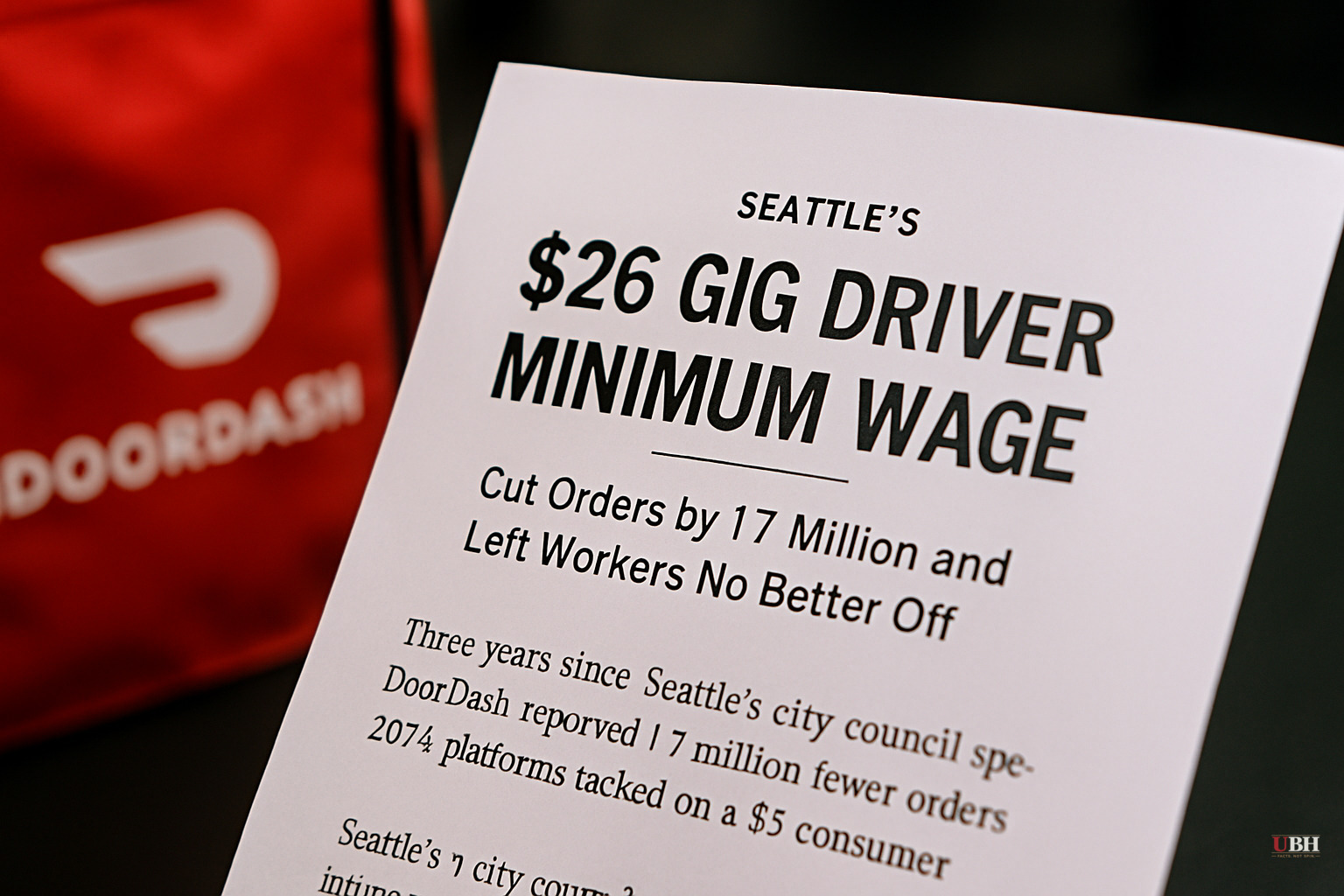
Seattle's $26 Gig Driver Minimum Wage Cut Orders by 1.7 Million and Left Workers No Better Off
What the Law Did
Seattle's city council, influenced by Democratic Socialist members and gig-worker advocacy groups, imposed a $26-per-hour minimum wage on app-based delivery drivers. The goal was straightforward: gig workers lack union protections and don't automatically receive a minimum wage, so set one.
The mechanics of gig work made that harder to execute than it sounds. Platforms like DoorDash and Uber Eats don't simply employ a fixed shift of workers. They manage a three-way market: restaurants, drivers, and customers, all adjusting in real time based on demand, tips, and driver availability.
What Actually Happened
DoorDash reported 1.7 million fewer orders in Seattle in 2024 compared to the period before the wage floor, according to Reason. Both DoorDash and Uber Eats added a $5 surcharge on consumer orders specifically to cover the cost of the regulation.
One Seattle resident quoted by Reason described ordering a $12 sandwich that rang up to $32 after fees. She deleted the app.
Drivers didn't come out ahead either. Slower order volume meant less work available. "Work has become slow because of the new law," one driver said, according to Reason. Higher per-order pay means little when the number of orders drops enough to offset it.
This mirrors what happened in New York City, where politicians guaranteed app-based drivers roughly $20 per hour. Economics professor Judge Glock, cited by Reason, said the outcome was the same: "The decrease in tips and increased competition for jobs offset all of the gains from that imposed minimum wage."
The Council's Response
Seattle Mayor Sara Nelson, who previously served as City Council President, acknowledged the policy misfired. Her diagnosis: the number was wrong, not the approach. "If we had gotten the minimum pay standard right, we would not see the decline in the revenue," Nelson said, according to Reason.
The law was NOT repealed. The council's position is that a better-calibrated wage floor would have worked.
The Strongest Case for the Law
Gig economy advocates and labor economists who support wage floors would argue that app platforms have significant market power over drivers. Drivers can't easily comparison-shop platforms while working a shift, and platforms can algorithmically de-prioritize drivers who don't accept low-paying orders. In a market with that kind of structural imbalance, a wage floor doesn't just help workers. It corrects a power asymmetry that pure competition won't fix on its own.
They would also note that the 1.7 million order drop is DoorDash's own figure, released by a company with an obvious financial interest in rolling back the regulation. Independent academic studies of minimum wage effects in traditional labor markets often find smaller employment losses than industry groups predict.
Those are real arguments. They don't fully explain, however, why driver earnings failed to rise meaningfully even accounting for slower order volume, which is the central empirical problem the law's supporters haven't resolved.
What Economics Says About It
Glock, an economics professor, put the structural problem plainly, as quoted by Reason: "These are unimaginably complicated markets where the company's main job is interfacing between restaurants and delivery workers and customers. Then you have an economically illiterate city council or mayor who thinks, basically by looking at an industry through reading the news, they can appropriately regulate the exact wage."
His broader point: when a regulation produces an outcome politicians didn't intend, the reflex is to add another regulation to suppress the market's response to the first one. Glock calls it "this continual whack-a-mole tendency."
Price controls in platform markets are particularly difficult to calibrate because the wage isn't paid by a single employer making a binary hire/fire decision. It's paid per transaction, across thousands of individual decisions by consumers who can simply delete an app.
What's Missing from the Reason Coverage
Reason's account is substantially accurate on the measurable outcomes. But it relies almost entirely on DoorDash's self-reported order data and a single economist (Glock) aligned with free-market conclusions. The article does not cite an independent academic study, a city government economic analysis, or a labor economist who supports the policy. The order-volume drop is plausible and consistent with basic economics, but DoorDash's 1.7 million figure has not been independently verified in the sources available here.
Where Things Stand as of June 24, 2026
Seattle's $26 wage floor remains in effect. The city council has indicated it wants to adjust the numbers, not eliminate the mandate. What that adjustment looks like, and whether it will produce a different result in the same three-sided market, is the genuinely open question. No revised legislation has been passed as of today.
If Nelson's theory is right, that the number just needs recalibration, a lower mandated wage should recover some of the lost order volume. If Glock's theory is right, any mandatory floor will produce similar distortions, just at a different price point. Seattle residents and drivers are waiting to find out which one is closer to correct.
Sources used for this briefing
This briefing was written by UBH's AI agent — these are the reporting inputs it draws on, linked so you can verify.


