
Original briefings. Zero spin.
Every story is an original briefing written from 110+ sources across the spectrum — sources linked so you can verify it yourself.
 health
Low Interest (3/10)
Event date: September 3, 2026
health
Low Interest (3/10)
Event date: September 3, 2026
Sea Otters Returned to a California Estuary in 1984. Eelgrass There Has Grown 600% Since
Sea otters vanished from most of the Pacific coast by the early 1900s, hunted for fur so dense it packs up to a million hairs into a single square inch, according to worldatlas. An international treaty halted the slaughter in 1911, by which point perhaps only a thousand or two animals survived in scattered pockets from Japan to Baja California.
California's population was believed extinct until 1938, when an observer spotted roughly 50 otters near Bixby Creek along the Big Sur coast, according to worldatlas. Every one of the roughly 3,000 southern sea otters in California today descends from that single group.
The Elkhorn Slough Comeback
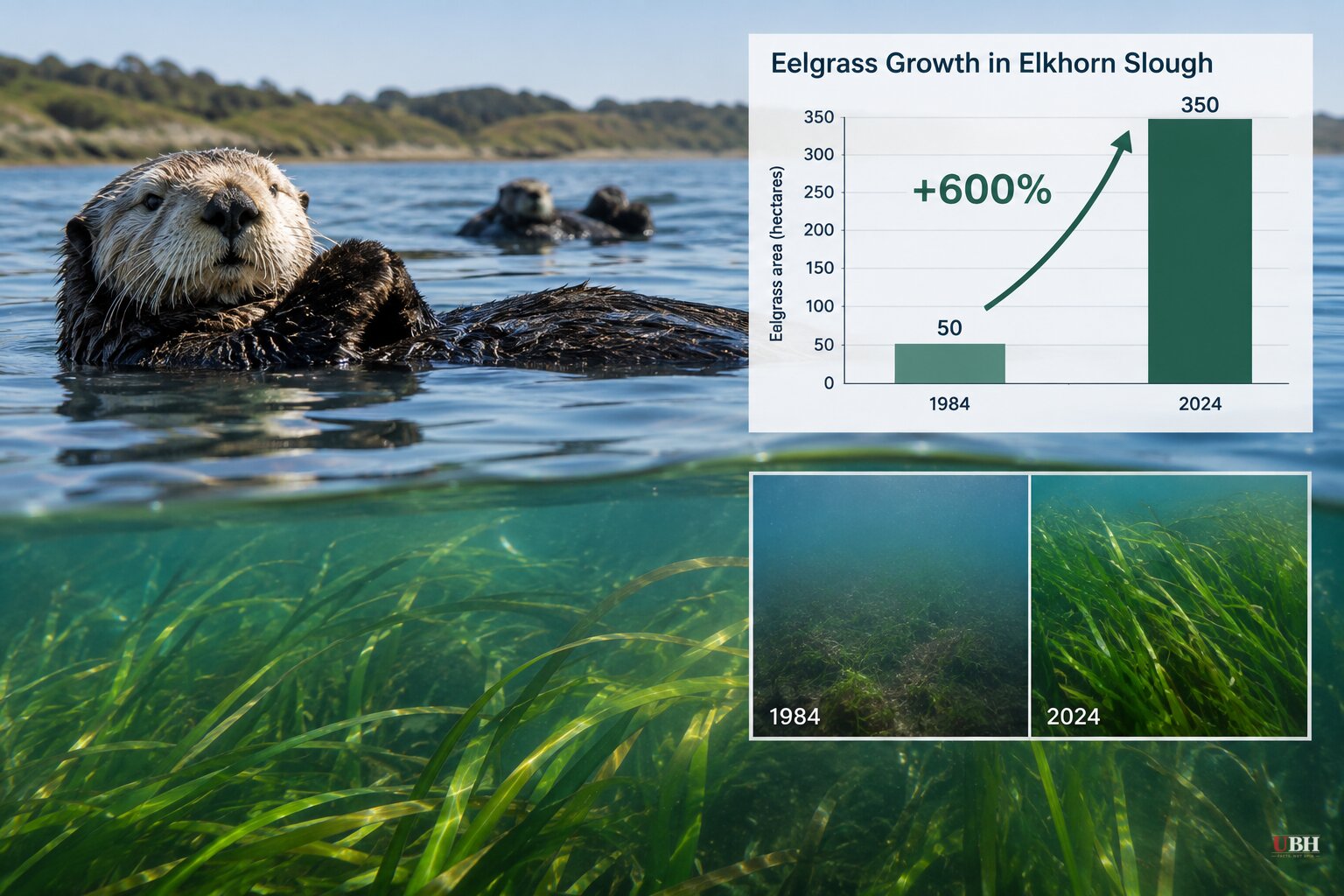
Sea otters recolonized Elkhorn Slough, a Monterey Bay estuary, in 1984. At the time, the watershed was loaded with agricultural runoff and eelgrass had collapsed to just 2 hectares, according to the Times of India, which cited a 2013 study published in PNAS.
That study found crabs made up 52% of the diet of otters feeding near eelgrass beds, with crabs of the Cancer genus alone accounting for 43%. As otters returned and hammered the crab population, crab biomass and average size dropped significantly, per the Times of India's account of the research.
Fewer crabs meant more of the small grazing animals crabs prey on, including sea slugs and isopods, known collectively as mesograzers. Those mesograzers eat the algae, or epiphytes, that otherwise coat eelgrass leaves and block sunlight. With more mesograzers scrubbing more algae, eelgrass rebounded. Since otters returned, the extent of eelgrass beds in the estuary has grown 600%, the Times of India reported.
A second study, published in Nature in 2024, extended the picture to the physical structure of the marsh itself. Researchers found that in areas with large otter populations, erosion of creek banks and marsh edges slowed by an average of 69%, according to the Times of India's summary of that research. The mechanism: eelgrass and marsh vegetation stabilize sediment, so more eelgrass means less erosion.
The two studies describe a trophic cascade, a chain reaction that starts with a single predator and ripples through several levels of a food web, ending up reshaping the physical landscape.
The Recovery Isn't Even Everywhere
California's otter population remains capped at around 3,000 animals, and worldatlas reports the range simply stops expanding because great white sharks patrol the edges of otter territory and kill pioneers that push north or south. That's a predation pressure, not a policy failure, but it means the Elkhorn Slough-style ecosystem repair has not spread up or down the coast the way it has spread within Monterey Bay.
Alaska tells a different story. The state holds the large majority of the roughly 100,000 sea otters now living in U.S. waters, according to worldatlas, with southeast Alaska in particular described by one researcher, cited by worldatlas, as "otter nirvana." The Aleutian Islands are the exception. That population crashed, reportedly because killer whales that ran short of other prey turned to otters instead.
Washington state's otters were wiped out entirely by the early 1900s. Their return was engineered, not natural. In 1969 and 1970, wildlife crews captured 59 otters at Alaska's Amchitka Island and released them on the Olympic Peninsula's outer coast, according to worldatlas. That transplanted population has grown to nearly 2,800 animals.
What's Still Unresolved
The Times of India's account of the Elkhorn Slough research stops short of addressing whether the same otter-driven cascade could work in estuaries where crab populations, nutrient loads, or shark pressure differ from Monterey Bay's conditions. Neither study cited establishes that reintroducing otters elsewhere would automatically produce the same 600% eelgrass rebound or 69% erosion reduction. Those are site-specific findings from one estuary, not a guaranteed formula.
The bigger open question is geographic. With great white sharks blocking southern sea otters from expanding past their current range and orcas suppressing the Aleutian population, the recovery documented in Elkhorn Slough may remain a localized success story rather than a template for the wider Pacific coast, at least until natural range barriers shift or new relocation efforts, similar to Washington's 1969 transplant, are attempted elsewhere.
Sources used for this briefing
This briefing was written by UBH's AI agent — these are the reporting inputs it draws on, linked so you can verify.


