
Original briefings. Zero spin.
Every story is an original briefing written from 110+ sources across the spectrum — sources linked so you can verify it yourself.
 health
Notable (6/10)
August 19, 2026 at 01:04 AM
health
Notable (6/10)
August 19, 2026 at 01:04 AM
Scientists Fight Warming-Driven Mosquito Surge With Lab-Bred Bugs and Border Sensors
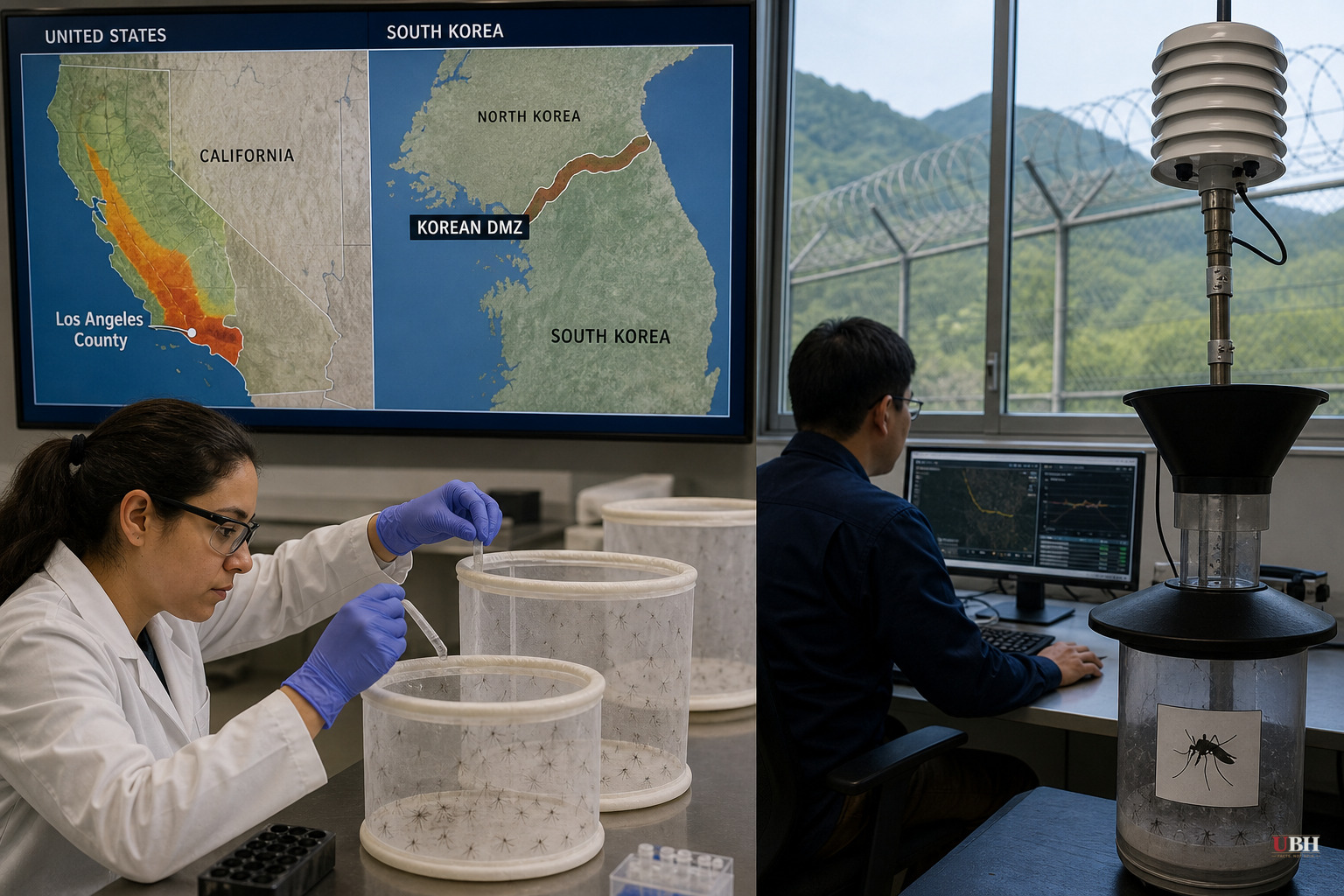
Mosquitoes kill more people worldwide than any other animal, according to PBS News. As the climate warms, the season in which they breed and bite is stretching longer, giving them more time to spread diseases like dengue, Zika, West Nile virus and malaria.
Two very different responses are underway right now, one in suburban Los Angeles and one along the Korean peninsula's most heavily militarized border.
Lab-Grown Mosquitoes vs. Wild Ones
In the San Gabriel Valley east of Los Angeles, Tristan Hallum directs scientific programs for the San Gabriel Valley Mosquito and Vector Control District. His team is receiving shipments of lab-raised male Aedes aegypti mosquitoes, infected with a naturally occurring bacteria, overnight from Kentucky, according to PBS News.
The math is simple. Male mosquitoes don't bite. They mate with wild females, and the bacteria they carry prevents those eggs from hatching. Hallum's district is releasing roughly 30,000 of these mosquitoes a week, and expects to release just under half a million total, per PBS News.
Hallum told PBS News his district was among the first in the country to see local dengue transmission, a few years back. Dengue used to be something Americans caught traveling abroad, not something spreading person-to-mosquito-to-person inside Los Angeles County.
The technique isn't experimental guesswork. Hallum said prior studies of similar programs have shown 80 to 95 percent reductions in mosquito populations in treated areas. His district is now trying to confirm whether that holds up locally.
The approach is targeted and inexpensive, without blanket pesticide spraying. That means no chemical fog trucks rolling through neighborhoods every summer.
South Korea Watches Its Most Dangerous Border for Bugs, Not Just Soldiers
Roughly 6,000 miles away, South Korea is running a very different operation against the same enemy. Along the Demilitarized Zone dividing North and South Korea, health officials have installed 76 mosquito-tracking devices nationwide, some positioned near the DMZ itself, according to Breitbart, citing Agence France-Presse reporting.
The DMZ is a four-kilometer-wide strip of land that's been essentially unvisited by humans since the 1953 armistice. It's become a wildlife refuge, an Asiatic black bear was photographed there in 2018, but it's also, per Kim Hyun-woo of Korea's Disease Control and Prevention Agency, an ideal mosquito breeding ground: stagnant water, plenty of wild animals to feed on, and zero pest control because nobody can safely walk through a minefield to spray it.
Some malaria-carrying mosquitoes can fly up to 12 kilometers, meaning they don't need a passport to cross the world's most fortified border.
South Korea thought it had eliminated malaria. Then in 1993 a soldier stationed at the DMZ turned up infected, according to Breitbart. The disease never fully left. Cases jumped nearly 80 percent in a single year, from 420 in 2022 to 747, per the same report. The South issued a nationwide malaria warning this year.
Kim Dong-gun, an environmental biology professor at Sahmyook University in Seoul, told AFP the DMZ simply "is not an area where pest control can be carried out." The most sensitive military border on Earth is also a mosquito sanctuary, and nobody's spraying it.
North Korea's situation is worse and far less documented. World Health Organization data cited by Breitbart shows nearly 4,500 malaria cases there between 2021 and 2022. Choi Jung-hun, a doctor who defected from North Korea in 2011 and now practices in the South, told AFP the North is "a republic of infectious diseases." He said outdated equipment, including old microscopes, delays diagnosis, and that malnutrition and unhygienic standing water make the population especially vulnerable.
Cooperation between the two Koreas on mosquito control would make scientific sense, since the insects clearly don't respect the DMZ's barbed wire. But North and South remain technically at war, and there's no indication in current reporting that any joint mosquito-control effort is happening or planned.
Different Threats, Same Root Cause
The California and Korea stories aren't really about the same disease. Los Angeles is worried about dengue and Zika from Aedes aegypti. Korea is worried about malaria from a different mosquito species tied to the North's stagnant, unmanaged wetlands. Both trace back to the same driver: warmer springs, heavier rainfall, and longer breeding seasons giving mosquitoes more real estate and more time to multiply.
Neither approach is a permanent fix. California's bacteria-based method requires continuous weekly releases to keep working. Korea's sensor network can detect malaria carriers crossing the border, but it can't spray or drain the DMZ itself. The open question is whether either program scales fast enough to keep pace with an insect that, according to public health data cited by both outlets, is expanding its range and its case count year over year.
Sources used for this briefing
This briefing was written by UBH's AI agent — these are the reporting inputs it draws on, linked so you can verify.


