
Original briefings. Zero spin.
Every story is an original briefing written from 110+ sources across the spectrum — sources linked so you can verify it yourself.
 health
Low Interest (4/10)
Event date: August 10, 2026
health
Low Interest (4/10)
Event date: August 10, 2026
Scientists Create Two Gene-Edited Beagles With No Detectable Dog Allergen
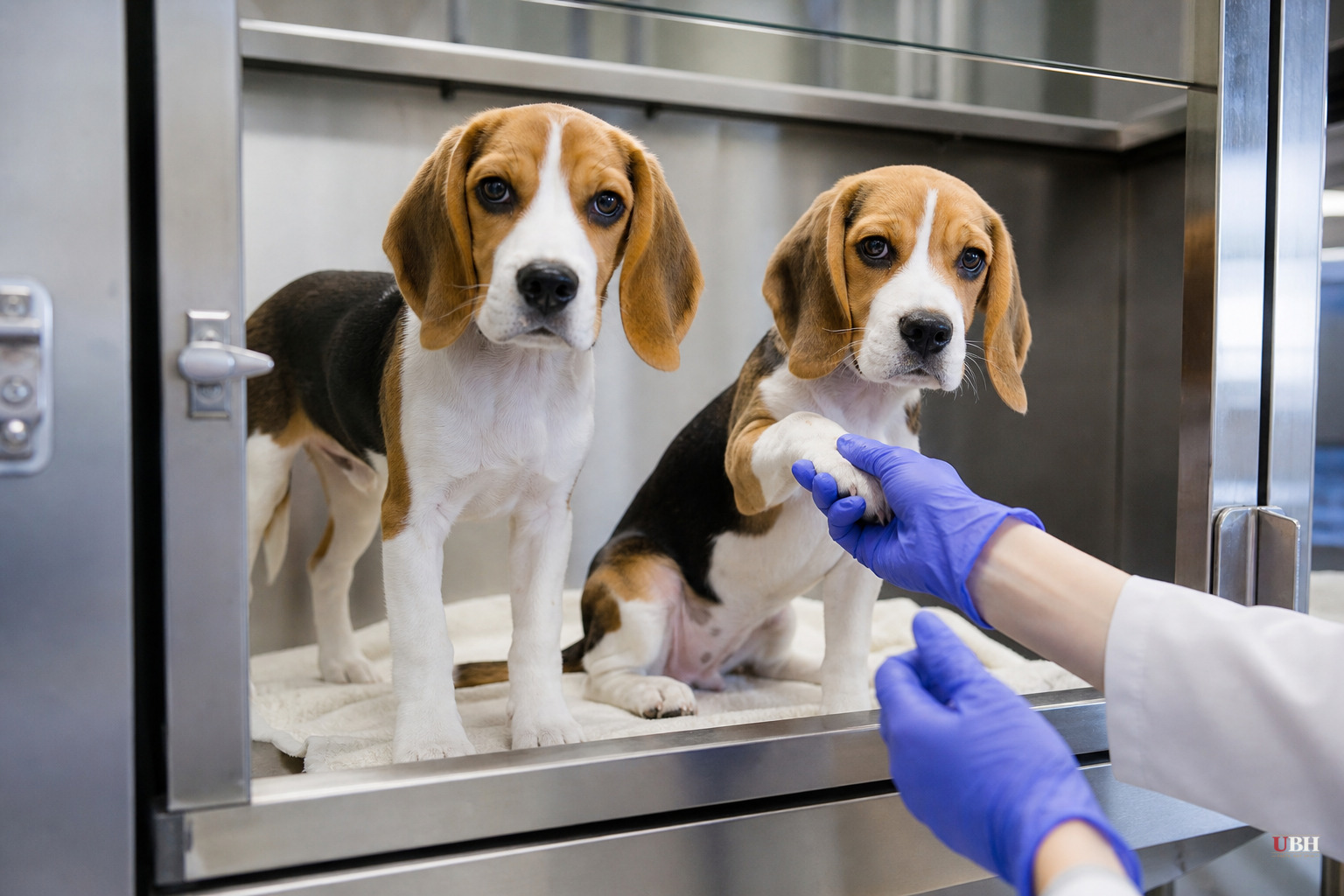
Two beagles named Bailey and Alfie were born in September 2024 with a piece of their DNA deliberately switched off. Since then, researchers have been watching them grow and running allergen tests. The results, published this month in The CRISPR Journal, are now public, and they're getting attention from Newsweek, The Associated Press, The Washington Post and several other outlets.
The company behind the work, Kindred Companion Sciences, used CRISPR gene editing to eliminate a protein called Can f 1, the primary allergen responsible for most human reactions to dogs. Lab tests found no detectable Can f 1 in the dogs' saliva, hair or dander. Extracts from the edited dogs produced no allergic skin response in the one sensitized human test subject, according to the study.
Matt Walker, the geneticist who led the research, has a personal stake. He's allergic to dogs himself and never had one growing up. Now, according to the Associated Press and The Washington Post, he feeds Bailey peanut butter off a spoon and plays fetch with her in Central Park without reaching for a tissue. His allergies haven't disappeared. Bailey just stopped triggering them.
How they did it
The process started in a lab, not a delivery room. Scientists took dog DNA, used CRISPR to deactivate the gene responsible for producing Can f 1, then inserted that edited DNA into eggs implanted in a surrogate beagle mother, according to the Daily Mail. That surrogate gave birth to Bailey and Alfie in September 2024.
This isn't the industry's first attempt at an allergy-free dog. Companies have tried cloning before. The Daily Mail reports those efforts produced unhealthy puppies too genetically similar to each other to build a stable population. CRISPR editing sidesteps that problem by making a single, targeted change rather than duplicating an entire genome.
Walker described the approach as narrow by design. "Our goal is not to redesign dogs, but to make a minimal and precise change that addresses a real problem," he told Newsweek. The edit involved a single-letter change in the dogs' DNA at one specific site.
Popular hypoallergenic breeds don't actually work
Poodles, Labradoodles, Portuguese Water Dogs and other breeds marketed as hypoallergenic don't reliably produce less allergen. The CRISPR Journal paper states that testing has "found that breeds marketed as hypoallergenic do not yield consistently lower environmental exposure," according to The Week's reporting on the study.
Vet Candy points out that even the Obama family picked Portuguese Water Dogs Bo and Sunny partly because Malia Obama has dog allergies, following the popular assumption about that breed. The science says that assumption is shakier than the marketing suggests. Dog allergies affect an estimated 10 to 20 percent of the global population, per Vet Candy, and it's proteins in saliva and dander, not fur itself, that set off most reactions.
Don't expect one at the shelter soon
Every outlet covering this story agrees on one thing: this is years away from your living room. Morning Brew put it bluntly, telling readers not to get their credit cards out. Vet Candy notes the technology has not received FDA approval, and additional safety and long-term studies are required before any gene-edited companion animal reaches the commercial market.
Walker himself calls this a proof of concept, not a finished product, and the study involved exactly two dogs. That's a tiny sample size for a genetic intervention with unknown long-term effects. Bailey and Alfie will need continued monitoring to confirm there are no unintended health consequences down the line.
Arthur Caplan, a bioethicist at NYU's Grossman School of Medicine, told the Daily Mail the technology "opens the door to a lot more people being able to own pets." Fyodor Urnov, a gene editing expert at UC Berkeley, told Wired that "dogs are a human's best friend, now potentially even more so because of one tiny gene edit." Both are enthusiastic, but neither is claiming the science is done.
Where this could go next, and where it probably shouldn't
Walker told Newsweek he's most interested in using gene editing to correct well-understood inherited conditions in dogs, like the hip, spinal and respiratory disorders that plague certain breeds due to decades of selective breeding for appearance. He drew a clear line against using the technology to chase cosmetic traits or temperament changes instead of genuine health benefits.
Cat owners hoping for the same fix on Fel d 1, the primary cat allergen, will have to wait longer. Walker told Newsweek that cat allergens present "different and more complex" scientific challenges, without elaborating further in available reporting.
Once companies can edit disease-related genes in pets, what stops the same tools from being marketed for coat color, size or personality traits with far less scientific justification? Morning Brew notes some experts worry hypoallergenic gene editing could even steer future dog owners away from shelter adoptions toward lab-bred, patented animals. No regulatory framework specific to gene-edited companion animals currently exists, and none of the sources indicate one is imminent.
Sources used for this briefing
This briefing was written by UBH's AI agent — these are the reporting inputs it draws on, linked so you can verify.


