
Original briefings. Zero spin.
Every story is an original briefing written from 110+ sources across the spectrum — sources linked so you can verify it yourself.
 health
Notable (5/10)
Event date: September 3, 2026
health
Notable (5/10)
Event date: September 3, 2026
School Phone Bans Hit the UK, Virginia and France This Fall, But a New Study Finds No Test Score Bump
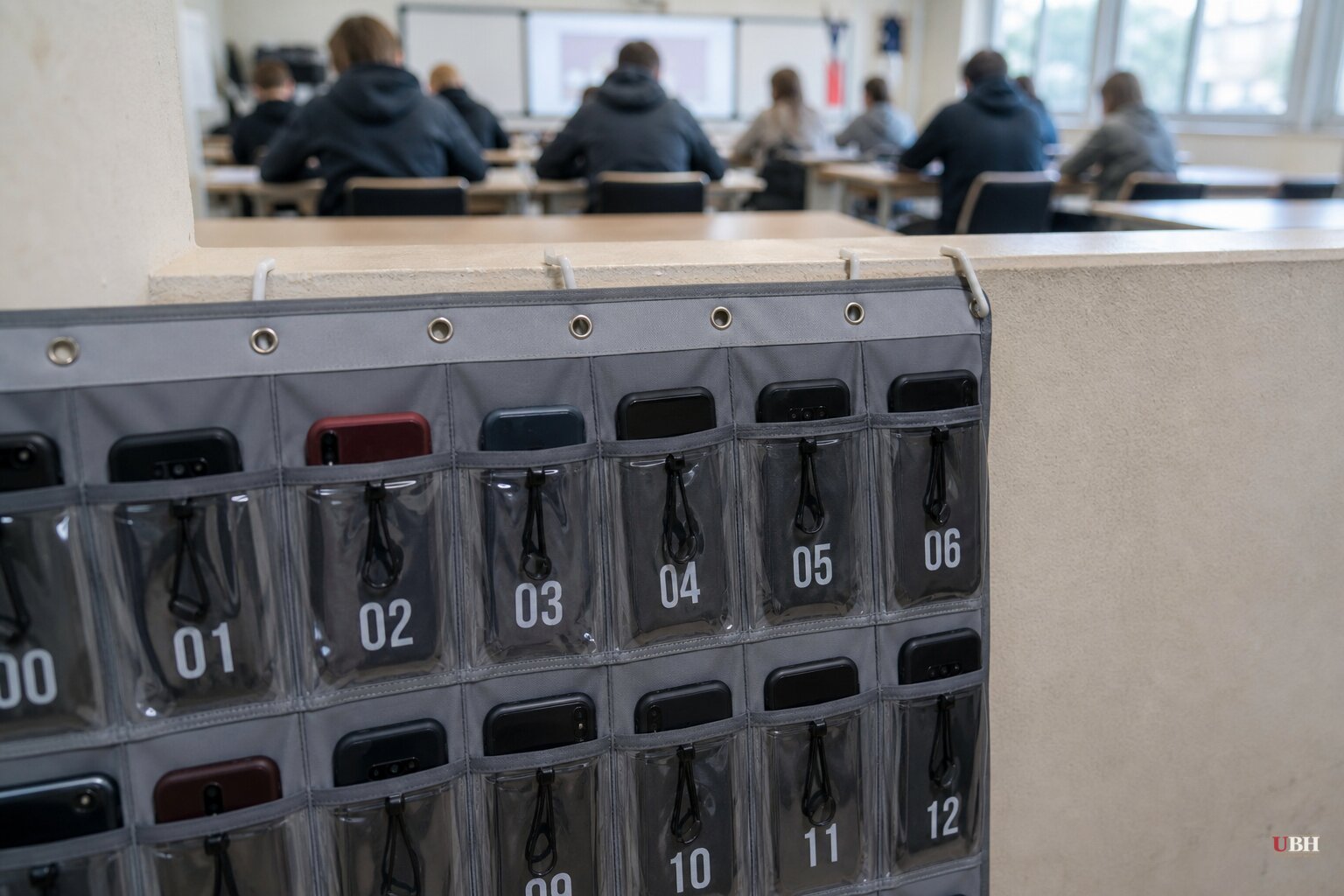
Starting Tuesday, September 1, new UK government guidance requires every school in England to have a policy blocking phone access during the school day, according to The Independent. Virginia's General Assembly tightened its own statewide bell-to-bell restriction this spring, building on an executive order former Governor Glenn Youngkin signed in 2024, per The Daily Signal. And in France, a ban that has covered middle and elementary schools since 2018 expanded to high schools this September, according to TF1 INFO.
How schools are actually doing it
The UK guidance doesn't dictate one method, and schools are split. Some use "no see no hear" rules that just tell kids to keep phones out of sight. Others bought magnetic-lock pouches from companies like Yondr, running roughly £20 to £25 per student, The Independent reported. Helen Newbery, deputy head at Manor High School in Leicestershire, told The Independent her school of nearly 1,000 students paid for pouches out of its own budget after years of running the honor-system version. She said the switch followed a full term of conversations with students so the rule "doesn't feel as if it is punitive."
Putney High School in London went further, banning smartphones outright for students up to Year 8, per The Independent.
Virginia is doing it county by county. In Henrico County, students can't touch a phone without teacher permission and can't wear smartwatches, though they're allowed to keep phones in their backpacks for emergencies, students told The Daily Signal. Goochland County Public Schools Superintendent Andrew Armstrong said his district has run a bell-to-bell, phone-free policy since the 2023-2024 school year, and called it "effective," specifically citing fewer distractions during class transitions and lunch. Chesterfield and Henrico also cut back how much time elementary students spend on district-issued laptops this year, according to The Daily Signal.
France's rollout has been rougher. TF1 INFO reported some high schools only learned the details of the new rule about a week before it took effect, and students are already talking about sneaking looks at phones on the sly. Under the policy, phones get switched to airplane mode and stored in a designated spot during the day. Angers-based psychologist Enora de Gouvello told TF1 INFO that when phones disappear, "the brain will turn to other activities" — framing the transition as an adjustment period rather than an instant fix. Notably, a separate French push to ban social media for kids under 15 has not been enacted, per TF1 INFO.
The part nobody wants to hear
A study from Stanford University's Institute for Economic Policy Research and the National Bureau of Economic Research, released earlier this year, found virtually no impact on test scores in schools that have enforced phone bans for three years, according to Fast Company. Jason Baron, the study's co-author and an assistant professor of economics at Duke University, told Fast Company the finding surprised his team. "Our first reaction was we might see a positive shift in test scores," he said, adding that on reflection it made sense: banning a phone doesn't guarantee attention, it just guarantees "they might doodle instead."
For skeptics who suspect these bans are more about optics than outcomes, that's a concrete data point. It's also fair to note the counterargument parents raised when phone bans first eased off after 2009: they wanted a way to reach their kids in an emergency, per Fast Company, which is why most current policies, including Henrico's, still let students keep a phone in a backpack rather than confiscate it entirely.
Newbery, for her part, isn't chasing test scores. She told The Independent she believes students are "already spending less time on their phones and focusing better in lessons" just a couple weeks into the year — a behavioral claim, not an academic one, and one the Stanford/NBER data doesn't contradict since it measured test scores, not focus or bullying rates.
A broader fight over what's wrong with schools
Some conservative commentators are folding the phone debate into a larger argument about declining rigor in public education. In an opinion piece for The Epoch Times, educator Christian Milord argued that phones and computer overuse are one of several factors, alongside dropped phonics instruction, DEI programming, and "restorative justice" discipline policies, that he believes have eroded academic standards over the past several years. That's Milord's own analysis and framing, not a finding from the phone-ban studies themselves, and the sources here don't establish a causal link between DEI programs or restorative justice and the test-score data on phone bans specifically.
Meanwhile schools are having the opposite argument about a different piece of technology. Chelsie Thielen, a Minnesota teacher and doctoral student writing for eSchool News, argued districts shouldn't ban AI tools the way they've banned phones, warning that blanket bans are "short-sighted" since students will enter a workforce where AI use is standard. She noted that in all but a handful of states, AI guidance for schools remains non-binding, unlike the now-mandatory phone rules in the UK, Virginia, and France.
The open question is whether phone bans start showing up in test scores after a longer runway, or whether Baron's team is right that removing the device just shifts the distraction somewhere else. Baron's study covered schools three years into their bans; whether year four or five looks different is something no one has measured yet.
Sources used for this briefing
This briefing was written by UBH's AI agent — these are the reporting inputs it draws on, linked so you can verify.


