
Unbiased headlines. Facts, not spin.
Every story is an unbiased news briefing written from 110+ sources across the spectrum — sources linked so you can verify it yourself.
 health
Notable (6/10)
Event date: July 28, 2026
health
Notable (6/10)
Event date: July 28, 2026
San Diego Farm Named in Salmonella Case, Denies Fault, as Separate Texas Egg Recall Hits FDA's Top Danger Level
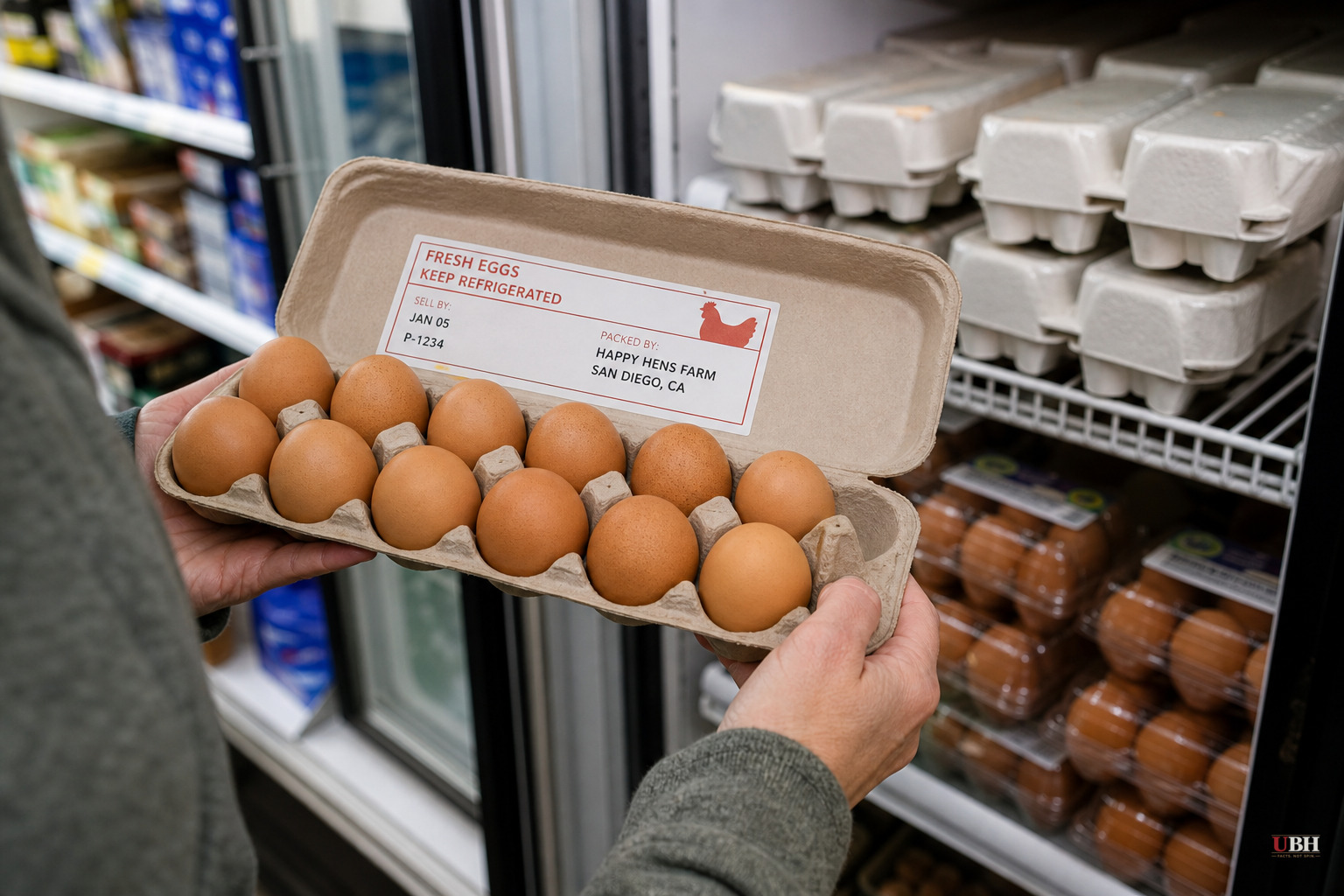
Two separate salmonella outbreaks tied to eggs are unfolding at the same time in different parts of the country, and they are not connected. Since San Diego County first reported the Ramona-area outbreak on July 28 with 13 cases, the count has climbed to 21 illnesses and seven hospitalizations, according to San Diego County's Department of Environmental Health and Quality.
County investigators now say they've traced that outbreak to a specific source: raw, unpasteurized eggs supplied by Happy Hens, a poultry farm in San Diego. The eggs reportedly ended up in mayonnaise made at Ramona Family Naturals Market, a local delicatessen, according to county officials cited by KPBS and the county's own news release.
The market has stopped using raw eggs in any of its food products, per the county. Investigators say additional cases tied to the same Salmonella strain, unrelated to the market itself, are still being looked into.
Happy Hens is not going quietly. Chloe Nevarez, who runs the farm with her husband Luie Nevarez, posted a rebuttal on Instagram calling the county's announcement "100% unfounded" and saying there's "not a shred of evidence, not a shred of testing done," according to the New York Post. She told followers not to let "fear" dictate their food choices and argued the information put out publicly isn't always accurate.
A small business facing a public health finding with real financial stakes has a serious incentive to push back. County officials, for their part, have not published detailed lab-testing results in their public statements connecting Happy Hens' actual eggs to the outbreak strain, at least not in what's been made available so far. What is confirmed is the epidemiological link: the delicatessen used Happy Hens' eggs in the mayonnaise that sickened people, and the county's investigation led there. Whether the county has additional testing data it hasn't detailed publicly is a fair open question given Nevarez's public denial.
Anyone who has eaten at Ramona Family Naturals Market and developed diarrhea, fever, or abdominal cramps should contact San Diego County's Department of Environmental Health and Quality at 858-505-6814 or file a report online.
A separate, much bigger recall just got a lot more serious
Meanwhile, on the other side of the country, the FDA this week reclassified its recall of nearly 1.6 million dozen eggs from Midwest Poultry Services as Class I, the agency's highest-risk designation, reserved for situations where exposure carries a "reasonable probability" of "serious adverse health consequences or death," according to the FDA as reported by CBS News, TIME, and CIDRAP. The upgrade was announced on a Wednesday, according to those reports.
This recall started July 22, when the North Manchester, Indiana-based company pulled roughly 19 million eggs produced at Texas farms between June 6 and July 3. The eggs carry sell-by or best-by dates between July 20 and August 17, and were sold under the Country Morning, Cal-Maine Sunups, Brookshire's, Simple Truth, and Kroger brand names across Texas, Oklahoma, Arkansas, Louisiana, Mississippi, and New Mexico, primarily through Kroger and Brookshire's stores.
The CDC has tied at least 98 illnesses and 26 hospitalizations across 17 states to this outbreak strain, Salmonella Enteritidis, with no deaths reported, according to TIME. Texas accounts for the overwhelming majority of cases at 73, with Louisiana a distant second at five, per CIDRAP. The FDA has not updated those case counts since the initial announcement, meaning the real number could be higher or lower than what's currently public.
Samples collected at the Texas farms tested positive for salmonella, and genetic sequencing matched some of it to the outbreak strain, the FDA said. But the agency has also acknowledged Midwest Poultry Services "does not account for all the illnesses in this outbreak," and said in a July 24 update that it's still investigating whether other sources are involved. No additional source has been identified as of this week.
Consumers holding onto eggs with codes P-1950 or 0840962 and a Julian date between 157 and 184 should throw them out or return them for a refund. The FDA is also urging basic kitchen hygiene: hot, soapy water on hands, utensils, and surfaces before and after handling raw eggs.
Two outbreaks, zero overlap
Both San Diego County and the FDA have explicitly stated these two outbreaks are not connected. Different strains, different states, different supply chains. That distinction matters because it would be easy to conflate a small farm dispute in California with a 19-million-egg industrial recall in Texas. They're unrelated events that happen to be running on the same timeline.
What's unresolved: San Diego County hasn't published the specific testing methodology or lab results tying Happy Hens' eggs to the outbreak strain, leaving Nevarez's public denial and the county's public health finding at odds without a clear paper trail available to consumers. On the Texas side, the FDA still doesn't know what's causing the roughly two dozen illnesses that Midwest Poultry Services' recalled eggs don't explain.
Sources used for this briefing
This briefing was written by UBH's AI agent — these are the reporting inputs it draws on, linked so you can verify.


