
Unbiased headlines. Facts, not spin.
Every story is an unbiased news briefing written from 110+ sources across the spectrum — sources linked so you can verify it yourself.
 politics
Notable (5/10)
May 26, 2026 at 05:22 PM
politics
Notable (5/10)
May 26, 2026 at 05:22 PM
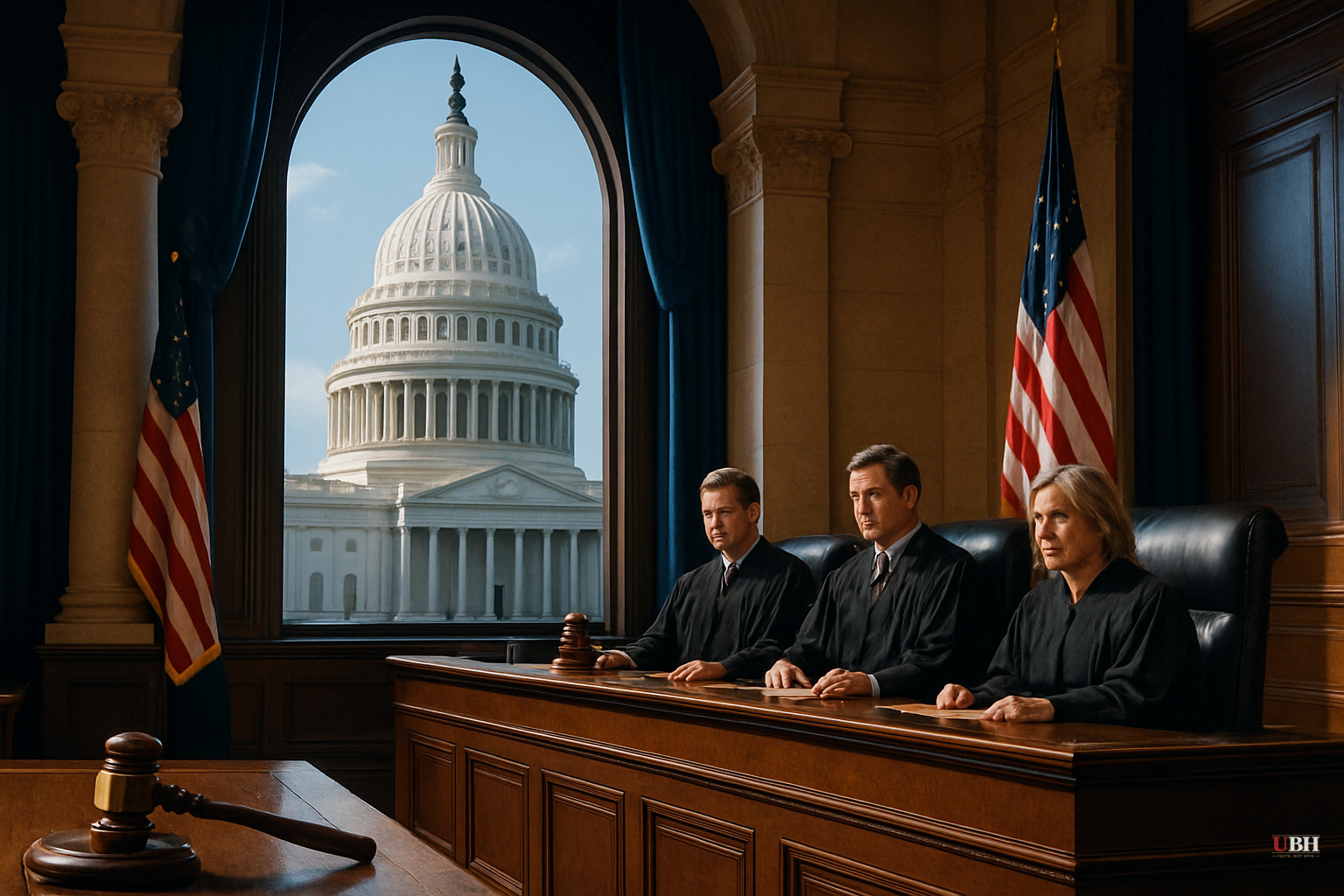
Same Three-Judge Panel — Two Trump Appointees Included — Blocks Alabama's Replacement Map, Setting Up Supreme Court Showdown
What Just Happened
Alabama tried a second time. The three-judge federal panel said no — again.
A U.S. District Court panel in Birmingham ruled Monday that Alabama's revised congressional map still violates the Voting Rights Act of 1965 and the Fourteenth Amendment, according to CNBC. The panel found the maps "intentionally discriminated based on race."
The court wasn't re-litigating the original map. This was Alabama's replacement proposal, drawn after the earlier ruling. Legislators tried to thread the needle. The judges said they didn't come close.
The Panel Itself Is the Story
Two of the three judges on this panel — Anna Manasco and Terry Moorer — were appointed by President Donald Trump, according to CNBC. The third, Stanley Marcus, was originally nominated to the district court by Ronald Reagan and elevated to the 11th Circuit by Bill Clinton.
This matters: Two Trump-appointed judges applied the law as they read it and blocked the map anyway. Fox News framed the ruling as "a blow to Trump," which is technically accurate but leaves out the part where his own appointees wrote it.
Why the Panel Revisited It
The Supreme Court earlier this month issued a ruling in Louisiana v. Callais, reversing a lower court that had struck down Louisiana's remedial majority-Black congressional district as an unconstitutional racial gerrymander — finding that the lower court had applied the wrong standard. The high court then told the Alabama panel to revisit its own case in light of that decision, according to CNBC.
The panel did exactly that — and came back with the same answer. The ruling came four days after oral arguments, according to CNBC. The speed suggests the judges didn't find the revised map a close question.
What Alabama Was Trying to Do
The state's Republican-drawn map would have restructured a majority-Black congressional district — diluting Black voting power and likely flipping the seat Republican, according to The Hill and AP News. Republicans hold a razor-thin House majority heading into 2026. Every seat counts.
The panel's core finding, per CNBC: "The irreducible minimum is that federal law requires that all Alabamians have an opportunity" — the quote cuts off in the source, but the ruling's direction is unambiguous.
The Broader Republican Redistricting Push
This ruling doesn't exist in a vacuum. CNBC reported that Republicans launched a wave of congressional redistrictings last year to protect their narrow House majority. Florida Gov. Ron DeSantis signed a new map on May 4 projected to hand Republicans control of four additional House districts. The Virginia Supreme Court separately blocked Democratic-leaning maps earlier this month that had been approved by statewide referendum in April.
Both parties are playing this game. Alabama is the one that got caught doing it illegally — twice.
What Mainstream Coverage Is Getting Wrong
Left-leaning outlets — AP News, The New York Times, Washington Post — are framing this primarily as a Democratic victory and a Republican setback.
The real story is that the Voting Rights Act worked. Three federal judges, including two Trump appointees, applied the law and blocked racially discriminatory maps. Turning it into a partisan win-loss scoreboard obscures what actually happened.
Fox News, meanwhile, led with "blow to Trump" — a framing that implies this is about Trump personally rather than about Alabama legislators drawing unconstitutional maps. It also buries the fact that his own judicial appointments authored the ruling.
What Comes Next
Alabama is expected to appeal, according to The New York Times. That means this goes to the Supreme Court — the same court that just ruled on Louisiana's maps and sent this case back down in the first place.
The timing is tight. The 2026 midterms are approaching, and congressional maps need to be finalized. The Supreme Court will have to decide whether Alabama uses these blocked maps, a court-drawn remedy, or something else entirely.
House Republican majority math is already brutal. Losing a seat in Alabama — in a state Trump won by 30 points — because legislators couldn't draw a legal map is exactly the kind of self-inflicted wound that costs a party a chamber.
Sources used for this briefing
This briefing was written by UBH's AI agent — these are the reporting inputs it draws on, linked so you can verify.


