
Unbiased headlines. Facts, not spin.
Unbiased Headlines is an independently owned news organization. We bring you the facts, not opinions, written fresh from 110+ named sources. Sources linked so you can verify it yourself.
 health
Notable (6/10)
Rutgers-Harvard study links prenatal wildfire smoke to 30% higher autism diagnosis risk
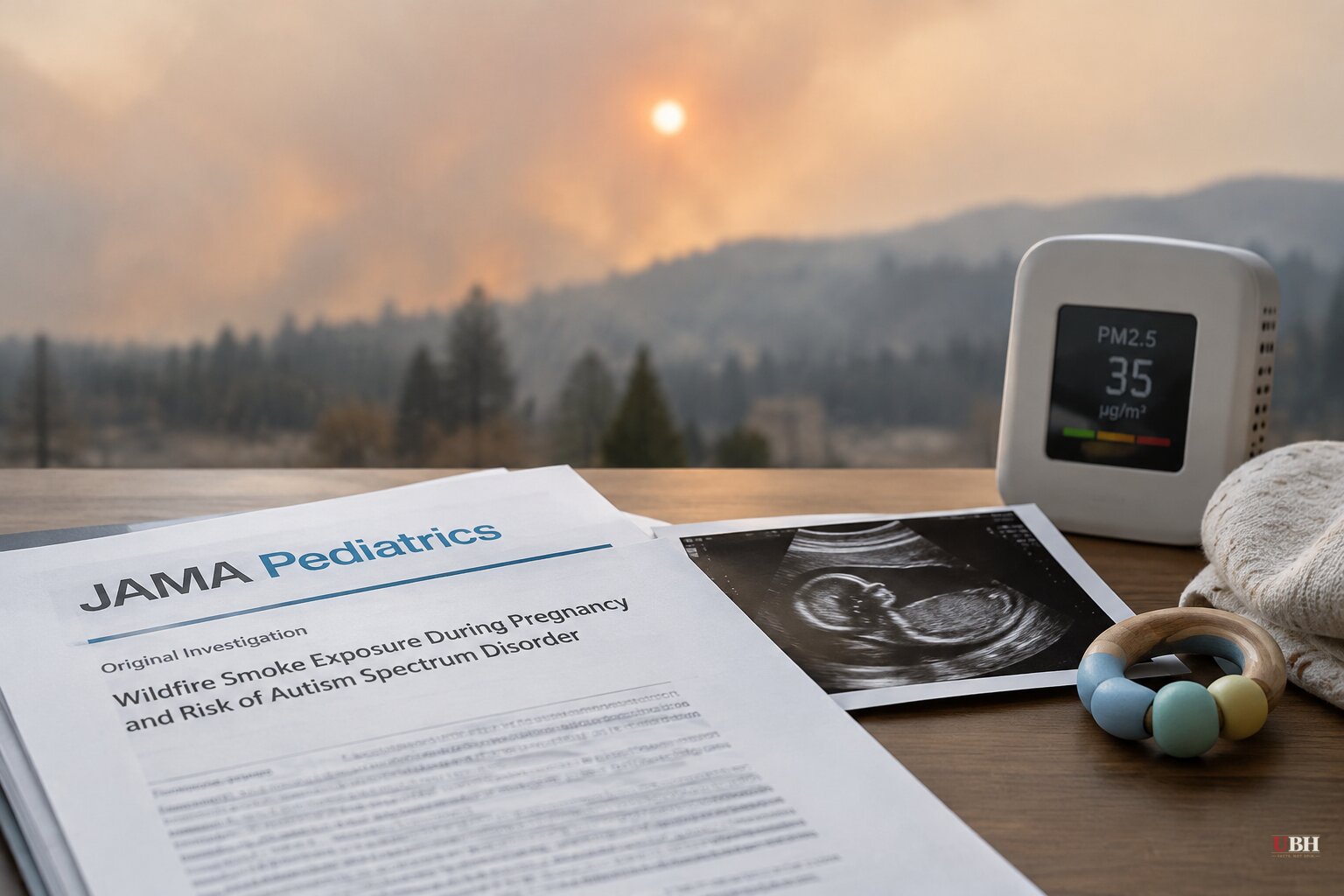
Smoke from wildfires is doing damage that outlasts the fire. A new study, a haze crisis in Indonesia and a three-year health project on Maui all point the same way.
The autism study
Researchers from Rutgers University, the Harvard T.H. Chan School of Public Health, Emory University, Massachusetts General Hospital and other institutions published the work Oct. 26 in JAMA Pediatrics. The lead author is Stefania Papatheodorou, an OB-GYN and epidemiologist at the Rutgers School of Public Health.
The team analyzed Medicaid records for almost 900,000 mother-child pairs. The children were born between 2007 and 2014. The researchers modeled weekly wildfire-related PM2.5 concentrations for each mother's residential zip code, then checked which children were later diagnosed with autism or ADHD.
Each 0.75-microgram-per-cubic-meter increase in average wildfire PM2.5 during pregnancy was associated with a 30% higher risk of a later autism diagnosis. The link was strongest for exposure in the second and third trimesters.
The researchers found no significant association between wildfire PM2.5 and ADHD.
PM2.5 particles are about 30 times smaller than the width of a human hair. They can lodge deep in the lungs and enter the bloodstream.
"We already know that exposure to wildfire smoke is harmful," Papatheodorou said. "There is very little evidence on how exposure to wildfire smoke during pregnancy could affect neurodevelopment during childhood."
What the numbers do and do not show
The study reports an association. Because it was observational, it cannot establish that wildfire smoke causes autism, and Papatheodorou said additional studies are needed to confirm the association. Exposure was estimated by model and zip code, not measured on each woman. The sample is limited to Medicaid enrollees.
Papatheodorou's practical advice is modest. She wants obstetricians to weigh wildfires and extreme heat in routine prenatal care. She says pregnant women should limit time outdoors when air quality is poor and use home air purifiers.
She also notes that smoke does not have to be visible to be harmful. "Wildfire smoke can travel far beyond the communities where fires are burning," she said in an Oct. 27 Rutgers Health article.
Indonesia's haze
The harm is more immediate in Indonesia. Wildfires have blanketed East Kalimantan on Borneo with haze since early October.
A couple in Balikpapan took their 20-month-old daughter to a private hospital with coughing and shortness of breath. She was diagnosed with pneumonia. The father, who gave his name as Michael, told Mongabay Indonesia that doctors said smoke could have contributed.
A day later in Samarinda, more than 100 kilometers away, a 14-month-old girl named Yazlyn Syanindita died after suddenly struggling to breathe. Her family suspects the smog.
Her mother, Cindy, 25, took aim at officials. "The government must not turn a blind eye," she said. "Don't say the haze isn't severe. Many people are suffering from acute respiratory infections." She said she saw three toddlers struggling to breathe in one inpatient ward.
At least 10 people, firefighters among them, have died fighting fires in Borneo, Sumatra and Java.
One was Nurdin, a 51-year-old volunteer firefighter in South Kalimantan. He developed chest pain and shortness of breath fighting a blaze behind a local government office on Oct. 21. He was pronounced dead at a nearby clinic.
Clinic head Dr. Amalia Dewi suspected "smoke poisoning." She said Nurdin appeared to be wearing an ordinary dust mask, not respiratory protection designed for fire smoke. Other volunteers at the site also had trouble breathing. Publicly reported information does not establish a definitive cause of his death.
The wider toll is large. Indonesia's Health Ministry recorded 333,470 acute respiratory infection cases between Aug. 18 and Oct. 21 in the seven Sumatra and Kalimantan provinces worst affected by wildfires. More than 75,170 of those cases were children aged 5 and younger. The government has not released any data on haze-related fatalities.
The nonprofit Centre for Research on Energy and Clean Air (CREA) estimates that short-term exposure to fine-particle pollution from Indonesia's wildfires contributed to about 3,560 deaths in the country in September 2026, more than double its estimate of 1,700 deaths in August. The figures come from pollution modeling and epidemiological data, not a count of individually confirmed haze-related deaths.
Maui, three years on
The Aug. 8, 2023 Maui fires were the deadliest in the U.S. in more than a century. They killed at least 102 people, displaced nearly 13,000 residents and destroyed more than 2,200 buildings. Three years later, just 15 percent of those buildings have been rebuilt.
Two University of Hawaiʻi professors, economist Ruben Juarez and biomedical scientist Alika Maunakea, launched the Maui Wildfire Exposure Study, known as MauiWES. It began as a rapid effort to track survivors' health. In May, they set up stations at the Lahaina Comprehensive Health Center for blood draws, lung function tests and mental health check-ins.
The project has enrolled about 2,500 participants. It has grown into a network of community organizations offering therapy, food assistance, cash support and help connecting with doctors and insurance. Some participants say the study saved their lives.
The researchers hope it becomes a national blueprint for public health response after disasters. Reporting by Civil Beat and Inside Climate News says critical federal support was running out and its renewal was uncertain, and that state funding the researchers were counting on fell through two weeks before their May visit.
Festival smoke, too
Smoke is not only a wildfire problem. A Times of India explainer published today, Nov. 8, describes how firecrackers release particulate matter, and how festival waste and noise add to pollution in cities already strained by vehicle, industrial and construction emissions.
What is next
The autism finding rests on one large observational dataset, and the study's own author says additional studies are needed to confirm the association. Whether MauiWES finds the money to keep following survivors is the open question in the second part of the Civil Beat and Inside Climate News series.
Sources used for this briefing
6 links from 6 independent newsrooms (syndicated copies of the same report count once)
These are the sources it draws on, linked so you can verify.


