
Unbiased headlines. Facts, not spin.
Unbiased Headlines is an independently owned news organization. We bring you the facts, not opinions, written fresh from 110+ named sources. Sources linked so you can verify it yourself.
 health
Major Story (7/10)
Definium Says Single-Dose LSD Tablet Beat Placebo in Late-Stage Anxiety and Depression Trials
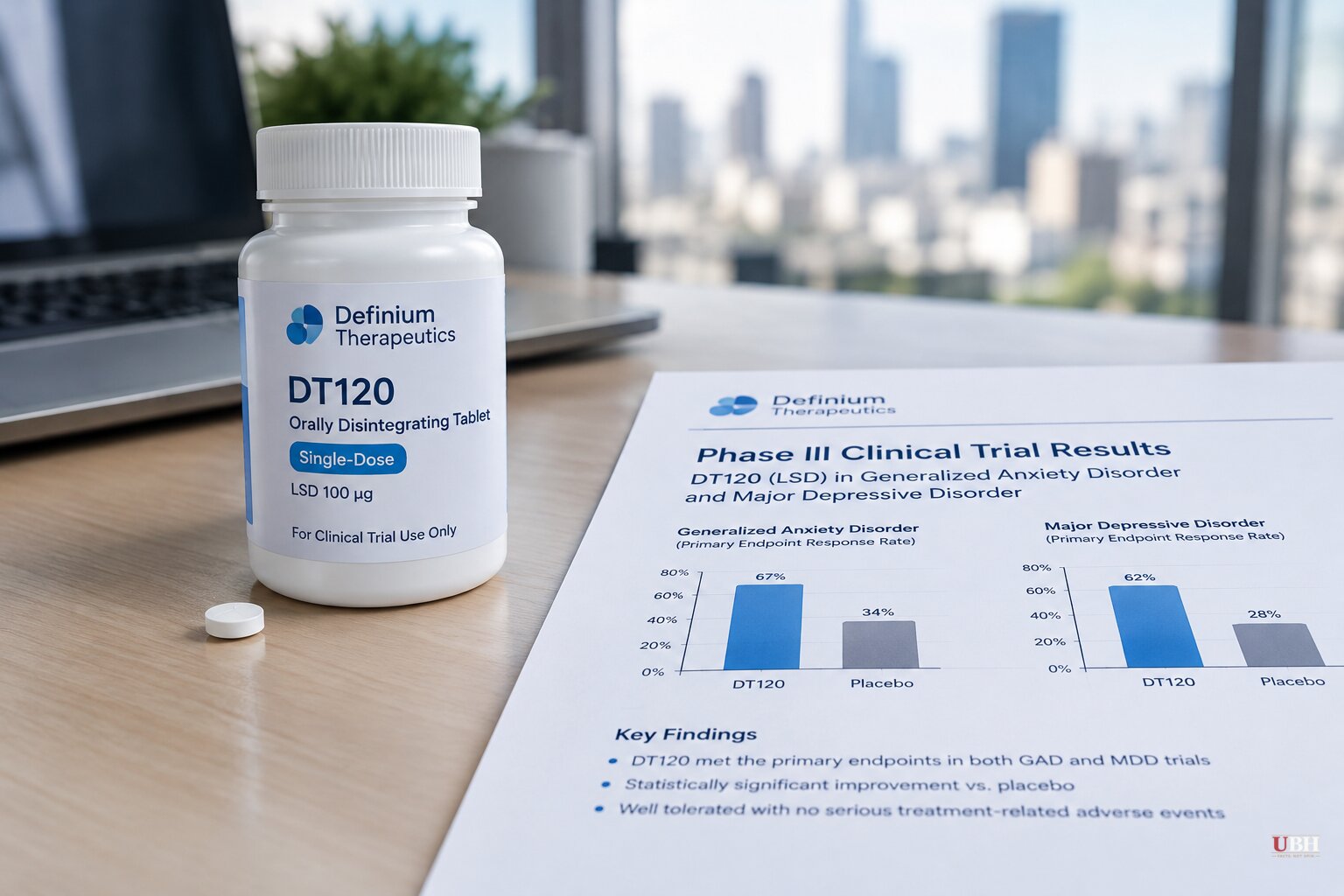
A single dose of an LSD tablet beat placebo in late-stage trials for anxiety and depression, according to results from Definium Therapeutics. The drug, DT120, is an investigational orally disintegrating tablet formulation of lysergide.
Two of the trials were presented at the Neuroscience Education Institute (NEI) Fall Congress in Colorado Springs, Colorado. A third, for anxiety, was also reported this week.
The anxiety trials
The Voyage study enrolled 214 patients with generalized anxiety disorder (GAD). Participants got one 100 µg dose of DT120. At week 12, their Hamilton Anxiety Rating Scale (HAM-A) scores had improved by 11.6 points from baseline (P<0.0001), according to Dan Karlin, MD, Definium's chief medical officer, and colleagues.
Against placebo, the advantage was 5.4 points at week 12 (P<0.0001). The gap showed up early. At week 1, patients on DT120 were 11.9 points better than their own baseline and 7.7 points better than placebo.
Baseline HAM-A averaged 27.9, with an entry threshold of 20 or higher. Average age was 42 and 64% of participants were female. About 21% had used a psychedelic before, and 9% had taken LSD. More than a third (36%) had already tried two or more medications for GAD.
Definium has also reported results from a third pivotal trial, Panorama, which enrolled 245 adults at about 32 sites. On the 100 µg dose, HAM-A fell 9.8 points at week 12 versus 4.7 for placebo, a 5.1-point difference. Definium reported a clinical response (at least a 50% drop in anxiety scores) in 32% of the DT120 group versus 14% on placebo. Remission came in at 15% versus 4%.
Panorama also included an active control: 52 patients received a lower 50 µg dose. The design addresses a known problem in psychedelic research. Patients and raters can often tell who got the real drug, which is called functional unblinding. The FDA has addressed the issue in its development guidance for psychedelic compounds.
The depression trial
The Emerge study enrolled 149 patients with major depressive disorder (MDD). DT120 produced an 8.1-point placebo-adjusted improvement on the Montgomery-Åsberg Depression Rating Scale (MADRS) at week 6 (P<0.0001). A 7.3-point placebo-adjusted benefit held at week 12 (P<0.0001).
What the treatment day looks like
In Voyage, DT120 was given in one supervised session. Average time to discharge clearance on the End-of-Session Checklist was 6.4 hours, and 90% of patients were cleared by hour 8.
The drug was generally well tolerated. The trial reported no serious adverse events and no suicidality signals.
Karlin framed the trial as a different model of care. "This represents a different treatment paradigm, not only in its potential therapeutic benefit but also in the patient experience: a dedicated treatment day, supported by appropriately trained clinical personnel, rather than the ongoing commitment of daily medication or recurring maintenance treatments," he said.
He also pointed at the status quo. "Too many patients face a treatment journey that involves daily medication, managing side effects, waiting weeks to determine whether a treatment is working, and ongoing adjustments to sustain benefits. Innovation in mental healthcare has simply not kept pace with the need," Karlin said.
What the numbers do and do not show
The effects are real in the trial data, and they are consistent. The placebo-adjusted HAM-A gap was 5.4 points in Voyage and 5.1 in Panorama. Those are results from two separate GAD studies, and the company itself has the most to gain from them.
The figures that need the most scrutiny are the ones that depend on blinding. A drug with obvious psychoactive effects makes expectation hard to separate from pharmacology. The 50 µg arm in Panorama was built to test that, and the reported dose response is the company's answer. How regulators weigh it has not been stated.
The data also stop at 12 weeks. A one-day treatment is only an advantage over daily pills if the benefit holds. The sources give no figures on durability beyond the double-blind period.
Definium has not announced a filing date with the FDA, a price, or how many supervised-session sites would be needed to deliver the drug at scale. Those answers decide whether a roughly eight-hour clinic day, with trained staff, can be offered widely or only in a few places.
Sources used for this briefing
2 links from 2 independent newsrooms (syndicated copies of the same report count once)
These are the sources it draws on, linked so you can verify.


